

Hexarelin: A Comprehensive Guide to Uses, Research, Dosing, Forms, and Potential Benefits
Hexarelin is a synthetic peptide best known for its ability to stimulate the release of growth hormone, or GH, through the ghrelin/growth hormone secretagogue receptor pathway.
It belongs to a class of compounds called growth hormone secretagogues, or GHSs. These compounds do not supply growth hormone directly. Instead, they stimulate the body’s own pituitary gland to release more GH.
Hexarelin attracted attention because it is a potent GH-releasing peptide and has been studied not only for endocrine effects, but also for possible actions involving the heart, metabolism, bone, and tissue protection.
At the same time, Hexarelin is often discussed in bodybuilding and anti-aging communities in ways that go far beyond the actual evidence.
There is published human research showing that Hexarelin can increase growth hormone secretion. However, there is much less evidence demonstrating that it reliably produces clinically meaningful:
muscle growth
fat loss
better athletic performance
improved recovery
or anti-aging effects.
Hexarelin is also not FDA-approved for any medical indication, and there is no FDA-approved human dosing regimen.
What Is Hexarelin?
Hexarelin is a synthetic hexapeptide, meaning it contains six amino-acid residues.
Its sequence is commonly represented as:
His-D-2-methyl-Trp-Ala-Trp-D-Phe-Lys-NH2
It was developed as a potent synthetic analogue of earlier growth hormone-releasing peptides.
Hexarelin belongs to the same broad pharmacologic family as compounds such as:
GHRP-2
GHRP-6
and ipamorelin.
All of these compounds stimulate the growth hormone secretagogue receptor, also called GHSR-1a.
That is the same receptor activated by the naturally occurring hormone ghrelin.
What Is Ghrelin?
Ghrelin is a hormone produced primarily in the stomach.
It is best known for increasing hunger, but it also has an important role in stimulating growth hormone secretion.
Ghrelin binds to GHSR-1a receptors in the hypothalamus and pituitary.
When these receptors are activated, growth hormone release increases.
This is one reason growth hormone secretagogues can produce GH pulses without directly administering recombinant growth hormone.
Hexarelin mimics this part of ghrelin signaling.
However, unlike ghrelin itself, Hexarelin was specifically designed to be a strong GH-releasing compound.
How Does Hexarelin Work?
Hexarelin primarily acts as an agonist at the GHSR-1a receptor.
Activation of this receptor triggers intracellular signaling that ultimately promotes growth hormone release from pituitary somatotroph cells.
The pathway can be simplified as:
Hexarelin → GHSR-1a receptor → Pituitary stimulation → Growth hormone release
Growth hormone then circulates through the body and can stimulate production of insulin-like growth factor 1, or IGF-1, especially in the liver.
IGF-1 mediates many of the downstream effects associated with GH.
These include effects on:
- Protein metabolism
- Bone
- Connective tissue
- Fat metabolism
- Cellular growth
- Muscle maintenance
- Glucose metabolism
Hexarelin Versus GHRH Peptides
Hexarelin should not be confused with peptides such as CJC-1295 or sermorelin.
Those compounds act through the GHRH receptor.
Hexarelin acts through the ghrelin receptor.
These are two different pathways.
Because both pathways can promote GH release, researchers have sometimes studied combinations of GHRH analogues and growth hormone secretagogues.
In physiology, stimulation of both systems can produce a larger GH response than either alone.
This is why Hexarelin has occasionally been discussed in combination with peptides such as CJC-1295.
However, that does not mean such combinations have established clinical dosing or safety.
How Strongly Does Hexarelin Increase Growth Hormone?
One of the better-established effects of Hexarelin is its ability to produce a substantial GH response.
Human endocrine research from the 1990s demonstrated that Hexarelin could significantly stimulate growth hormone secretion.
Studies in healthy adults, older adults, and children with certain forms of growth hormone deficiency found that the peptide could produce measurable increases in circulating GH.
This endocrine effect is considerably better established than claims involving muscle growth or fat loss.
In other words:
Hexarelin clearly affects growth hormone physiology.
What is much less certain is whether that hormonal effect translates into useful long-term clinical outcomes.
Hexarelin and IGF-1
Because growth hormone stimulates hepatic IGF-1 production, repeated GH stimulation could potentially affect IGF-1 levels.
IGF-1 plays a major role in:
protein synthesis
bone metabolism
cell growth
and tissue repair.
However, higher IGF-1 is not automatically better.
Excessive chronic GH/IGF-1 signaling can produce unwanted effects involving:
glucose metabolism
fluid retention
cardiovascular stress
and potentially other growth-related pathways.
For that reason, long-term stimulation of the GH-IGF-1 axis requires careful study.
What Do People Use Hexarelin For?
Outside formal clinical research, Hexarelin is most commonly discussed for:
Growth Hormone Stimulation
This is the most evidence-based reason researchers study it.
Hexarelin is a potent GH secretagogue.
Muscle and Body Composition
Because growth hormone and IGF-1 influence protein metabolism, Hexarelin is frequently discussed in connection with:
muscle preservation
lean body mass
body recomposition
and exercise recovery.
However, there is no strong clinical evidence showing that Hexarelin produces major muscle growth in healthy adults.
Fat Metabolism
Growth hormone can stimulate lipolysis, meaning the mobilization of stored fat.
For this reason, Hexarelin is sometimes marketed as a fat-loss peptide.
That claim is much weaker than the evidence showing GH release.
A compound can increase GH without necessarily producing large or sustained reductions in body fat.
Recovery
Because GH participates in tissue repair and protein metabolism, Hexarelin is sometimes discussed for:
training recovery
connective-tissue support
and general recovery.
Again, these outcomes have not been validated through large human trials.
Healthy Aging
Because growth hormone secretion declines with age, some people discuss Hexarelin in anti-aging contexts.
Common claims include:
better energy
improved sleep
muscle maintenance
reduced fat
and improved vitality.
These claims should be treated cautiously.
There is no evidence that Hexarelin extends human lifespan or reverses aging.
Hexarelin and the Heart
One of the more interesting areas of Hexarelin research involves the cardiovascular system.
Animal and laboratory studies have suggested that Hexarelin may have cardioprotective effects that are not entirely explained by growth hormone release.
Researchers have investigated possible effects involving:
cardiac function
ischemia-reperfusion injury
left ventricular performance
and cardiac fibrosis.
Some studies suggest that GHSR-related signaling may influence the heart directly.
This has raised the possibility that Hexarelin has actions beyond the pituitary.
However, these findings are largely preclinical.
There is no FDA-approved cardiovascular indication for Hexarelin.
Hexarelin and Bone
Growth hormone and IGF-1 are both involved in bone metabolism.
This has led to research interest in Hexarelin for:
bone turnover
osteoblast activity
and bone density.
Animal studies have suggested that growth hormone secretagogues may influence bone biology.
However, Hexarelin has not been established as a treatment for osteoporosis or fracture healing.
Hexarelin and Appetite
Because Hexarelin acts on the ghrelin receptor, appetite is an important question.
Ghrelin is well known for increasing hunger.
Older growth hormone-releasing peptides such as GHRP-6 are often associated with pronounced increases in appetite.
Hexarelin can interact with similar signaling pathways, although appetite effects may vary depending on dose and individual response.
It is generally considered less strongly appetite-stimulating than GHRP-6, but more research is needed to characterize this properly.
Hexarelin and Cortisol
One important difference among GH secretagogues is how selectively they affect growth hormone.
Hexarelin is considered less selective than ipamorelin.
Human studies have shown that Hexarelin can sometimes increase not only growth hormone but also:
ACTH
and cortisol.
This matters because chronic elevation of cortisol could counteract some of the effects people seek from GH stimulation.
Excessive cortisol can contribute to:
sleep disturbance
insulin resistance
muscle breakdown
increased appetite
and fat accumulation.
This is one reason ipamorelin is often described as a more selective GH secretagogue.
Hexarelin and Prolactin
Hexarelin may also increase prolactin in some circumstances.
Prolactin is a pituitary hormone involved in reproduction and lactation.
In men, excessive prolactin can contribute to:
reduced libido
sexual dysfunction
and other endocrine symptoms.
This does not mean every exposure to Hexarelin causes clinically significant hyperprolactinemia.
It does mean that the peptide is not completely selective for GH release.
Desensitization and Tolerance
One of the most important issues with Hexarelin is receptor desensitization.
Research suggests that repeated exposure can produce a reduced growth hormone response over time.
This is often described as tachyphylaxis or desensitization.
In simple terms:
the more frequently the receptor is stimulated, the less strongly it may respond.
This is one of the reasons Hexarelin is sometimes considered less attractive for prolonged continuous use than some other GH secretagogues.
Importantly, this is not just an internet theory.
Endocrine studies have demonstrated reduced GH responsiveness after repeated administration.
Recovery of responsiveness may occur after treatment is stopped.
Human Research
Hexarelin has considerably more human endocrine research than many research peptides.
Studies have examined its effects in:
healthy adults
older adults
children
and people with growth hormone deficiency.
These studies generally focused on short-term hormonal responses.
They established that Hexarelin can:
increase GH secretion
and, under some conditions, alter other pituitary hormones.
What they did not establish is that long-term use produces major improvements in:
body composition
strength
athletic performance
injury recovery
or longevity.
This distinction is essential.
Hexarelin Dosing in Research
There is no FDA-approved human dosage for Hexarelin.
Published doses therefore represent clinical research protocols rather than instructions for personal use.
Older human studies commonly used doses expressed in:
micrograms per kilogram of body weight.
Protocols varied depending on whether the peptide was administered:
intravenously
subcutaneously
or through other experimental routes.
Many endocrine studies used single doses designed to measure the short-term GH response rather than long-term treatment.
Because Hexarelin can desensitize receptors, dose frequency becomes especially important.
There is no established clinical protocol that defines:
optimal starting dose
maintenance dose
cycle duration
or maximum safe exposure.
Online protocols therefore should not be confused with validated medical dosing.
How Is Hexarelin Administered?
Clinical research has primarily used parenteral routes.
These have included:
Intravenous Administration
Many early endocrine studies used intravenous dosing because it allowed researchers to measure the GH response precisely.
Subcutaneous Administration
Subcutaneous administration has also been investigated.
This route is commonly discussed in research-market settings.
Lyophilized Research Material
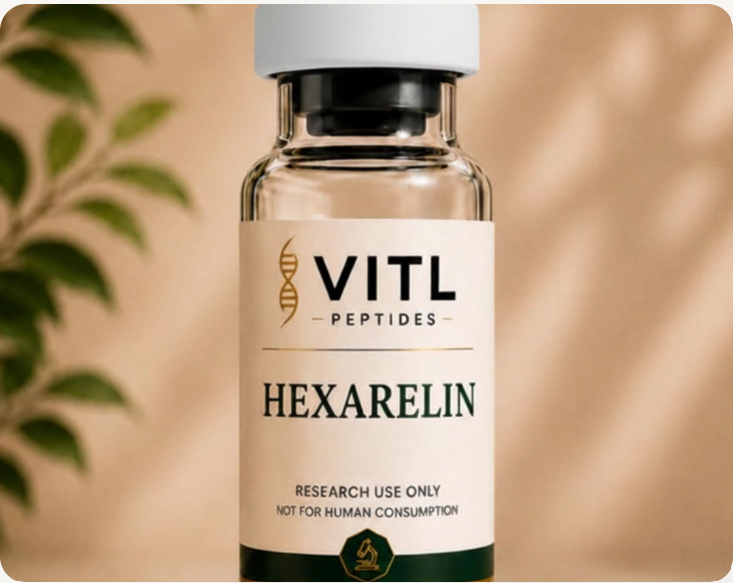
Modern Hexarelin is most commonly encountered as a freeze-dried research peptide intended for laboratory investigation.
There is no FDA-approved commercial Hexarelin pen, vial, or injection product.
What Forms Is Hexarelin Offered In?
Hexarelin is generally encountered as:
Lyophilized Powder
Freeze-dried peptide is the most common research form.
Lyophilization improves stability during storage and shipping.
Research Vials
The peptide is commonly packaged in small vials containing specified milligram quantities.
Reconstituted Research Solutions
Laboratories may reconstitute Hexarelin for specific experimental procedures.
A research vial should not automatically be assumed to be:
sterile
pharmaceutical grade
accurately dosed
or appropriate for human administration.
Hexarelin Versus Ipamorelin
These two compounds are often compared.
Both stimulate GHSR-1a.
However:
Hexarelin is generally considered more potent for GH release.
Ipamorelin is generally considered more selective.
Hexarelin is more likely to affect:
cortisol
and potentially prolactin.
Ipamorelin tends to produce a cleaner GH response in available studies.
Hexarelin also appears to produce more pronounced desensitization with repeated use.
This is one reason ipamorelin became more popular in modern peptide clinics despite Hexarelin’s strong GH-releasing effect.
Hexarelin Versus GHRP-6
GHRP-6 is another older growth hormone-releasing peptide.
Both act through the ghrelin receptor.
GHRP-6 is well known for producing a strong increase in appetite.
Hexarelin is generally considered:
more potent for GH release
and often less appetite-stimulating than GHRP-6.
However, both can influence additional pituitary hormones.
Neither is FDA-approved for bodybuilding or anti-aging.
Hexarelin Versus CJC-1295
The mechanisms are different.
Hexarelin: GHSR-1a agonist.
CJC-1295: GHRH receptor agonist.
Because the two pathways can complement one another, combining them may theoretically amplify GH release.
However, there is no FDA-approved Hexarelin/CJC-1295 protocol, and large clinical trials have not established the safety or clinical benefit of such combinations.
Potential Side Effects
Because Hexarelin affects multiple endocrine pathways, possible side effects may include:
- Headache
- Flushing
- Dizziness
- Increased appetite
- Water retention
- Tingling or numbness
- Joint discomfort
- Changes in blood glucose
- Injection-site reactions
- Fatigue
- Changes in cortisol
- Changes in prolactin
Long-term risks remain poorly characterized.
The fact that Hexarelin has been studied in humans does not mean long-term nonmedical use has been established as safe.
Blood Sugar and Insulin Sensitivity
Growth hormone can decrease insulin sensitivity.
Therefore, prolonged GH stimulation may affect:
fasting glucose
insulin
and overall glucose tolerance.
People with metabolic disease would be especially important to monitor in formal clinical research.
Long-term controlled studies of Hexarelin’s effect on diabetes risk are lacking.
Growth Signaling and Cancer
Growth hormone and IGF-1 participate in cell growth and survival signaling.
This does not mean Hexarelin causes cancer.
However, chronic stimulation of the GH/IGF-1 axis raises legitimate questions regarding people with:
active cancer
previous malignancy
or elevated cancer risk.
Large long-term safety studies would be required to define this risk.
Such studies do not currently exist.
Is Hexarelin FDA Approved?
No.
Hexarelin is not FDA-approved for any medical condition.
There is no approved indication for:
growth hormone deficiency
muscle gain
fat loss
anti-aging
athletic recovery
osteoporosis
or cardiovascular treatment.
There is also no FDA-approved commercial Hexarelin formulation or official human dosage.
Competitive Sports
Hexarelin is especially important for competitive athletes to recognize.
Growth hormone secretagogues are prohibited under World Anti-Doping Agency rules.
Hexarelin falls within this category because it stimulates endogenous GH release.
Athletes can therefore face anti-doping consequences even if the compound is being used for recovery rather than explicitly for performance enhancement.
Current Research
Modern interest in Hexarelin has shifted somewhat away from bodybuilding-oriented claims and toward understanding the broader biology of ghrelin receptor signaling.
Researchers continue to investigate:
cardiac protection
mitochondrial effects
bone biology
metabolism
growth hormone signaling
and GHSR pharmacology.
These areas may eventually prove more scientifically important than the peptide’s reputation as a performance compound.
The cardiovascular research is particularly interesting because some effects appear to occur independently of growth hormone.
This suggests that Hexarelin and related compounds may influence peripheral tissues directly.
What Research Is Still Needed?
Several important questions remain unresolved.
Researchers need better information regarding:
long-term human pharmacokinetics
receptor desensitization
optimal exposure
cortisol and prolactin effects
glucose metabolism
cardiovascular outcomes
body composition
and long-term safety.
Randomized controlled trials would be necessary to establish whether Hexarelin produces any meaningful benefit for:
muscle mass
fat loss
exercise recovery
cardiac disease
or bone health.
The Bottom Line
Hexarelin is a potent synthetic growth hormone secretagogue that activates the ghrelin/GHSR-1a receptor.
Its strongest established effect is stimulation of endogenous growth hormone release.
Human endocrine studies clearly demonstrate that Hexarelin can produce significant GH responses.
That gives the compound a stronger physiological evidence base than many experimental peptides.
However, the leap from:
“Hexarelin increases growth hormone”
to
“Hexarelin builds muscle, burns fat, accelerates recovery, or reverses aging”
is not supported by equally strong clinical evidence.
Hexarelin also has several characteristics that distinguish it from newer GH secretagogues.
It is:
potent
but relatively less selective,
can influence cortisol and prolactin,
and may show receptor desensitization with repeated exposure.
Those features help explain why compounds such as ipamorelin have sometimes become more popular despite Hexarelin’s strong GH-releasing effects.
Hexarelin has also produced interesting experimental findings involving:
cardiac protection
bone metabolism
tissue biology
and broader ghrelin-receptor signaling.
These may ultimately prove to be more important areas of research.
However, there is currently:
no FDA-approved Hexarelin medication,
no established human dosing regimen,
no approved indication,
and no large clinical evidence base establishing long-term safety or body-composition benefits.
Perhaps the most accurate way to describe Hexarelin in 2026 is as a powerful experimental growth hormone secretagogue with well-documented short-term endocrine activity, intriguing cardiovascular and metabolic research, but insufficient evidence to support the broad muscle-building, fat-loss, recovery, and anti-aging claims commonly associated with it.
For researchers studying the GH-IGF-1 axis and ghrelin-receptor biology, Hexarelin remains a valuable experimental compound.
For consumers, the important distinction is between demonstrating a hormone response and demonstrating a meaningful health or performance benefit.
Those are not the same thing.
Educational and research notice: This article is intended for general scientific and educational information. It is not medical advice or a recommendation for human use of Hexarelin. Doses discussed in scientific literature are experimental research protocols and should not be interpreted as personal dosing instructions. Hexarelin is not FDA-approved for growth hormone deficiency, muscle gain, fat loss, recovery, anti-aging, or any other medical condition.