
IGF-1 LR3: A Comprehensive Guide to Uses, Research, Dosing, Forms, and Potential Benefits
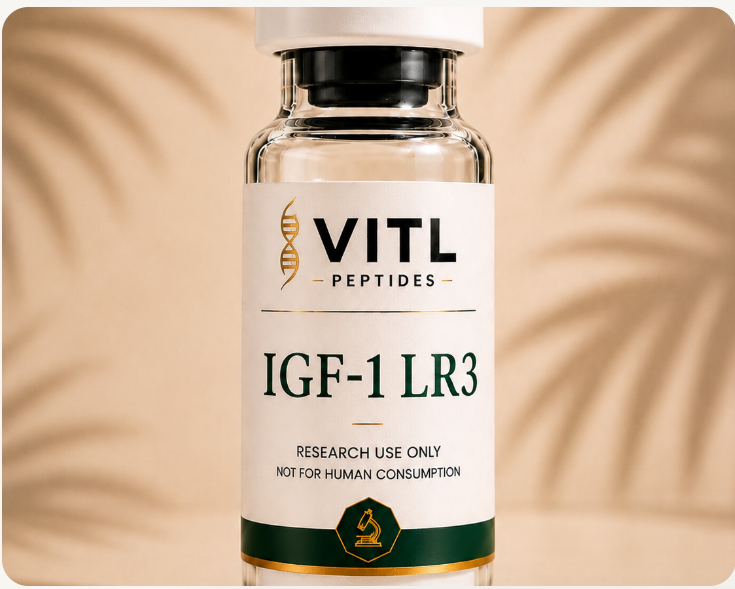
IGF-1 LR3, also known as Long R3 IGF-I or Long [Arg3] IGF-I, is a laboratory-engineered analogue of insulin-like growth factor 1, or IGF-1.
It is commonly discussed in research involving:
cell growth
protein synthesis
muscle biology
tissue growth
metabolic signaling
recovery
and the broader growth hormone–IGF-1 axis.
IGF-1 LR3 is fundamentally different from peptides such as CJC-1295, ipamorelin, and Hexarelin.
Those compounds attempt to stimulate the pituitary gland to release more growth hormone.
IGF-1 LR3 acts much farther downstream.
Instead of increasing the signal that causes growth hormone release, IGF-1 LR3 is designed to directly mimic and enhance the biological activity of IGF-1 itself.
That distinction is important because IGF-1 is a powerful growth and metabolic signaling molecule.
IGF-1 LR3 was engineered specifically to interact much less strongly with the body’s natural IGF-binding proteins, potentially leaving a greater proportion of the molecule available to interact with IGF-1 receptors. Laboratory studies have demonstrated that this can make Long R3 IGF-I considerably more potent than native IGF-1 in certain cell systems. (pubmed.ncbi.nlm.nih.gov)
However, the evidence surrounding IGF-1 LR3 requires a major qualification:
IGF-1 LR3 is primarily a laboratory research reagent. There is no FDA-approved IGF-1 LR3 medication, no established human therapeutic dose, and very little controlled clinical research involving administration of LR3 itself to humans.
This is very different from mecasermin, a recombinant form of native human IGF-1 that is FDA-approved under the brand name Increlex for certain children with severe primary IGF-1 deficiency. (accessdata.fda.gov)
What Is IGF-1?
To understand IGF-1 LR3, it helps to first understand ordinary IGF-1.
Insulin-like growth factor 1 is a naturally occurring protein hormone consisting of 70 amino acids.
It is produced in many tissues, but circulating IGF-1 is produced largely by the liver in response to growth hormone, or GH.
The basic endocrine pathway can be simplified as:
Hypothalamus → Pituitary → Growth Hormone → Liver and Other Tissues → IGF-1
Growth hormone produces some effects directly, but many of its growth-promoting effects are mediated through IGF-1.
IGF-1 plays important roles in:
- Childhood growth
- Bone development
- Muscle biology
- Protein synthesis
- Cell survival
- Tissue repair
- Glucose metabolism
- Organ development
The FDA-approved recombinant IGF-1 medication mecasermin is structurally identical in amino-acid sequence to endogenous human IGF-1. (accessdata.fda.gov)
IGF-1 LR3 is different.
What Does “LR3” Mean?
The name tells researchers exactly how the molecule was modified.
Native human IGF-1 contains 70 amino acids.
IGF-1 LR3 contains 83 amino acids.
Two major modifications were made.
First, the glutamic acid normally present at position 3 of IGF-1 was replaced with arginine.
That explains the R3, or Arg3, portion of the name.
Second, researchers added a 13-amino-acid extension to the N-terminal end of the protein.
That explains the word Long.
The modifications dramatically reduce the analogue’s affinity for several IGF-binding proteins while preserving its ability to activate the IGF-1 receptor. (cellsciences.com)
The result is an engineered growth factor specifically designed to produce greater biological activity in laboratory cell-culture systems.
Why Do IGF-Binding Proteins Matter?
IGF-1 does not normally circulate freely through the bloodstream.
Most circulating IGF-1 is attached to proteins called IGF-binding proteins, or IGFBPs.
There are several major IGF-binding proteins, including IGFBP-1 through IGFBP-6.
IGFBP-3 is particularly important in the bloodstream.
These proteins perform several functions.
They:
transport IGF-1
protect it from rapid degradation
regulate where it can travel
and importantly
limit how much IGF-1 is immediately available to activate IGF-1 receptors.
This creates a sophisticated buffering system.
The body does not simply allow all circulating IGF-1 to continuously stimulate growth receptors.
IGF-1 LR3 was deliberately designed to partially bypass that regulatory mechanism.
How Does IGF-1 LR3 Work?
IGF-1 LR3 retains activity at the IGF-1 receptor, or IGF-1R.
The IGF-1 receptor is a receptor tyrosine kinase found on many cells throughout the body.
When activated, it triggers several intracellular signaling cascades.
Two particularly important pathways include:
PI3K → Akt → mTOR
and
Ras → Raf → MEK → ERK.
These pathways influence:
protein synthesis
cell survival
cell division
glucose utilization
and tissue growth.
This explains why IGF-1 biology is relevant to muscle, bone, organs, development, and cancer research.
Why Is LR3 More Potent Than Native IGF-1 in Some Experiments?
The major reason appears to be its reduced interaction with IGF-binding proteins.
For example, research involving human fibroblasts found that Long R3 IGF-I was approximately 20 times more potent than native IGF-I in stimulating proliferation in that particular laboratory system.
Researchers attributed much of this difference to its reduced susceptibility to inhibition by IGF-binding proteins. (pubmed.ncbi.nlm.nih.gov)
Another study involving lung fibroblasts reported that Long R3 IGF-I produced half-maximal stimulation at approximately 0.6 nM, compared with approximately 1.5 nM for native IGF-I. (pubmed.ncbi.nlm.nih.gov)
These findings are important scientifically.
They do not mean that LR3 is automatically “20 times stronger” in a human body.
Laboratory potency depends heavily on:
cell type
IGFBP concentrations
receptor expression
exposure duration
and experimental conditions.
Why Was IGF-1 LR3 Developed?
One misconception is that LR3 was originally created as a bodybuilding drug.
It was not.
Long R3 IGF-I was developed largely as a biotechnology and cell-culture reagent.
Its reduced affinity for binding proteins allows it to stimulate growth and survival of cultured mammalian cells more efficiently than ordinary IGF-1 in some settings.
Modern biotechnology suppliers continue to sell recombinant Long R3 IGF-I for applications such as:
mammalian cell culture
CHO-cell production systems
recombinant protein manufacturing
and cell-signaling experiments. (merckmillipore.com)
This laboratory origin is important when evaluating products marketed for personal use.
What Do People Research IGF-1 LR3 For?
Outside industrial cell culture, LR3 has become associated with several experimental areas.
Muscle Growth and Hypertrophy
This is probably the most widely discussed application.
IGF-1 signaling activates pathways involved in:
muscle protein synthesis
satellite-cell activity
cell survival
and muscle remodeling.
For that reason, IGF-1 LR3 has attracted considerable attention in bodybuilding and sports-performance communities.
However, there is a major difference between demonstrating that IGF signaling promotes muscle-cell growth and demonstrating that IGF-1 LR3 safely produces meaningful muscle gain in people.
There are no large controlled clinical trials demonstrating the latter.
Recovery and Tissue Repair
IGF-1 participates in normal tissue repair.
It influences:
fibroblasts
muscle cells
bone
cartilage
and other tissues.
This has generated interest in LR3 for research involving tissue regeneration and recovery.
But once again, there is little direct human clinical research on the LR3 analogue.
Cell Growth
This is where the evidence is strongest.
IGF-1 LR3 is highly useful in laboratory culture because it can promote proliferation and survival in several mammalian cell types.
This is one of its legitimate and established research applications.
Metabolic Signaling
Because IGF-1 is structurally related to insulin, IGF-1 signaling overlaps with metabolic pathways.
Researchers investigate LR3 in relation to:
glucose uptake
insulin-like signaling
energy metabolism
and nutrient utilization.
This same biology creates one of its most important potential safety concerns: hypoglycemia.
IGF-1 LR3 and Muscle Research
IGF-1 is deeply involved in skeletal-muscle biology.
Resistance training can influence local IGF-related signaling, and IGF pathways interact with satellite cells that help muscle adapt to stress and injury.
Activation of the PI3K/Akt/mTOR pathway can support protein synthesis.
This provides a strong theoretical rationale for investigating IGF analogues in muscle research.
However, the popular claim that LR3 reliably produces dramatic muscle gain in humans has not been demonstrated through high-quality clinical studies.
Much of the evidence used to support that claim comes from:
cell culture
animal experiments
native IGF-1 research
or knowledge of normal IGF physiology.
These are not equivalent to randomized trials of LR3 in healthy adults.
What Has Animal Research Found?
Animal research has demonstrated that LR3 can be highly biologically active, but results are not always what might be expected from bodybuilding claims.
For example, guinea pigs infused with Long R3 IGF-I for seven days developed increases in the relative weight of several internal organs, including the:
adrenals
gut
kidneys
and spleen,
but overall body growth was not significantly increased. (pubmed.ncbi.nlm.nih.gov)
Another study in pigs found that four days of LR3 infusion actually decreased average daily weight gain and food intake while reducing endogenous IGF-I, insulin, IGFBP-3, and growth hormone signaling. (pubmed.ncbi.nlm.nih.gov)
These findings demonstrate an important principle:
Biological systems respond through feedback loops.
Increasing one growth factor does not necessarily create unlimited growth.
IGF-1 LR3 and Intestinal Growth
Some of the strongest animal evidence for LR3 involves gastrointestinal tissue.
In rats, continuous administration of LR3 increased weight of the small and large intestine and increased intestinal crypt-cell proliferation. (pubmed.ncbi.nlm.nih.gov)
Other studies similarly found enhanced intestinal growth in young animals receiving Long R3 IGF-I. (pubmed.ncbi.nlm.nih.gov)
These findings show that LR3’s growth-promoting effects are not necessarily limited to skeletal muscle.
It can influence multiple tissues that express IGF-1 receptors.
That fact is important when considering possible systemic risks.
Is There Human Research on IGF-1 LR3?
Direct controlled human research is extremely limited.
This is one of the most important facts about the compound.
A significant scientific literature exists on:
native IGF-1
recombinant human IGF-1
mecasermin
and IGF physiology.
But those substances are not identical to IGF-1 LR3.
Similarly, laboratory studies involving human cells are sometimes described online as “human studies.”
That terminology can be misleading.
A study using cultured human fibroblasts is a human-cell experiment, not a clinical trial involving people.
Researchers have developed sophisticated testing methods specifically to identify LR3 and related IGF analogues in human plasma for anti-doping purposes, which reflects concern about illicit exposure rather than evidence of therapeutic clinical use. (sciencedirect.com)
IGF-1 LR3 Versus Mecasermin
This distinction is essential.
Mecasermin
Mecasermin is recombinant native human IGF-1.
It contains the same 70-amino-acid sequence as endogenous IGF-1.
It is FDA-approved as Increlex for long-term treatment of growth failure in certain children with severe primary IGF-1 deficiency. (accessdata.fda.gov)
IGF-1 LR3
LR3 is an 83-amino-acid modified analogue.
It contains:
a 13-amino-acid N-terminal extension
and
an arginine substitution at position 3.
It has much lower affinity for IGF-binding proteins.
It is not FDA-approved.
The safety, dosing, and pharmacokinetic information from Increlex therefore cannot simply be transferred to LR3.
Dosing Information
There is no FDA-approved human dosage for IGF-1 LR3.
There is also no well-validated clinical dosing protocol for:
muscle growth
recovery
body composition
anti-aging
or other uses commonly discussed online.
Published LR3 experiments have largely involved cells and animals.
For example, animal studies have used continuous infusions measured in micrograms per kilogram per day. One pig study used approximately 180 mcg/kg/day for four days, while other animal experiments used substantially different exposures. (pubmed.ncbi.nlm.nih.gov)
These are animal research doses, not human dosing recommendations.
Online protocols commonly quote very small daily or intermittent human amounts, often expressed in micrograms. Those protocols generally originate from bodybuilding communities, clinics, or research-market practices rather than controlled clinical trials.
Why Mecasermin Dosing Should Not Be Applied to LR3
FDA-approved mecasermin has an established pediatric dosing protocol, but it is highly inappropriate to simply transfer this schedule to LR3.
The two compounds interact differently with IGF-binding proteins.
Mecasermin is native IGF-1.
LR3 was intentionally modified to avoid much of the normal IGFBP regulation.
That means the pharmacological exposure could be significantly different.
Even with FDA-approved mecasermin, dosing is carefully supervised because IGF-1 can cause serious adverse effects.
The current Increlex label warns specifically about severe hypoglycemia, including hypoglycemic seizures. (accessdata.fda.gov)
This illustrates why extrapolating medical IGF-1 dosing to a modified research analogue would be unsafe.
How Long Does IGF-1 LR3 Last?
One of the most repeated claims online is that LR3 has a half-life of approximately 20, 30, or even 56–72 hours.
These numbers should be treated cautiously.
The compound was designed to have greater biological persistence than native free IGF-1 because of reduced interaction with IGF-binding proteins, and laboratory suppliers describe improved stability.
However, robust human pharmacokinetic studies establishing a definitive clinical half-life for LR3 are lacking.
Therefore, it is more scientifically accurate to describe LR3 as having altered and prolonged biological behavior relative to native IGF-1 in experimental systems rather than presenting a precise multi-day human half-life as settled fact.
What Forms Is IGF-1 LR3 Offered In?
IGF-1 LR3 is principally a laboratory reagent.
Lyophilized Powder
Research suppliers commonly offer recombinant LR3 as lyophilized, or freeze-dried, protein.
Lyophilization improves stability during storage.
Laboratory Solutions
Biotechnology suppliers also offer LR3 in prepared liquid formulations for cell-culture research.
Commercial biotechnology products are specifically marketed for applications such as mammalian cell growth and recombinant protein production. (cellsciences.com)
Research Vials
Online research-peptide suppliers often package LR3 into small vials containing specified microgram or milligram quantities.
These should not be confused with an FDA-approved drug.
There is no FDA-approved commercial IGF-1 LR3 injection.
Black-Market Product Concerns
The performance-enhancement market creates additional risk.
Researchers examining a confiscated or black-market product identified Long R3 IGF-I carrying a His-tag, a laboratory purification tag that normally would not be intended as part of a human therapeutic product.
The investigators specifically noted that the effects of the tagged material in humans were unknown. (pubmed.ncbi.nlm.nih.gov)
This is an important example of why a vial labeled “IGF-1 LR3” cannot automatically be assumed to contain a properly manufactured pharmaceutical substance.
Hypoglycemia Risk
Perhaps the most immediate theoretical danger from systemic IGF exposure is low blood glucose.
IGF-1 has insulin-like metabolic activity.
It can increase glucose uptake into tissues and influence hepatic glucose production.
The FDA-approved native IGF-1 drug Increlex carries prominent warnings about severe hypoglycemia and has even been associated with hypoglycemic seizures. (accessdata.fda.gov)
Because LR3 is engineered to reduce binding-protein regulation, it should not be assumed to be less capable of producing glucose-related effects.
Symptoms of severe hypoglycemia can include:
- Sweating
- Tremor
- Confusion
- Weakness
- Loss of coordination
- Loss of consciousness
- Seizure
There is insufficient human clinical research to quantify that risk for LR3 specifically.
Tissue and Organ Growth
IGF-1 is not a muscle-specific growth signal.
IGF-1 receptors are widely distributed throughout the body.
Animal LR3 research demonstrating increased intestinal and organ growth underscores this point. (pubmed.ncbi.nlm.nih.gov)
Therefore, the simplistic idea that systemic LR3 exposure selectively sends growth signals only to trained skeletal muscle is biologically unrealistic.
Cancer and IGF-1 Signaling
The IGF-1 receptor regulates:
cell survival
cell proliferation
and anti-apoptotic signaling.
These are normal and essential functions.
They are also pathways that can become relevant in cancer biology.
This does not mean that IGF-1 LR3 has been proven to cause cancer.
However, stimulating a strong growth-factor pathway raises legitimate concerns in people who have:
active malignancy
previous malignancy
or other conditions involving abnormal cell proliferation.
The approved mecasermin label is instructive here.
INCRELEX is contraindicated in children with malignant neoplasia or a history of malignancy, and postmarketing malignant neoplasms have been reported—particularly when IGF-1 exposure exceeded recommended ranges. FDA states that a direct causal relationship has not been established. (accessdata.fda.gov)
Again, these data concern mecasermin, not LR3, but they demonstrate why potent IGF signaling requires careful clinical oversight.
Other Potential Safety Concerns
Based on IGF-1 biology and experience with pharmaceutical mecasermin, potential areas of concern with excessive IGF signaling could include:
edema or fluid retention
headache
joint discomfort
soft-tissue growth
changes in glucose regulation
and growth of tissues other than skeletal muscle.
The complete adverse-event profile of LR3 in humans has not been established.
This uncertainty is itself a significant safety limitation.
Is IGF-1 LR3 FDA Approved?
No.
IGF-1 LR3 is not an FDA-approved medication.
It has no approved indication for:
muscle growth
bodybuilding
fat loss
recovery
injury repair
growth hormone deficiency
or anti-aging.
The FDA-approved IGF-1 medication is mecasermin, not IGF-1 LR3.
Mecasermin was first approved in 2005 for growth failure in children with severe primary IGF-1 deficiency or certain children with GH-gene deletion who have developed neutralizing antibodies to growth hormone. (accessdata.fda.gov)
The FDA’s current listing continues to identify Increlex as an approved prescription subcutaneous mecasermin product. (nctr-crs.fda.gov)
LR3 should not be represented as an alternative version of an FDA-approved IGF-1 drug.
IGF-1 LR3 and Competitive Sports
Competitive athletes should be particularly cautious.
The 2026 World Anti-Doping Agency Prohibited List specifically prohibits:
IGF-1 and its analogues
under its category of growth factors and growth-factor modulators. (wada-ama.org)
Because IGF-1 LR3 is an IGF-1 analogue, it falls squarely within this category.
Anti-doping laboratories have developed methods to detect Long R3 IGF-I and related analogues in human samples. (sciencedirect.com)
An athlete can therefore face serious anti-doping consequences from exposure regardless of whether the compound is marketed as “research use only.”
IGF-1 LR3 Versus Growth Hormone
Growth hormone and IGF-1 are related but different.
Growth hormone acts upstream.
It stimulates production of IGF-1 and also has direct metabolic effects.
IGF-1 LR3 acts directly at IGF-related signaling pathways.
Growth hormone secretion is regulated by:
GHRH
somatostatin
ghrelin
and other physiological feedback mechanisms.
Administering an IGF analogue bypasses much of that upstream regulation.
In fact, animal research suggests that LR3 exposure can suppress endogenous GH and IGF-related signaling through negative feedback. (pubmed.ncbi.nlm.nih.gov)
So using more IGF signaling does not necessarily mean the entire GH-IGF system simply rises together.
IGF-1 LR3 Versus CJC-1295 and Ipamorelin
The distinction can be summarized simply.
CJC-1295: stimulates GHRH receptors.
Ipamorelin: stimulates ghrelin/GHSR receptors.
Both: encourage the pituitary to release endogenous growth hormone.
IGF-1 LR3: bypasses those pathways and directly activates IGF-related signaling.
This makes LR3 a very different research compound from growth hormone secretagogues.
What Research Is Needed Next?
For human medical use, IGF-1 LR3 would require much more basic clinical research.
Researchers would need to establish:
human pharmacokinetics
actual circulating half-life
bioavailability
dose-response relationships
glucose effects
IGF-1 receptor occupancy
organ-specific effects
cardiovascular effects
long-term cancer-related safety
and immunogenicity.
Only after establishing those fundamentals would meaningful trials involving muscle, injury recovery, or other potential applications be scientifically appropriate.
The Bottom Line
IGF-1 LR3 is an engineered 83-amino-acid analogue of insulin-like growth factor 1.
It differs from native 70-amino-acid IGF-1 in two important ways:
an arginine replaces glutamic acid at position 3
and
a 13-amino-acid extension is added to the N-terminal end. (cellsciences.com)
These modifications substantially reduce its interaction with IGF-binding proteins while preserving strong biological activity through the IGF-1 receptor.
In laboratory experiments, this can make LR3 considerably more potent than native IGF-1.
That characteristic has made it valuable for:
cell culture
recombinant protein manufacturing
cell-growth research
IGF receptor studies
and experimental research involving metabolism and tissue growth.
It has also made the compound attractive to bodybuilding and performance communities because IGF-1 signaling is involved in protein synthesis and muscle biology.
But the evidence does not justify treating LR3 as a clinically established muscle-building drug.
There are no large controlled human trials demonstrating that IGF-1 LR3 safely increases muscle mass, accelerates recovery, reduces body fat, or improves athletic performance.
Animal studies demonstrate that its effects can extend well beyond skeletal muscle.
Long R3 IGF-I has produced significant growth of intestinal and other organ tissues in some models, while in pigs it altered endogenous GH, IGF-I, insulin, and IGF-binding protein levels through physiological feedback. (pubmed.ncbi.nlm.nih.gov) (pubmed.ncbi.nlm.nih.gov)
There is also:
no FDA-approved IGF-1 LR3 product,
no established human LR3 dosage,
no validated human half-life,
and no established long-term safety profile.
It is particularly important not to confuse LR3 with mecasermin, the FDA-approved recombinant human IGF-1 medication Increlex. Mecasermin has an established medical indication and pharmaceutical manufacturing standards, but it also carries serious warnings—including severe hypoglycemia—demonstrating how biologically powerful IGF-1 signaling can be. (accessdata.fda.gov)
Perhaps the most accurate way to describe IGF-1 LR3 in 2026 is:
a highly active experimental analogue of IGF-1 engineered to reduce normal IGF-binding-protein regulation, with strong laboratory activity and legitimate biotechnology applications, but with very limited direct human clinical evidence and major unanswered questions regarding dosing, glucose regulation, organ growth, long-term safety, and the consequences of sustained growth-factor signaling.
For researchers studying IGF-1 receptors, cell proliferation, metabolism, tissue growth, and biotechnology applications, Long R3 IGF-I is a valuable experimental tool.
For consumers, however, it is essential to distinguish between:
showing that LR3 strongly stimulates IGF-related growth pathways in cells
and
showing that administering it to people safely produces a desired physical or medical benefit.
At present, only the first of those has a substantial evidence base.
Educational and research notice: This article is intended for general scientific and educational information only. It is not medical advice or a recommendation for human use of IGF-1 LR3. Animal and laboratory doses discussed above should not be interpreted as human dosing instructions. IGF-1 LR3 is not FDA-approved for muscle growth, fat loss, athletic performance, recovery, anti-aging, growth disorders, or any other medical condition. Competitive athletes should also be aware that IGF-1 and its analogues are prohibited under the 2026 WADA Prohibited List.