
Bacteriostatic Water for Peptides: A Lab Protocol Guide
When working with lyophilized peptides in a laboratory setting, researchers frequently encounter another product alongside the peptide vial: bacteriostatic water.
Bacteriostatic water is a sterile preparation of water containing a small amount of antimicrobial preservative. In the United States, commercially manufactured Bacteriostatic Water for Injection typically contains 0.9% benzyl alcohol as the bacteriostatic preservative. DailyMed — Bacteriostatic Water for Injection
In laboratory peptide work, an appropriate diluent may be used to place certain freeze-dried materials back into solution. This process is called reconstitution.
But bacteriostatic water is often misunderstood. It does not sterilize contaminated material, it is not interchangeable with every other laboratory solvent, and its presence does not make an unapproved research peptide suitable for human use.
Understanding what bacteriostatic water actually is—and how it differs from other types of water—is an important part of good laboratory practice.
What Is Bacteriostatic Water?
Bacteriostatic water is primarily purified sterile water containing a preservative designed to inhibit the growth of certain microorganisms.
The word itself explains its purpose:
Bacterio = bacteria
Static = inhibiting growth
That distinction matters.
A bacteriostatic substance does not necessarily kill every microorganism present. Instead, it inhibits bacterial growth under appropriate conditions.
This is why bacteriostatic water should never be considered a substitute for aseptic laboratory technique.
If microorganisms are introduced through poor handling practices, the preservative does not magically restore sterility.
Why Is Benzyl Alcohol Added?
The ingredient that distinguishes conventional bacteriostatic water from plain sterile water is generally benzyl alcohol.
Commercial Bacteriostatic Water for Injection commonly contains benzyl alcohol at a concentration of 0.9%, or approximately 9 mg/mL. The preservative helps suppress bacterial growth after the container has been accessed. DailyMed — Bacteriostatic Water for Injection labeling
This is particularly relevant to multidose containers.
Every time a container is accessed, there is an opportunity for contamination. A bacteriostatic preservative provides an additional protective measure—but it does not eliminate the need for proper technique.
Bacteriostatic Water vs. Sterile Water
These two products sound similar, but they are not necessarily interchangeable.
Sterile Water for Injection is sterile water without an antimicrobial preservative.
Bacteriostatic Water for Injection contains an antimicrobial preservative, typically benzyl alcohol.
This creates an important practical difference.
A preservative-free sterile-water container does not receive the same antimicrobial protection after access that a bacteriostatic multidose container does.
Conversely, some materials or experimental protocols may be incompatible with benzyl alcohol or another preservative.
The appropriate diluent therefore depends on the specific peptide, experimental protocol, formulation, and manufacturer’s instructions.
Researchers should never assume that bacteriostatic water is automatically the correct solvent for every lyophilized peptide.
What Does Reconstitution Mean?
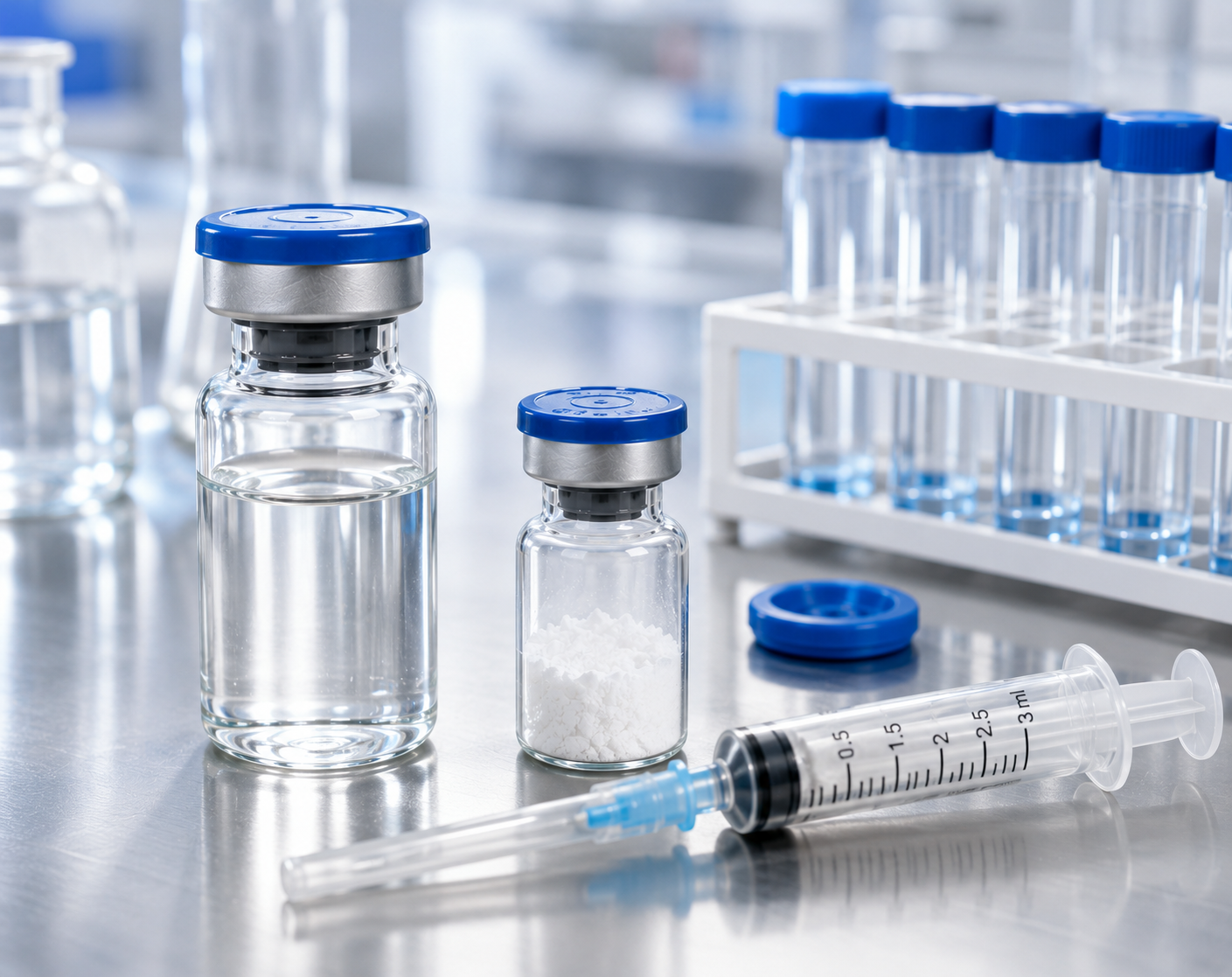
Lyophilization removes most of the water from a peptide-containing solution, leaving behind a dry cake or powder.
Reconstitution reverses part of that process by introducing an appropriate solvent so that the peptide can return to solution.
Conceptually:
Lyophilized material + validated solvent → peptide solution
The word validated is important.
Different peptides have different solubility characteristics. Some dissolve readily in water, while others may require specific buffers, pH conditions, salts, or specialized solvents.
Consequently, a universal “add bacteriostatic water to every peptide” protocol would not be scientifically appropriate.
Why Use a Preserved Diluent?
For compatible laboratory preparations intended for repeated sampling, a preserved diluent can provide a practical advantage.
Each entry into a container represents another potential opportunity for microbial contamination.
The preservative in bacteriostatic water is intended to inhibit microbial proliferation if small numbers of susceptible organisms are inadvertently introduced.
That is very different from claiming that repeated access is risk-free.
Good laboratory practice still aims to minimize the number of times a container is accessed and to maintain appropriate aseptic procedures throughout the experiment.
Bacteriostatic Does Not Mean Sterilizing
This is perhaps the most important misconception to correct.
Adding bacteriostatic water to a nonsterile substance does not make the resulting solution sterile.
Similarly, adding bacteriostatic water to a research peptide of unknown microbiological quality does not establish that the finished preparation is suitable for injection or clinical use.
Chemical purity, sterility, and endotoxin contamination are separate quality characteristics.
A peptide could demonstrate extremely high chromatographic purity and still fail microbiological specifications.
The FDA discusses bacterial endotoxins and pyrogen control separately from ordinary chemical purity testing. FDA — Bacterial Endotoxins/Pyrogens
Aseptic Technique Still Matters
Whenever sterile laboratory materials are manipulated, aseptic technique is critical.
The goal is to avoid introducing microorganisms or environmental contaminants into the product.
At a laboratory level, this means working in an appropriately controlled environment, using suitable sterile supplies when required, minimizing unnecessary exposure, and following the laboratory’s established standard operating procedures.
The stopper and surrounding surfaces should be handled according to the relevant validated protocol.
Containers should also remain closed except when access is required.
A bacteriostatic preservative should be viewed as an additional safeguard, not a replacement for contamination control.
Laboratory Reconstitution: The General Workflow
The exact procedure must come from the peptide’s validated laboratory protocol, but the general scientific workflow is straightforward.
First, researchers verify the identity of the peptide and confirm that the intended diluent is chemically compatible with it.
The required final concentration is then established from the needs of the experiment.
An appropriate volume of diluent is calculated.
Under the laboratory’s aseptic procedure, the measured diluent is introduced into the peptide vial or other appropriate vessel.
The material is then allowed to dissolve using the handling method appropriate for that peptide.
Finally, the solution is labeled with relevant information such as identity, concentration, preparation date, batch information, and storage conditions.
The resulting preparation is stored according to validated stability requirements.
Why Gentle Handling May Matter
Peptides vary substantially in their physical characteristics.
Some peptide-containing formulations may be vulnerable to aggregation, foaming, adsorption to surfaces, or other physical stresses.
For that reason, laboratory protocols sometimes specify gentle mixing rather than aggressive agitation.
But this should not be generalized into a rule that every peptide must be handled identically.
The correct approach depends on the individual molecule and formulation.
Researchers should follow the handling instructions developed for the particular material rather than relying on generalized internet instructions.
Concentration Is a Laboratory Calculation
Once a known quantity of peptide has been dissolved in a known volume of solvent, the concentration can be expressed mathematically.
The fundamental relationship is:
Concentration = amount of peptide ÷ total solution volume
For example, laboratory concentrations might be expressed as:
mg/mL, µg/mL, or µmol/L
depending upon the experimental application.
Importantly, this type of concentration calculation should not be confused with a human dosing recommendation. Laboratory concentration is simply a description of how much material is present per unit volume.
Accurate calculations require reliable knowledge of how much peptide is actually present. A vial’s labeled quantity and chromatographic purity percentage do not necessarily provide identical information, which is why peptide-content or assay testing can be important in quantitative research.
What Happens to Stability After Reconstitution?
Reconstitution fundamentally changes the storage environment.
Before reconstitution, a lyophilized peptide contains relatively little water.
After reconstitution, the peptide is once again surrounded by water molecules.
This can increase molecular mobility and potentially accelerate degradation pathways such as hydrolysis, oxidation, aggregation, or deamidation depending upon the peptide.
As a result:
The shelf life of a dry peptide should never automatically be applied to the same peptide after reconstitution.
The reconstituted material requires its own stability specifications.
Refrigeration After Reconstitution
Many aqueous peptide formulations are stored refrigerated when supported by their stability data.
A commonly defined pharmaceutical refrigeration range is approximately 2°C to 8°C (36°F to 46°F).
However, this should not be interpreted as a universal rule.
Some peptides may require different temperatures, while others may have limited stability even under refrigeration.
The correct storage condition and allowable storage period must come from product-specific stability information or a validated research protocol.
Does Bacteriostatic Water Extend Peptide Shelf Life?
Not in the way this question is sometimes interpreted.
The preservative helps inhibit bacterial growth. It does not necessarily prevent chemical degradation of the peptide.
Those are two separate processes.
Benzyl alcohol cannot be assumed to stop oxidation, hydrolysis, aggregation, deamidation, or other chemical changes.
Therefore, a solution could remain free from obvious microbial growth while the peptide itself gradually loses chemical integrity.
This is why microbiological preservation and chemical stability must be evaluated separately.
How Long Does Bacteriostatic Water Last After Opening?
The answer should come from the labeling of the particular commercially manufactured product.
For approved multidose injectable containers in general, CDC guidance notes that multidose vials should typically be dated when first opened and discarded within 28 days unless the manufacturer specifies another period. CDC — Preventing Unsafe Injection Practices
That general rule should not be used to invent a shelf life for a reconstituted peptide.
The usable period of the diluent and the stability period of the peptide solution are separate questions.
If a particular peptide remains stable for less time than the diluent, the peptide’s shorter validated period controls the experiment.
Signs That a Solution Should Be Investigated
Researchers should follow their laboratory’s rejection criteria.
Obvious abnormalities may include unexpected discoloration, cloudiness, visible foreign particles, compromised seals, damaged containers, or unexpected precipitation.
But visual inspection has significant limitations.
A solution can look perfectly clear while containing chemically degraded peptide or microbiological contamination that cannot be seen with the naked eye.
Appearance should therefore never substitute for appropriate quality testing.
Proper Labeling Is Essential
Once a laboratory preparation has been made, good labeling becomes particularly important.
Depending upon the laboratory protocol, useful information may include:
Peptide identity
Batch or lot number
Concentration
Diluent
Preparation date
Storage condition
Researcher or sample identifier
Clear labeling helps prevent experimental errors and allows researchers to trace results back to the material used.
When Bacteriostatic Water May Not Be Appropriate
Bacteriostatic water is not a universal peptide solvent.
Some peptides may require another solution because of solubility, pH, chemical compatibility, analytical requirements, or sensitivity to preservatives.
Some experiments may specifically require preservative-free conditions.
In other situations, a buffer may be necessary to maintain an appropriate pH.
This means the first question should never simply be:
“How much bacteriostatic water should I add?”
The more scientifically appropriate first question is:
“What diluent has been validated for this peptide and this experiment?”
Only after establishing chemical compatibility does it make sense to calculate a laboratory concentration.
The Importance of Source and Quality
The quality of the diluent matters just as much as careful handling.
For controlled laboratory work, researchers should use appropriately manufactured and documented materials rather than attempting to create bacteriostatic water from ordinary water and preservative ingredients.
Commercial pharmaceutical preparations are manufactured under controlled conditions and have defined composition, packaging, and labeling.
The same principle applies to peptide research generally: preparation technique cannot compensate for poorly characterized starting materials.
The Bottom Line
Bacteriostatic water plays an important role in certain peptide and laboratory applications because it combines sterile water with an antimicrobial preservative—typically 0.9% benzyl alcohol.
Its greatest practical advantage is its ability to inhibit the growth of susceptible bacteria following appropriate access to a multidose container.
But its capabilities have clear limits.
Bacteriostatic water does not sterilize contaminated peptides. It does not establish that a research peptide is safe for human use. It does not prevent every type of chemical degradation. And it is not automatically the correct solvent for every peptide.
Good laboratory practice begins by identifying the appropriate diluent for the specific molecule, establishing the required experimental concentration, maintaining aseptic conditions, accurately labeling the resulting solution, and following validated storage and stability requirements.
The key distinction is simple:
Bacteriostatic water helps control microbial growth; it does not replace proper formulation, sterility controls, stability testing, or sound laboratory technique.
Research-use note: This guide describes general laboratory principles rather than instructions for preparing or administering peptide injections in humans. Research peptides and diluents should be handled according to applicable laboratory protocols, manufacturer specifications, and regulatory requirements.