
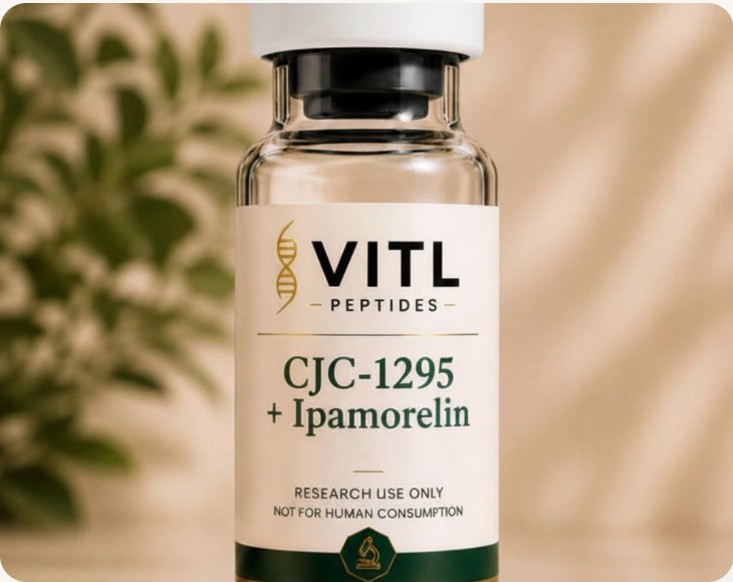
CJC-1295 + Ipamorelin: A Comprehensive Guide to Uses, Research, Dosing, Forms, and Potential Benefits
The combination of CJC-1295 and ipamorelin is frequently discussed in peptide research, fitness, recovery, and healthy-aging communities because both compounds influence the body’s growth hormone–IGF-1 axis, but they do so through different receptors.
The underlying idea is relatively straightforward.
CJC-1295 is a synthetic analogue of growth hormone-releasing hormone, or GHRH. It stimulates GHRH receptors in the pituitary gland.
Ipamorelin is a synthetic growth hormone secretagogue that acts primarily through the ghrelin receptor, also called the growth hormone secretagogue receptor or GHSR-1a.
Because natural growth hormone secretion is regulated through several complementary signaling systems, researchers and peptide users have proposed that activating both pathways simultaneously could produce a stronger growth-hormone response than activating either pathway alone.
This concept is biologically plausible, but there is an important limitation:
The CJC-1295 + ipamorelin combination itself has not been validated through large controlled human clinical trials.
A 2026 scientific review specifically noted that CJC-1295 and ipamorelin are commonly combined in performance and body-composition settings, but controlled evidence demonstrating meaningful synergy or improved body composition in healthy humans remains limited.
Neither CJC-1295 nor ipamorelin is FDA-approved for muscle building, fat loss, anti-aging, exercise recovery, or general growth-hormone enhancement.
What Is CJC-1295?
CJC-1295 is a synthetic analogue of GHRH, the hormone produced by the hypothalamus that signals the pituitary gland to release growth hormone.
When GHRH receptors on pituitary somatotroph cells are activated, intracellular signaling increases the production and secretion of growth hormone.
Growth hormone then circulates through the body and stimulates production of insulin-like growth factor 1, or IGF-1, particularly in the liver.
The pathway can be simplified as:
Hypothalamus → GHRH → Pituitary → Growth Hormone → IGF-1
CJC-1295 attempts to enhance the GHRH portion of this pathway.
One complication is that the name “CJC-1295” may refer to two quite different compounds:
CJC-1295 with DAC
and
CJC-1295 without DAC, often called Modified GRF(1-29).
This distinction is extremely important when discussing a CJC-1295 + ipamorelin combination.
With DAC or Without DAC?
In online peptide discussions, the CJC-1295 paired with ipamorelin is often the short-acting no-DAC version, although some compounded and research-market products may contain or claim to contain the DAC version.
FDA has noted that marketed combination products labeled CJC-1295/ipamorelin have sometimes failed to specify whether the CJC-1295 component contains DAC or which salt form is present.
The difference is substantial.
CJC-1295 without DAC is short acting and is intended to generate a relatively brief GHRH signal.
CJC-1295 with DAC binds albumin and can remain active for several days, creating much more prolonged GH and IGF-1 stimulation.
A product or study referring only to “CJC-1295 + ipamorelin” therefore does not provide enough pharmacological information unless the exact CJC-1295 form is specified.
What Is Ipamorelin?
Ipamorelin is a synthetic five-amino-acid peptide classified as a growth hormone secretagogue.
Its sequence includes modified amino acids and was designed to selectively stimulate growth hormone secretion.
Rather than binding to the GHRH receptor, ipamorelin activates GHSR-1a, the same receptor family activated by the naturally occurring hormone ghrelin.
Early pharmacology research found that ipamorelin stimulated growth hormone release while producing less activity involving several other pituitary hormones than some older growth hormone-releasing peptides.
This relative selectivity is one reason ipamorelin became popular in growth-hormone research.
How Does Ipamorelin Work?
Ipamorelin binds to GHSR-1a receptors in the hypothalamic-pituitary system.
Activation of these receptors encourages the pituitary to release growth hormone.
In a human pharmacokinetic and pharmacodynamic study involving healthy male volunteers, ipamorelin produced a distinct episode of growth hormone secretion.
GH concentrations peaked approximately 0.67 hours—or about 40 minutes—after administration and subsequently declined.
The study also estimated ipamorelin’s terminal half-life at approximately two hours.
This provides real human evidence that ipamorelin can stimulate endogenous GH secretion.
However, demonstrating an increase in growth hormone is not the same thing as demonstrating increased muscle mass, fat loss, improved recovery, or longer lifespan.
Those outcomes require separate clinical evidence.
Why Combine CJC-1295 and Ipamorelin?
The rationale comes from the physiology of growth hormone secretion.
CJC-1295 stimulates the GHRH receptor.
Ipamorelin stimulates the ghrelin/GHSR receptor.
These signaling systems can complement one another.
Natural GH release is influenced by several competing signals:
GHRH encourages GH release.
Ghrelin and related GHSR signaling encourage GH release.
Somatostatin suppresses GH release.
Combining a GHRH analogue with a ghrelin-receptor agonist could theoretically produce a stronger GH pulse because two stimulatory pathways are being activated simultaneously.
This concept has a reasonable biological foundation and has been demonstrated broadly with other combinations of GHRH and growth-hormone secretagogues.
However, the specific CJC-1295 + ipamorelin combination has not undergone the kind of randomized clinical development required to establish an optimal ratio, dosing schedule, safety profile, or meaningful clinical benefit.
A 2026 review specifically characterized the popularity of CJC-1295/ipamorelin stacking as being driven largely by mechanistic reasoning and anecdotal practice rather than robust controlled human outcome data.
What Do People Research This Combination For?
The combination is commonly discussed in connection with several potential applications.
These should be understood as areas of interest rather than FDA-approved uses.
Growth Hormone Release
This is the most biologically plausible objective.
Both components independently stimulate endogenous growth hormone through different receptors.
CJC-1295 activates GHRH signaling, while ipamorelin activates the ghrelin receptor.
The combination is therefore intended to amplify GH secretion.
Recovery
Growth hormone participates in protein metabolism, connective-tissue biology, and recovery processes.
For that reason, CJC-1295 + ipamorelin is often discussed for:
exercise recovery
muscle recovery
connective-tissue support
recovery between workouts
and sometimes recovery following injury.
These outcomes have not been proven in controlled trials of the combination.
Body Composition
One of the most common reasons people become interested in GH-axis peptides is body composition.
Growth hormone influences both fat and protein metabolism.
Consequently, CJC-1295 + ipamorelin is frequently associated with research involving:
fat metabolism
lean body mass
muscle preservation
and body recomposition.
A recent scientific review cautioned that body-composition and performance claims surrounding CJC-1295, ipamorelin, and similar peptides substantially exceed the available clinical evidence.
Sleep
Growth hormone secretion is strongly associated with sleep.
One of the largest natural GH pulses occurs during slow-wave or deep sleep.
This has led to widespread claims that GH-releasing peptides may improve:
deep sleep
sleep quality
overnight recovery
and morning energy.
There is not sufficient controlled evidence showing that the CJC-1295 + ipamorelin combination reliably produces these outcomes.
Healthy Aging
Growth hormone and IGF-1 levels generally decline with age.
This has created substantial interest in growth-hormone-releasing compounds for healthy-aging research.
Potential areas of interest include:
muscle preservation
recovery
energy
body composition
skin and connective tissue
and sleep.
However, lower GH with advancing age is part of normal human physiology, and artificially increasing GH or IGF-1 has not been demonstrated to extend human lifespan.
In fact, the relationship between GH, IGF-1, aging, and longevity is complex.
Human Research on CJC-1295
The strongest human evidence involves CJC-1295 with DAC rather than the no-DAC version often used in combination products.
Published human studies found that the DAC-containing formulation substantially increased circulating GH and IGF-1 for several days.
By contrast, a 2026 review concluded that CJC-1295 without DAC remains essentially uncharacterized in controlled peer-reviewed human trials.
This is important because many CJC-1295/ipamorelin blends marketed through research channels contain or claim to contain the no-DAC form.
Therefore, human data from long-acting CJC-1295 cannot automatically be applied to these short-acting combination products.
Human Research on Ipamorelin
Ipamorelin has somewhat better direct human pharmacology data.
In one controlled dose-escalation study, researchers administered ipamorelin intravenously to healthy male volunteers at several infusion rates.
The compound produced dose-related exposure and stimulated a discrete growth-hormone response, with GH peaking roughly 40 minutes after treatment.
Researchers also studied ipamorelin in patients undergoing bowel surgery because ghrelin-receptor agonism can influence gastrointestinal motility.
In a randomized trial involving 117 patients, investigators used intravenous ipamorelin at 0.03 mg/kg twice daily for up to seven days.
The treatment did not significantly improve the primary measure of postoperative gastrointestinal recovery compared with placebo, although it was described as generally well tolerated within that study.
This provides evidence of human exposure to ipamorelin, but it does not validate the much different protocols commonly discussed for physique, recovery, or anti-aging purposes.
What About Dosing?
There is no FDA-approved dosing schedule for CJC-1295 + ipamorelin.
More importantly, there is no validated clinical-trial protocol establishing an optimal ratio or dose of the combination for muscle gain, fat reduction, recovery, sleep, or healthy aging.
Online protocols frequently quote doses in micrograms and recommend one or more administrations per day.
These approaches generally originate from:
peptide clinics
research-market practices
online communities
or extrapolation from the pharmacology of the individual compounds.
They should not be confused with evidence-based dosing.
Published human ipamorelin studies used very different protocols. The pharmacokinetic study used controlled intravenous infusions across several dose levels, while the postoperative study used 0.03 mg/kg intravenously twice daily.
Neither protocol establishes an appropriate subcutaneous dose for a CJC-1295/ipamorelin blend.
Similarly, doses studied for CJC-1295 with DAC cannot simply be applied to CJC-1295 without DAC because their pharmacokinetics differ dramatically.
Why the Ratio Matters
Commercial research blends often contain both peptides in the same vial.
For example, a vial might be labeled with a total quantity containing a particular amount of CJC-1295 and a particular amount of ipamorelin.
That ratio matters because the two compounds are pharmacologically different.
A vial containing equal milligram amounts does not mean the two compounds have equal biological potency or duration.
The problem becomes even greater when the label does not specify whether the CJC-1295 is:
with DAC
or
without DAC.
FDA’s review of the compounding market specifically identified combination products in which the type of CJC-1295 was unclear.
For scientific research, the exact identity, salt form, concentration, purity, and DAC status should therefore be known.
What Forms Are Offered?
The CJC-1295 + ipamorelin combination appears primarily through the research and compounding markets.
Lyophilized Combination Vials
One of the most common formats is freeze-dried or lyophilized powder containing both peptides in one vial.
Lyophilization removes water and generally improves peptide stability during transportation and storage.
Separate Research Vials
Researchers may also obtain CJC-1295 and ipamorelin as separate materials.
This allows each peptide to be characterized or studied independently.
Reconstituted Preparations
Some commercial or compounded preparations are supplied as liquids.
However, the presence of an injectable-looking vial does not establish FDA approval, sterility, potency, or pharmaceutical equivalence.
FDA emphasizes that compounded drugs are not FDA-approved and are not reviewed for safety, effectiveness, or manufacturing quality before marketing.
Potential Side Effects
Because there is no large clinical trial program evaluating the combination, its true adverse-event profile is not established.
Potential effects associated with stimulation of the GH-IGF-1 axis may include:
- Headache
- Flushing
- Dizziness
- Water retention
- Swelling
- Tingling or numbness
- Joint discomfort
- Muscle aches
- Changes in appetite
- Injection-site reactions
- Changes in glucose regulation
- Altered insulin sensitivity
A 2026 review of performance-oriented GH-axis peptides identified potential concerns including fluid retention, musculoskeletal symptoms, endocrine disturbances, appetite changes, dysglycemia, and injection-site reactions.
These should not be regarded as a complete or precisely quantified safety profile for the CJC-1295/ipamorelin combination.
FDA Safety Concerns
FDA currently identifies both CJC-1295 and ipamorelin acetate among bulk drug substances that may present significant safety risks when used in compounded preparations.
For CJC-1295, FDA cites potential:
immunogenicity
peptide-related impurities
difficulty characterizing the active pharmaceutical ingredient
increased heart rate
and systemic vasodilatory reactions.
For ipamorelin acetate, FDA similarly identifies possible immunogenicity and peptide impurity concerns. The agency also notes serious adverse events reported during intravenous clinical development and says it lacks sufficient safety information for certain other injectable routes.
These regulatory concerns do not establish that every product containing either compound will cause harm.
They do indicate that the safety database is insufficient to treat the combination as a well-established therapy.
Growth Hormone, Blood Sugar, and Insulin Sensitivity
Growth hormone can reduce insulin sensitivity under some circumstances.
That makes glucose regulation an important consideration whenever the GH-IGF-1 axis is chronically stimulated.
Potential areas researchers would need to monitor include:
fasting glucose
insulin
A1C
and changes in insulin sensitivity.
Long-term controlled studies of CJC-1295 + ipamorelin have not established how clinically significant these effects might be.
IGF-1 and Excess Growth Signaling
CJC-1295 can increase GH, which can subsequently increase IGF-1.
IGF-1 participates in:
protein synthesis
bone metabolism
tissue growth
and cellular survival.
Normal IGF-1 is essential physiology.
However, chronically excessive growth signaling is not necessarily desirable.
High GH or IGF-1 exposure can contribute to metabolic, cardiovascular, and tissue-growth effects.
This is another reason that simply attempting to maximize GH release is not a scientifically sound objective.
Cancer Concerns
IGF-1 participates in cellular proliferation and survival pathways.
For this reason, scientists investigate the relationship between the GH-IGF-1 axis and several cancers.
This does not mean CJC-1295 or ipamorelin has been demonstrated to cause cancer.
Rather, it means that chronically manipulating growth signaling raises legitimate questions about people with active cancer, previous malignancy, or elevated cancer risk.
Long-term controlled safety studies of the combination have not answered those questions.
Does the Combination Build Muscle?
This is one of the most common claims surrounding CJC-1295 + ipamorelin.
The biological argument is understandable:
CJC-1295 + ipamorelin → more GH → potentially more IGF-1 → potentially greater protein and tissue signaling.
But clinical medicine requires more than a plausible pathway.
There are currently no large randomized studies demonstrating that healthy adults using this combination gain a clinically meaningful amount of muscle compared with placebo.
A 2026 review concluded that performance and body-composition claims for these GH-axis research peptides remain poorly substantiated despite widespread self-administration.
Does It Burn Fat?
Growth hormone can increase lipolysis, meaning the mobilization of stored fat.
That provides another plausible biological rationale.
However, increasing a hormone associated with lipolysis does not automatically mean a treatment produces substantial fat loss.
There are no strong controlled trials demonstrating how much, if any, clinically meaningful fat reduction occurs from the CJC-1295/ipamorelin combination.
It should therefore not be compared with established obesity medications such as semaglutide or tirzepatide, which have extensive randomized weight-loss data.
Is CJC-1295 + Ipamorelin FDA Approved?
No.
There is no FDA-approved CJC-1295 + ipamorelin medication.
Neither compound is FDA-approved for:
muscle growth
fat loss
anti-aging
exercise recovery
sleep enhancement
or general growth-hormone optimization.
FDA has also identified concerns with both substances in the compounding context.
Compounded products themselves are not FDA-approved, meaning FDA does not review them in advance for safety, effectiveness, or quality.
Competitive Sports
CJC-1295 and ipamorelin are particularly important for competitive athletes to recognize.
Growth hormone-releasing factors and growth hormone secretagogues are prohibited under anti-doping rules.
Ipamorelin and other GHRPs have specifically been studied in anti-doping research because they stimulate endogenous growth hormone secretion.
Competitive athletes can therefore face anti-doping consequences even if a peptide is being used for recovery rather than with the stated intention of enhancing performance.
What Research Is Needed Next?
Given how frequently CJC-1295 + ipamorelin is discussed, the lack of direct research on the combination is surprisingly large.
Useful future studies would need to establish:
the optimal CJC-1295 form
CJC-1295 with DAC versus without DAC
appropriate ratios between the compounds
human pharmacokinetics
growth hormone responses
IGF-1 responses
effects on muscle mass
effects on body fat
effects on sleep
exercise recovery
glucose and insulin sensitivity
cardiovascular effects
long-term endocrine effects
and long-term safety.
Randomized, placebo-controlled studies would be necessary to distinguish genuine benefits from expectations, natural recovery, training effects, diet changes, and other confounding factors.
The Bottom Line
CJC-1295 + ipamorelin is one of the most widely discussed experimental combinations for manipulating the growth hormone–IGF-1 axis.
The scientific rationale comes from the fact that the two peptides target different but complementary pathways.
CJC-1295 activates GHRH receptors.
Ipamorelin activates ghrelin/GHSR-1a receptors.
Both signals can encourage the pituitary gland to release endogenous growth hormone.
Human studies demonstrate that ipamorelin itself can produce a distinct GH pulse, with peak GH occurring about 40 minutes after administration in controlled pharmacokinetic research.
CJC-1295 with DAC has also demonstrated substantial and prolonged increases in GH and IGF-1 in human research.
But the critical limitation is that the combination itself has not undergone robust controlled human clinical testing for the purposes for which it is most commonly discussed.
There is no established evidence that CJC-1295 + ipamorelin reliably produces clinically meaningful:
muscle gain
fat reduction
improved athletic performance
faster injury recovery
better sleep
or anti-aging effects.
A 2026 review of GH-IGF-1-modulating peptides specifically concluded that controlled evidence supporting the popular CJC-1295/ipamorelin combination remains limited and that many performance and body-composition claims rely heavily on biological rationale and anecdotal use rather than direct clinical evidence.
There is also no FDA-approved dosage, ratio, treatment schedule, or pharmaceutical CJC-1295/ipamorelin combination.
The precise formulation matters enormously because “CJC-1295” may mean either a short-acting no-DAC compound or a long-acting DAC-containing compound. FDA has even identified marketed combination products where this distinction was not clearly stated.
Both compounds also carry unanswered safety questions.
FDA identifies CJC-1295 and ipamorelin acetate among bulk substances with potential concerns involving immunogenicity, peptide impurities, and limited human safety information. CJC-1295 has additionally been associated with increased heart rate and systemic vasodilatory reactions in available data.
Perhaps the most accurate description of CJC-1295 + ipamorelin in 2026 is therefore:
an experimental two-peptide strategy designed to stimulate endogenous growth hormone through complementary GHRH and ghrelin-receptor pathways, with a sound physiological rationale and some human evidence supporting the hormonal activity of its individual components, but without the controlled clinical evidence necessary to establish the combination’s optimal dosing, long-term safety, or commonly claimed benefits for muscle growth, fat loss, recovery, sleep, or healthy aging.
For researchers studying growth-hormone physiology, the combination is particularly interesting because it provides a way to investigate how two separate stimulatory pathways interact.
For consumers, however, the distinction between increasing a hormone in a laboratory measurement and proving a meaningful health or performance benefit remains essential.
Educational and research notice: This article is intended for general scientific and educational information. It is not medical advice or a recommendation for human use of CJC-1295, ipamorelin, or their combination. Doses described are from studies of individual compounds and should not be interpreted as a personal dosing regimen for the combination. CJC-1295 + ipamorelin is not FDA-approved for muscle gain, fat loss, recovery, anti-aging, sleep improvement, growth-hormone optimization, or any other medical condition.