

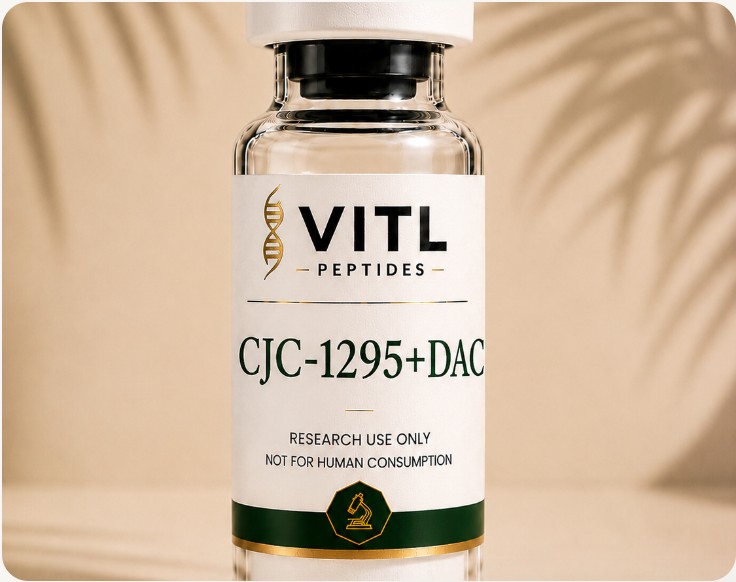
CJC-1295 With DAC: A Comprehensive Guide to Uses, Research, Dosing, Forms, and Potential Benefits
CJC-1295 with DAC is a synthetic peptide designed to stimulate the body’s own production of growth hormone, or GH, and indirectly increase insulin-like growth factor 1, or IGF-1.
It is commonly discussed in connection with research involving growth hormone secretion, recovery, body composition, muscle preservation, fat metabolism, sleep, healthy aging, and growth hormone deficiency.
Unlike CJC-1295 without DAC, which is short acting, CJC-1295 with DAC was engineered to remain active in the body for several days after a single administration.
That long duration of action is the defining feature of the compound.
The “DAC” portion stands for Drug Affinity Complex. This modification allows CJC-1295 to bind to albumin, one of the most abundant proteins circulating in the blood. Albumin has a relatively long lifespan, so attaching CJC-1295 to it dramatically slows the peptide’s clearance.
In human research, CJC-1295 with DAC has demonstrated an estimated half-life of approximately 5.8 to 8.1 days, with measurable increases in growth hormone lasting at least six days and increases in IGF-1 lasting approximately nine to eleven days after a single injection.
That makes CJC-1295 with DAC substantially better characterized in humans than the no-DAC version.
However, the compound remains investigational and is not FDA-approved for growth hormone deficiency, muscle gain, fat loss, anti-aging, recovery, or any other medical condition. FDA has also raised safety concerns involving compounded CJC-1295 products, including immunogenicity, peptide-related impurities, increased heart rate, and systemic vasodilatory reactions.
What Is CJC-1295 With DAC?
CJC-1295 is a synthetic analogue of growth hormone-releasing hormone, or GHRH.
GHRH is naturally produced in the hypothalamus and acts on the anterior pituitary gland.
Its primary role is to signal specialized pituitary cells known as somatotrophs to release growth hormone.
The natural pathway can be simplified as:
Hypothalamus → GHRH → Pituitary → Growth Hormone → IGF-1
CJC-1295 is designed to act at the GHRH receptor and prolong that signal.
The peptide is based on the biologically active portion of GHRH, but it includes amino-acid modifications that make it more resistant to enzymatic degradation.
The DAC modification then adds an additional layer of longevity.
Once administered, the DAC component reacts with albumin in the bloodstream.
This effectively creates a long-acting reservoir of the compound.
What Does DAC Actually Do?
DAC stands for Drug Affinity Complex.
Without this modification, a GHRH analogue may be cleared relatively quickly.
With DAC, the molecule binds covalently to circulating albumin.
That dramatically increases its residence time in the bloodstream.
This was one of the original goals in developing CJC-1295: overcome the short half-life that limits the practical therapeutic use of native GHRH.
A randomized controlled trial published in the Journal of Clinical Endocrinology & Metabolism demonstrated exactly how significant this modification can be.
After a single subcutaneous dose of CJC-1295 with DAC, mean plasma growth hormone concentrations increased approximately 2- to 10-fold for six days or longer.
Mean IGF-1 concentrations increased approximately 1.5- to 3-fold for nine to eleven days.
The estimated half-life of the compound was approximately 5.8 to 8.1 days.
This is why the DAC and no-DAC formulations should not be treated as interchangeable.
How Does CJC-1295 With DAC Work?
CJC-1295 binds to and activates the GHRH receptor.
When the GHRH receptor is stimulated, it activates intracellular signaling involving:
Gs proteins
adenylyl cyclase
cyclic AMP
and downstream signaling within pituitary somatotrophs.
This encourages the pituitary gland to synthesize and release growth hormone.
Growth hormone then acts directly on tissues throughout the body and stimulates production of IGF-1, particularly in the liver.
Both GH and IGF-1 influence multiple physiological systems.
These include:
- Protein metabolism
- Fat metabolism
- Bone remodeling
- Connective tissue
- Cellular growth
- Muscle maintenance
- Glucose metabolism
- Recovery
- Tissue repair
The long duration of CJC-1295 with DAC means that stimulation of this axis continues far longer than it would following natural GHRH release.
Does CJC-1295 With DAC Destroy Natural GH Pulses?
One interesting concern with long-acting GHRH stimulation is whether it would flatten the body’s normal pulsatile growth hormone pattern.
Growth hormone is naturally secreted in bursts rather than at one constant concentration.
Researchers specifically studied this question.
In a human study involving healthy men, investigators measured GH levels every 20 minutes overnight before and one week after administration of CJC-1295 with DAC.
They found that growth hormone secretion remained pulsatile.
The frequency and magnitude of the GH pulses did not significantly change.
Instead, baseline or trough GH concentrations rose substantially.
Average GH secretion increased approximately 46%, while IGF-1 increased approximately 45%.
This suggests that prolonged GHRH receptor stimulation did not completely eliminate normal pulsatile physiology.
Instead, it raised the baseline around which the pulses occurred.
Why Are Researchers Interested in Growth Hormone?
Growth hormone has a broad range of biological effects.
It plays a role in:
muscle protein metabolism
fat mobilization
bone density
connective tissue
organ growth
glucose metabolism
recovery
and IGF-1 production.
Growth hormone secretion also naturally decreases with age.
This has made the GH-IGF-1 axis a major area of research in endocrinology, aging, body composition, and metabolic health.
The appeal of a GHRH analogue such as CJC-1295 is that it stimulates the body’s own pituitary gland rather than supplying recombinant growth hormone directly.
That distinction is important because endogenous GH release remains partly influenced by the body’s natural inhibitory signals, including somatostatin.
However, this does not mean the system cannot be overstimulated.
CJC-1295 with DAC clearly produces prolonged elevations in GH and IGF-1.
What Do People Research CJC-1295 With DAC For?
Because CJC-1295 with DAC is not an approved medication, these should be understood as research interests rather than established medical uses.
Growth Hormone Release
This is the best-supported effect.
Human trials clearly demonstrated that CJC-1295 with DAC can increase circulating GH and IGF-1.
That effect has been demonstrated directly rather than inferred from animal research alone.
Body Composition
Growth hormone influences both lipid and protein metabolism.
For this reason, CJC-1295 is often discussed for potential effects involving:
fat reduction
lean body mass
muscle preservation
and body recomposition.
However, an important distinction must be made.
Human studies established that CJC-1295 raises GH and IGF-1, but they did not establish clinically meaningful muscle gain or fat loss as an outcome.
A 2026 review of GH-IGF-1-modulating peptides emphasized that the evidence for actual physique or performance improvements remains much weaker than the hormonal data.
Exercise Recovery
Growth hormone participates in connective tissue and protein metabolism.
This has led to interest in CJC-1295 for:
exercise recovery
muscle recovery
connective-tissue support
and reduced recovery time between training sessions.
Again, these uses are biologically plausible but not established through large controlled trials involving athletic outcomes.
Sleep
Growth hormone secretion is closely linked with sleep.
One of the body’s largest GH pulses typically occurs during deep sleep.
This connection has led to interest in whether increasing GHRH signaling could affect:
deep sleep
sleep quality
overnight recovery
and morning energy.
Human evidence specifically demonstrating improved sleep quality with CJC-1295 remains limited.
Healthy Aging
Because GH and IGF-1 levels tend to decline with age, CJC-1295 is sometimes discussed in longevity or anti-aging contexts.
People may associate the compound with:
energy
body composition
muscle preservation
skin quality
sleep
and recovery.
These claims should be viewed cautiously.
There is no evidence that CJC-1295 extends human lifespan or reverses aging.
In fact, the relationship between GH, IGF-1, and longevity is biologically complex, and higher levels are not necessarily always better.
Human Clinical Research
Unlike CJC-1295 without DAC, the DAC-containing form has actual randomized human trial data.
One of the key studies included healthy adults between the ages of 21 and 61.
Researchers performed two randomized, placebo-controlled, double-blind, ascending-dose studies.
Participants received either single doses or two to three repeated doses given weekly or every two weeks.
Following a single dose:
GH increased approximately 2- to 10-fold for six days or longer.
IGF-1 increased approximately 1.5- to 3-fold for nine to eleven days.
After repeated doses, mean IGF-1 levels remained above baseline for as long as 28 days.
The researchers also observed evidence of accumulation with repeated dosing.
This is one of the strongest pieces of evidence available for CJC-1295.
What Doses Have Been Studied?
CJC-1295 with DAC has no FDA-approved dosing regimen.
Published doses should therefore be understood only as descriptions of clinical research.
In the major human trial, researchers evaluated subcutaneous doses including:
30 micrograms per kilogram
60 micrograms per kilogram
125 micrograms per kilogram
and 250 micrograms per kilogram
in the single-dose portion of the program.
The repeated-dose study used protocols such as:
30 mcg/kg on days 0 and 14
60 mcg/kg on days 0 and 14
30 mcg/kg on days 0, 7, and 14
and
20 mcg/kg on days 0, 7, and 14.
These are clinical-trial protocols, not personal dosing recommendations.
The original investigators reported that the compound was relatively well tolerated, particularly in the 30 and 60 mcg/kg dose groups.
At the highest studied dose, however, IGF-1 levels exceeded age- and sex-adjusted normal ranges in some participants.
That demonstrates why more peptide is not necessarily better.
Why the Long Half-Life Matters for Dosing
With a half-life of approximately six to eight days, CJC-1295 with DAC can remain biologically active well beyond the day it is administered.
Repeated doses may therefore overlap.
In the multiple-dose study, researchers observed progressively higher drug exposure following subsequent doses.
After the day-14 injection, maximum circulating CJC-1295 concentrations were approximately 29% to 70% higher than after the original dose, depending on the treatment group.
This is known as drug accumulation.
It is another reason that dosing schedules copied from short-acting CJC-1295 without DAC should never be applied to the DAC form.
The pharmacokinetics are completely different.
How Is CJC-1295 With DAC Administered?
The published human research used subcutaneous injection.
This means the peptide was administered into the fatty tissue beneath the skin.
The compound was specifically designed to remain active for days, so clinical studies used weekly or even biweekly administration schedules rather than multiple injections per day.
There is no FDA-approved commercial formulation, so there is currently no official consumer delivery system.
What Forms Is CJC-1295 With DAC Offered In?
CJC-1295 with DAC is primarily encountered in the research-material market.
Lyophilized Powder
The most common form is freeze-dried or lyophilized peptide powder.
Lyophilization removes moisture and generally improves peptide stability during shipping and storage.
Research Vials
CJC-1295 with DAC is commonly sold in research vials containing specified milligram quantities.
Different salt forms may be encountered.
FDA has specifically reviewed several related substances, including:
CJC-1295 DAC free base
CJC-1295 DAC acetate
and CJC-1295 DAC trifluoroacetate.
These are chemically related forms of the same general long-acting peptide.
A research vial should not automatically be assumed to be sterile, pharmaceutical grade, accurately concentrated, or appropriate for human administration.
CJC-1295 With DAC Versus Without DAC
This is one of the most important comparisons.
CJC-1295 With DAC
- Long acting
- Binds serum albumin
- Half-life approximately 6–8 days
- Produces prolonged GH elevation
- Produces prolonged IGF-1 elevation
- Can accumulate with repeated doses
- Has published randomized human pharmacokinetic research
CJC-1295 Without DAC
- More accurately called Modified GRF(1-29)
- Short acting
- Does not use albumin binding for prolonged activity
- Intended to create relatively brief GH pulses
- Has little direct peer-reviewed human research
The DAC-containing version therefore has a much stronger human evidence base regarding pharmacokinetics and hormonal effects.
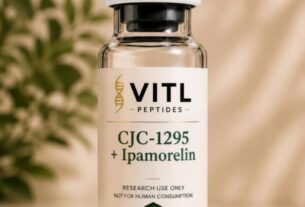
CJC-1295 With DAC and Ipamorelin
CJC-1295 is frequently discussed alongside ipamorelin.
The theoretical rationale is that the compounds stimulate GH through different receptors.
CJC-1295 acts through the GHRH receptor.
Ipamorelin acts through the ghrelin or growth hormone secretagogue receptor.
Physiologically, GHRH and ghrelin-related pathways can act synergistically to promote GH release.
This has led to widespread interest in combining them.
However, there are no high-quality clinical trials establishing a standardized or FDA-approved CJC-1295-with-DAC plus ipamorelin regimen.
A 2026 review noted that peptide combinations used for physique or performance enhancement remain substantially less studied than their popularity might suggest.
Potential Side Effects
Early CJC-1295 trials described the compound as generally well tolerated, but adverse events were reported.
Possible effects associated with GHRH and GH-axis stimulation may include:
- Flushing
- Headache
- Dizziness
- Injection-site reactions
- Water retention
- Tingling sensations
- Joint discomfort
- Changes in appetite
- Changes in heart rate
- Changes in glucose metabolism
FDA’s more recent evaluation adds important context.
The agency states that compounded CJC-1295 may present risks involving immunogenicity, peptide-related impurities, and active-ingredient characterization.
FDA has also identified serious adverse events involving increased heart rate and systemic vasodilatory reactions.
This does not mean everyone exposed to CJC-1295 experiences these effects.
It does mean the safety profile is not sufficiently established to treat the compound as risk-free.
Blood Sugar and Insulin Sensitivity
Growth hormone can oppose some of insulin’s effects.
Sustained elevation of GH may therefore reduce insulin sensitivity in certain circumstances.
This is one reason people with:
prediabetes
type 2 diabetes
metabolic syndrome
or existing insulin resistance
would be especially important populations to evaluate in future safety studies.
The original CJC-1295 human trials were relatively short and were not designed to establish years-long metabolic safety.
IGF-1 and Excessive Exposure
IGF-1 is a powerful growth-related hormone.
Normal physiological concentrations play important roles in tissue maintenance, bone health, and development.
However, chronically excessive IGF-1 is not desirable.
In FDA’s review of the original CJC-1295 study, participants receiving the highest 250 mcg/kg dose sometimes had IGF-1 levels exceeding the normal age- and sex-adjusted range.
That observation reinforces an important concept:
The goal of manipulating the GH-IGF-1 axis cannot simply be to push the numbers as high as possible.
Cancer and Growth Signaling
Because IGF-1 participates in cellular growth, division, and survival pathways, scientists have long examined the relationship between the GH-IGF-1 axis and cancer biology.
This does not establish that CJC-1295 causes cancer.
However, sustained elevation of GH and IGF-1 raises theoretical concerns in people with existing malignancies or certain cancer risks.
Long-term studies would be required to understand that relationship properly.
Such studies have not been completed for CJC-1295.
Is CJC-1295 With DAC FDA Approved?
No.
CJC-1295 with DAC is not FDA approved for growth hormone deficiency, anti-aging, muscle building, fat loss, athletic recovery, sleep improvement, or any other medical indication.
In December 2024, FDA’s Pharmacy Compounding Advisory Committee evaluated several CJC-1295-related substances, including the DAC-containing free base, acetate, and trifluoroacetate forms, in connection with proposed use for growth hormone deficiency.
Regulatory consideration for pharmacy compounding is not the same thing as FDA approval.
FDA currently lists CJC-1295 among bulk substances for which compounded preparations may present significant safety concerns.
CJC-1295 and Competitive Sports
Competitive athletes should also be cautious.
Growth hormone-releasing factors and other compounds that manipulate endogenous GH secretion can fall under anti-doping prohibitions.
Athletes competing under World Anti-Doping Agency rules should verify current regulations before exposure to any GHRH analogue or GH secretagogue.
A compound does not need to be FDA-approved to create an anti-doping violation.
Current Research in 2026
The most important published human research on CJC-1295 remains the early pharmacokinetic and pharmacodynamic work demonstrating long-lasting GH and IGF-1 stimulation.
That evidence is genuine and reasonably strong for demonstrating hormonal activity.
Where the evidence becomes much weaker is when claims move from:
“CJC-1295 increases GH and IGF-1”
to
“CJC-1295 builds muscle, burns fat, improves athletic performance, accelerates recovery, improves sleep, or reverses aging.”
Those outcomes have not been demonstrated through large randomized human trials.
A 2026 review examining peptides that modify the GH-IGF-1 axis emphasized exactly this gap between demonstrated hormonal effects and much less substantiated physique or performance claims.
Future research would ideally examine:
growth hormone deficiency
body composition
muscle and fat mass
bone density
sleep
exercise recovery
glucose metabolism
cardiovascular effects
long-term IGF-1 exposure
and long-term safety.
What Makes CJC-1295 With DAC Scientifically Interesting?
The most interesting feature may not be muscle building or fat loss at all.
It is the compound’s drug-delivery technology.
CJC-1295 demonstrated that a peptide normally cleared very rapidly could be modified to bind to circulating albumin and remain biologically active for approximately a week.
This kind of half-life extension strategy is extremely valuable in pharmaceutical development.
The clinical studies also demonstrated that continuous GHRH receptor stimulation can increase average GH and IGF-1 while still preserving a degree of natural GH pulsatility.
That makes CJC-1295 an interesting compound for understanding human endocrine physiology even if it never becomes an approved treatment.
The Bottom Line
CJC-1295 with DAC is a long-acting synthetic GHRH analogue designed to stimulate endogenous growth hormone and IGF-1 production.
Its defining characteristic is the Drug Affinity Complex, which allows the peptide to bind circulating albumin and remain active for days rather than minutes.
Human clinical research demonstrated that a single injection could increase average growth hormone concentrations approximately 2- to 10-fold for at least six days and increase IGF-1 approximately 1.5- to 3-fold for nine to eleven days.
Its estimated half-life was approximately 5.8 to 8.1 days, and repeated dosing produced evidence of accumulation.
Researchers also demonstrated that GH secretion remained pulsatile despite the prolonged stimulation, although baseline GH concentrations rose substantially.
These findings distinguish CJC-1295 with DAC from many experimental peptides whose effects are supported primarily by animal research.
However, the limits of the evidence remain important.
The clinical studies demonstrated hormonal effects, not proven improvements in:
muscle growth
fat loss
athletic performance
injury recovery
sleep quality
or longevity.
There is currently no FDA-approved CJC-1295 product, no FDA-approved dosage, and no approved indication.
FDA also continues to identify potential safety concerns involving compounded CJC-1295, including peptide impurities, immunogenicity, increased heart rate, and systemic vasodilatory reactions.
Perhaps the most accurate description of CJC-1295 with DAC in 2026 is as a potent, long-acting experimental GHRH analogue with demonstrated human ability to produce sustained increases in growth hormone and IGF-1, but with insufficient evidence to establish the muscle-building, fat-loss, recovery, anti-aging, or performance benefits often attributed to it.
For researchers examining the GH-IGF-1 axis, long-acting peptide pharmacology, GHRH signaling, and growth hormone deficiency, CJC-1295 with DAC remains scientifically interesting.
For consumers, the critical distinction is between proven endocrine activity and proven clinical benefit.
Educational and research notice: This article is intended for general scientific and educational information. It is not medical advice or a recommendation for human use of CJC-1295 with DAC. Doses described are historical clinical-trial protocols and should not be interpreted as personal dosing instructions. CJC-1295 with DAC is not FDA-approved for growth hormone deficiency, muscle growth, fat loss, recovery, anti-aging, or any other medical condition.