
5-Amino-1MQ: A Comprehensive Guide to Uses, Research, Dosing, Forms, and Potential Benefits
Among the growing number of experimental compounds being investigated for metabolism, body composition, and healthy aging, 5-Amino-1MQ has generated considerable interest.
Often discussed alongside research peptides, 5-Amino-1MQ is associated primarily with research involving fat metabolism, obesity, cellular energy, NAD+ biology, and metabolic health. Its mechanism is very different from familiar metabolic compounds such as semaglutide, tirzepatide, or retatrutide.
Rather than acting primarily on appetite-regulating receptors such as GLP-1, 5-Amino-1MQ inhibits an enzyme called nicotinamide N-methyltransferase, better known as NNMT.
Researchers have become interested in NNMT because this enzyme participates in pathways involving cellular energy metabolism, nicotinamide, NAD+, methylation, and adipose tissue.
Early animal research has produced intriguing findings involving body weight and fat mass. However, there is an extremely important limitation to understand from the beginning:
5-Amino-1MQ has not been adequately studied in human clinical trials, and there is currently no established safe or effective human dose.
It is therefore best understood as an experimental research compound, not an established weight-loss treatment.
First: Is 5-Amino-1MQ Actually a Peptide?
Technically, no.
Although 5-Amino-1MQ is frequently grouped with peptides by research suppliers and within peptide research communities, chemically it is a small molecule rather than a peptide.
Its full name is 5-amino-1-methylquinolinium, and the compound is commonly studied in its iodide salt form.
Peptides consist of amino acids linked together through peptide bonds. 5-Amino-1MQ does not have an amino-acid sequence or peptide backbone.
Instead, it belongs to a class of small organic molecules and was developed as an inhibitor of the enzyme NNMT.
This distinction matters scientifically, although it does not change the reason researchers are interested in it: its potential ability to influence metabolic pathways.
What Is NNMT?
To understand 5-Amino-1MQ, it helps to understand its primary target.
NNMT stands for nicotinamide N-methyltransferase.
NNMT is an enzyme expressed in several tissues throughout the body, including:
- Adipose tissue
- Liver
- Muscle
- Kidney
- Brain
The enzyme participates in nicotinamide metabolism.
Nicotinamide is a form of vitamin B3 and an important precursor involved in producing NAD+, or nicotinamide adenine dinucleotide.
NAD+ is essential for cellular energy production and participates in numerous biological processes involving:
mitochondrial function
DNA repair
cellular metabolism
oxidation-reduction reactions
and cellular stress responses.
NNMT transfers a methyl group to nicotinamide, producing 1-methylnicotinamide (1-MNA).
Because nicotinamide can otherwise participate in NAD+ salvage pathways, researchers became interested in whether excessive NNMT activity might influence the availability of metabolic resources within cells.
This ultimately led scientists to investigate NNMT inhibition as a possible metabolic strategy.
How Does 5-Amino-1MQ Work?
5-Amino-1MQ was developed as a selective NNMT inhibitor.
Laboratory research has demonstrated that it can inhibit NNMT activity and reduce levels of 1-methylnicotinamide in adipocytes.
One influential study published in Biochemical Pharmacology examined selective NNMT inhibitors, including 5-Amino-1MQ, in cultured fat cells and diet-induced obese mice.
Researchers found that inhibiting NNMT affected adipocyte metabolism and produced significant metabolic changes in obese mice.
This research became the foundation for much of today’s interest in 5-Amino-1MQ.
The proposed concept is that reducing NNMT activity may influence the balance between:
nicotinamide metabolism
NAD+ availability
cellular methylation
and energy expenditure.
That is considerably different from simply suppressing appetite.
5-Amino-1MQ and Fat Metabolism
The most widely discussed potential application of 5-Amino-1MQ is fat reduction.
Researchers became interested in NNMT after observing associations between the enzyme and adipose tissue metabolism.
In the foundational mouse research, scientists used animals that had developed obesity through a high-fat diet.
Treatment with the NNMT inhibitor produced significant reductions in body weight and white adipose tissue.
Importantly, researchers also monitored food intake.
The results suggested that the reduction in body weight could not simply be explained by the animals eating substantially less food.
That finding helped generate the hypothesis that NNMT inhibition may alter energy metabolism itself, rather than functioning only through appetite suppression.
This makes 5-Amino-1MQ mechanistically very different from GLP-1 receptor agonists.
Does 5-Amino-1MQ Suppress Appetite?
There is currently insufficient evidence to classify 5-Amino-1MQ as an appetite suppressant in humans.
This is an important distinction.
GLP-1-based medications can reduce appetite and increase satiety through well-characterized hormonal pathways.
5-Amino-1MQ targets NNMT instead.
The early animal research suggested that changes in body weight were not simply the consequence of reduced food consumption.
Researchers are therefore particularly interested in whether NNMT inhibition could alter:
energy expenditure
fat-cell metabolism
metabolic efficiency
and cellular energy utilization.
Whether those effects translate meaningfully into humans remains unknown.
What Do People Use 5-Amino-1MQ For?
Because 5-Amino-1MQ has not been approved as a medication, it would be more accurate to describe these as areas of interest rather than established medical uses.
Fat-Loss Research
This is by far the most common reason 5-Amino-1MQ receives attention.
Animal studies suggest NNMT inhibition can influence adipose tissue and body weight.
Consequently, 5-Amino-1MQ is frequently discussed within research involving obesity and metabolic dysfunction.
Body-Composition Research
Researchers are interested not only in body weight but also in changes involving fat mass and adipocyte size.
The original diet-induced obesity research found reductions in adipose tissue and changes in fat-cell characteristics following NNMT inhibition.
This has generated interest in whether the NNMT pathway could eventually become a therapeutic target for improving body composition.
Metabolic Health
NNMT participates in metabolic processes extending beyond fat storage.
Researchers are investigating connections between NNMT and:
insulin sensitivity
glucose metabolism
lipid metabolism
obesity
and metabolic disease.
This means the potential importance of NNMT inhibition could eventually extend beyond cosmetic fat loss.
Cellular Energy and NAD+ Research
Another major reason 5-Amino-1MQ attracts attention is its relationship with NAD+ metabolism.
NAD+ has become a major area of longevity and aging research because cellular NAD+ concentrations tend to decline with age.
NAD+ participates in mitochondrial energy production, DNA repair, and enzymes such as sirtuins and PARPs.
Because NNMT consumes nicotinamide that might otherwise participate in NAD+ salvage, researchers have investigated whether inhibiting NNMT could influence cellular NAD+ availability.
This does not mean that 5-Amino-1MQ has been clinically proven to “boost NAD+” or reverse aging in humans.
Those claims go substantially beyond current evidence.
5-Amino-1MQ and Muscle Research
NNMT inhibition has also attracted attention in research involving skeletal muscle.
Experimental studies have investigated whether manipulating NNMT activity can influence muscle function and recovery.
This has contributed to interest in 5-Amino-1MQ among researchers studying body composition because maintaining lean tissue while reducing adipose tissue is considerably more desirable than simply reducing total body weight.
However, it would be premature to describe 5-Amino-1MQ as a muscle-building compound.
Evidence supporting that type of claim in humans does not currently exist.
5-Amino-1MQ and Healthy Aging
One of the more speculative areas surrounding 5-Amino-1MQ involves longevity.
The reasoning generally centers on the relationship between:
NNMT
nicotinamide
NAD+
mitochondrial function
and cellular energy metabolism.
NAD+ is required by several enzymes involved in cellular maintenance and stress responses.
As organisms age, NAD+ metabolism can change.
Researchers have therefore investigated several strategies for influencing NAD+ biology, including supplementation with NAD+ precursors such as nicotinamide riboside and NMN, as well as modifying enzymes that consume or metabolize nicotinamide.
NNMT inhibition represents another potential approach.
However, there is currently no evidence demonstrating that 5-Amino-1MQ extends human lifespan or reverses human aging.
The connection with longevity remains an interesting research hypothesis rather than a demonstrated clinical effect.
Current Research on 5-Amino-1MQ
The most important thing to understand about the current evidence is that the research remains predominantly preclinical.
One of the foundational studies identified selective small-molecule NNMT inhibitors and evaluated their effects in laboratory cells and obese mice.
5-Amino-1MQ reduced NNMT-related metabolic activity in adipocytes and produced favorable changes in diet-induced obese mice.
These findings helped establish NNMT as a potentially druggable metabolic target.
Commercial laboratory references now characterize 5-Amino-1MQ as a selective NNMT inhibitor used experimentally to investigate adipogenesis, NAD+ pathways, obesity, muscle injury, and other biological processes.
However, animal effectiveness does not establish human effectiveness.
Many compounds produce impressive metabolic results in rodents and subsequently fail to demonstrate sufficient efficacy or safety in humans.
That gap is particularly important with 5-Amino-1MQ.
What Do We Know About Human Research?
Very little.
Unlike semaglutide, tirzepatide, or investigational retatrutide—which have been evaluated in thousands of human clinical-trial participants—5-Amino-1MQ does not currently have a comparable human clinical evidence base.
As of 2026, no validated human dosing regimen has been established through published clinical trials.
This means researchers still lack reliable answers to fundamental questions such as:
- What dose produces meaningful NNMT inhibition in humans?
- What is the optimal administration route?
- What is its human bioavailability?
- What is its human half-life?
- What dose produces unacceptable side effects?
- Are there important medication interactions?
- What happens with prolonged NNMT inhibition?
- Are metabolic changes sustained after treatment ends?
Until these questions are answered, 5-Amino-1MQ should be considered highly experimental.
Dosing Information
The dosing section for 5-Amino-1MQ is particularly important because numbers circulating online can create the impression that an established human protocol exists.
It does not.
There is currently no FDA-approved or clinically validated human dose of 5-Amino-1MQ.
The published research has largely involved laboratory experiments and animals.
In the frequently cited diet-induced obesity mouse study, researchers administered 5-Amino-1MQ subcutaneously at 20 mg/kg per administration, three times daily, over an 11-day experimental period.
That is an animal research protocol—not a human dosing recommendation.
Mouse doses cannot simply be converted into human doses based upon body weight.
Statements online suggesting fixed human doses or specific “cycles” generally come from commercial practices, anecdotal experimentation, or extrapolation from animal research rather than controlled human clinical trials.
Therefore, any discussion of a specific amount for people should clearly state that it has not been validated through human clinical research.
What Forms Is 5-Amino-1MQ Offered In?
5-Amino-1MQ appears in several research-market formulations.
Lyophilized Powder
One of the most common research forms is lyophilized, or freeze-dried, material.
Lyophilization removes water and can improve stability during storage.
Laboratory suppliers commonly offer 5-Amino-1MQ in milligram quantities for experimental research.
Research Vials
The compound may be packaged in sealed research vials containing measured amounts of lyophilized material.
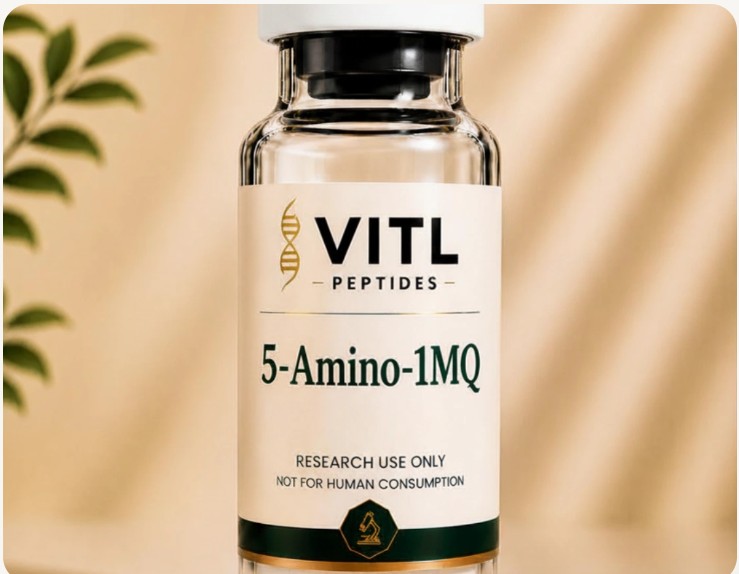
For example, VITL Peptides currently lists 5-Amino-1MQ in 5 mg, 10 mg, and 50 mg research-use-only vials.
These are explicitly labeled for research use only and not for human or veterinary consumption.
Capsules
Some companies market oral capsules purportedly containing 5-Amino-1MQ.
These products are particularly common within longevity and weight-management communities.
However, the existence of commercially available capsules should not be confused with evidence of established oral bioavailability, clinical effectiveness, or validated human dosing.
There is currently no FDA-approved 5-Amino-1MQ capsule.
Experimental Solutions
Researchers may prepare solutions from laboratory-grade material for specific experimental applications.
The appropriate solvent, concentration, storage conditions, and administration method depend upon the experimental protocol.
The fact that a compound is packaged in a vial does not establish that it is sterile, injectable, pharmaceutical grade, or appropriate for human administration.
How Is 5-Amino-1MQ Different From GLP-1 Drugs?
5-Amino-1MQ and GLP-1-based compounds are sometimes discussed together because of their potential relationship with weight management, but their mechanisms are very different.
GLP-1 medications primarily influence:
appetite
satiety
gastric emptying
insulin secretion
and glucose regulation.
5-Amino-1MQ instead inhibits NNMT, potentially affecting cellular metabolism and energy expenditure.
Therefore, 5-Amino-1MQ should not simply be thought of as another GLP-1.
It represents an entirely different experimental approach to metabolic regulation.
Potential Side Effects and Safety Concerns
The lack of human clinical trials means the human safety profile of 5-Amino-1MQ remains largely unknown.
That is more important than any individual list of anecdotal side effects.
Researchers have not yet established:
long-term toxicity
reproductive effects
cardiovascular safety
liver safety
kidney safety
drug interactions
or long-term consequences of NNMT inhibition in humans.
There are also theoretical considerations.
NNMT participates in methyl-donor metabolism and NAD+ biology. Sustained interference with this enzyme could potentially produce biological effects extending beyond adipose tissue.
Whether those effects would ultimately be beneficial, harmful, or clinically insignificant remains unknown.
The safety of the compound itself is also separate from the safety of products sold through unregulated research markets, where identity, purity, concentration, and contamination can introduce additional concerns.
Is 5-Amino-1MQ FDA Approved?
No.
5-Amino-1MQ is not an FDA-approved medication for weight loss, obesity, metabolic disease, anti-aging, or any other medical condition.
There is currently no FDA-approved prescribing information, commercial dosage, treatment protocol, or pharmaceutical product containing 5-Amino-1MQ for routine human treatment.
Products sold through research suppliers should therefore not be confused with FDA-approved medications.
What Research Is Needed Next?
The next major step would be carefully controlled human clinical research.
Researchers would need to establish basic pharmacokinetic information before broad therapeutic claims could be justified.
Ideally, future studies would investigate:
human absorption and bioavailability
dose-response relationships
NNMT inhibition in human tissues
effects on body weight and fat mass
effects on insulin sensitivity
changes in NAD+ metabolism
liver and kidney safety
cardiovascular effects
drug interactions
and long-term consequences of NNMT inhibition.
Randomized, placebo-controlled clinical trials would then be necessary to determine whether the metabolic effects observed in animals translate into meaningful benefits for humans.
The Bottom Line
5-Amino-1MQ represents a fascinating but very early-stage approach to metabolic research.
Despite commonly being grouped with peptides, it is technically not a peptide. It is a small-molecule inhibitor of nicotinamide N-methyltransferase, or NNMT.
That mechanism makes it scientifically interesting.
NNMT sits at an intersection involving nicotinamide metabolism, NAD+ biology, methylation, adipose tissue, and cellular energy regulation.
In laboratory and animal experiments, inhibiting NNMT with compounds such as 5-Amino-1MQ has produced interesting metabolic effects.
The best-known animal research demonstrated reductions in body weight and adipose tissue in diet-induced obese mice, helping establish NNMT as a potential target for future metabolic therapies.
These findings have generated interest in 5-Amino-1MQ for research involving:
fat metabolism
body composition
obesity
metabolic health
cellular energy
NAD+ biology
and potentially healthy aging.
But there is an enormous difference between a promising metabolic mechanism and a proven treatment.
Unlike established GLP-1 medications and newer metabolic drugs undergoing extensive human trials, 5-Amino-1MQ currently lacks a meaningful human clinical evidence base.
There is no clinically validated human dose, no established long-term safety profile, and no FDA-approved 5-Amino-1MQ medication.
Published dosing information comes primarily from animal research and should not be converted directly into instructions for human use.
For researchers, however, 5-Amino-1MQ remains particularly interesting because it targets metabolism through a pathway that differs substantially from conventional appetite-based weight-loss therapies.
If future human studies demonstrate that selective NNMT inhibition can safely reproduce some of the metabolic effects observed in animal models, NNMT could potentially become an important target in future research involving obesity and metabolic disease.
For now, the most accurate description of 5-Amino-1MQ is a promising experimental NNMT inhibitor with intriguing preclinical findings involving fat and energy metabolism, but with major unanswered questions regarding human effectiveness, dosing, pharmacokinetics, and long-term safety.
That distinction is essential when evaluating both the excitement and the limitations surrounding this emerging research compound.
Educational and research notice: This article is intended for general scientific and educational information. It is not medical advice or a recommendation for human use of 5-Amino-1MQ. Doses discussed are descriptions of experimental animal research and should not be interpreted as human dosing instructions. 5-Amino-1MQ has no established safe or effective human dosage and is not FDA-approved for treating obesity, weight loss, metabolic disease, or other medical conditions.