
DSIP: A Comprehensive Guide to Uses, Research, Dosing, Forms, and Potential Benefits
DSIP: A Comprehensive Guide to Uses, Research, Dosing, Forms, and Potential Benefits
DSIP, short for Delta Sleep-Inducing Peptide, is an experimental peptide that has been studied primarily for its possible effects on sleep, circadian rhythms, stress responses, pain, neuroendocrine function, and withdrawal symptoms.
Unlike many recently popular research peptides, DSIP is not new. It was first isolated and characterized during the 1970s, and much of the human research involving the compound was performed during the 1980s and early 1990s.
Its name came from early experiments suggesting that the peptide could increase delta-wave or slow-wave sleep, the deep stage of sleep associated with physical restoration and recovery.
That history created an appealing idea: rather than producing sedation in the way conventional sleeping medications do, perhaps DSIP could encourage the brain to enter a more natural pattern of restorative sleep.
The science has turned out to be much more complicated.
Some early studies reported improvements in sleep latency, sleep efficiency, or overall sleep duration. Other controlled studies found only small effects or no clinically meaningful benefit. A later scientific review went so far as to describe DSIP as a “still unresolved riddle,” noting that its role as a genuine endogenous sleep factor remains poorly established.
Today, DSIP—also known internationally as emideltide—remains an experimental research peptide. It is not FDA-approved for insomnia, narcolepsy, sleep improvement, opioid withdrawal, or any other medical condition.
What Is DSIP?
DSIP is a short peptide consisting of nine amino acids, making it a nonapeptide.
Its amino-acid sequence is:
Trp-Ala-Gly-Gly-Asp-Ala-Ser-Gly-Glu
The peptide was originally isolated from the cerebral venous blood of rabbits during experiments involving electrically induced sleep.
Researchers found that the isolated substance could produce slow-wave EEG activity when administered experimentally and named it Delta Sleep-Inducing Peptide. The sequence was formally reported in 1978.
The FDA’s substance database lists DSIP under the official name emideltide and identifies it as a nine-amino-acid peptide with the same sequence.
Its molecular weight is approximately 848 daltons, making it considerably smaller than many therapeutic peptides.
Why Is It Called Delta Sleep-Inducing Peptide?
The term delta sleep refers to deep, slow-wave sleep.
During deep sleep, brain electrical activity becomes dominated by relatively slow, high-amplitude delta waves.
This phase of sleep is often associated with:
- Physical recovery
- Immune function
- Hormonal regulation
- Tissue repair
- Memory consolidation
- Reduced sympathetic nervous-system activity
Researchers originally believed DSIP might represent a naturally occurring substance that helped trigger or regulate this deep stage of sleep.
Early animal studies supported the idea to some degree.
However, the effect was not completely consistent across species.
A major review published in 1984 noted that DSIP appeared to increase delta sleep in rabbits, rats, mice, and some human experiments, whereas effects in cats were more strongly associated with REM sleep.
This species-dependent response was one of the first clues that DSIP’s biology was more complex than simply being a universal “sleep hormone.”
Is DSIP a Natural Human Peptide?
This remains surprisingly uncertain.
Early researchers detected DSIP-like immunoreactivity in human plasma, cerebrospinal fluid, urine, and other tissues.
That suggested the body might naturally produce DSIP or a closely related molecule.
However, scientists were never able to clearly identify a conventional gene encoding DSIP or a specific receptor uniquely responsible for DSIP signaling.
That created a major scientific puzzle.
A 2006 review noted that despite decades of research, the natural occurrence and physiological role of DSIP remained unclear. The authors suggested that some of the DSIP-like activity detected experimentally might actually come from one or more structurally related peptides rather than DSIP itself.
This uncertainty remains central to understanding the peptide.
How Does DSIP Work?
There is no single established mechanism of action.
Researchers have proposed that DSIP may influence several neurological and endocrine systems.
Experimental studies have investigated possible effects involving:
GABA signaling
serotonin
dopamine
norepinephrine
endogenous opioids
cortisol
circadian rhythms
and broader hypothalamic-pituitary signaling.
Older research also suggested that DSIP might modulate adrenergic neurotransmission and influence several neuropharmacological drugs.
Because the peptide does not appear to act like a conventional sedative, some investigators proposed that it may influence the body’s underlying mechanisms that regulate the transition into sleep.
That remains hypothetical.
No specific DSIP receptor has been conclusively identified, and its complete pharmacology remains poorly characterized.
DSIP and Sleep
Sleep is obviously the best-known research area surrounding DSIP.
Early human studies produced some encouraging findings.
One of the first controlled human experiments involved six healthy volunteers.
Participants received a slow intravenous infusion of DSIP at 25 nanomoles per kilogram of body weight.
Researchers reported that sleep during a short observation period increased substantially compared with placebo. They also observed shorter sleep onset and improved sleep efficiency during the following night.
Importantly, researchers did not observe the classic generalized sedation associated with conventional hypnotic drugs.
This helped support the theory that DSIP might somehow support natural sleep physiology rather than simply suppressing wakefulness.
DSIP and Insomnia
Following those initial experiments, researchers studied DSIP in people with chronic insomnia.
Some early studies reported encouraging changes.
A 1984 publication summarized experiments in which single injections of 25 nmol/kg before sleep appeared to improve certain sleep parameters.
Repeated administration was reported to produce progressive normalization of sleep structure in some individuals.
However, later and better-controlled studies produced less impressive results.
A double-blind study involving 16 chronic insomnia patients compared intravenous DSIP with placebo.
The DSIP group demonstrated somewhat higher sleep efficiency and shorter sleep latency.
However, researchers concluded that these effects were weak, and some of the statistical differences could have resulted from changes in the placebo group rather than a strong treatment effect.
Subjective sleep quality did not significantly improve.
The investigators ultimately concluded that short-term DSIP treatment was unlikely to provide major therapeutic benefit for chronic insomnia.
Another controlled study similarly concluded that although some sleep parameters improved, the overall benefit was of little clinical significance.
Does DSIP Increase Deep Sleep?
This is one of the most common claims surrounding the peptide.
The answer is less clear than its name suggests.
Some early animal experiments demonstrated increases in slow-wave sleep.
However, human clinical studies have not consistently shown dramatic increases in deep delta sleep.
For example, one controlled insomnia study found increases in total sleep and stage 2 sleep but did not demonstrate meaningful increases in stages 3 and 4 slow-wave sleep.
This is why referring to DSIP as a guaranteed deep-sleep enhancer overstates the available evidence.
The compound may influence sleep architecture, but its effects appear variable and are not well characterized.
DSIP and Circadian Rhythms
Researchers have also investigated DSIP’s influence on circadian rhythms.
Circadian rhythms regulate approximately 24-hour patterns involving:
sleep and wakefulness
body temperature
hormone production
metabolism
physical activity
and alertness.
Older research suggested that DSIP’s effects could vary depending upon the time of day it was administered.
Reviews also reported changes in circadian patterns involving locomotor activity, neurotransmitter concentrations, plasma proteins, and cortisol.
This suggests that DSIP may interact with broader biological timing systems rather than functioning exclusively as a sleep-inducing compound.
However, modern circadian research has not established DSIP as an important clinical regulator of the human body clock.
DSIP and Stress
Another area of experimental interest involves stress physiology.
Researchers have reported changes in DSIP-related activity during stressful conditions and have investigated whether the peptide can modify physiological responses to stress.
Animal research has examined DSIP under conditions involving:
hypoxia
physical stress
neurochemical stress
and changes in cortisol and catecholamines.
Some studies have suggested possible stress-protective activity.
For example, experimental research has investigated DSIP’s effects on mitochondrial function and brain metabolism during hypoxic stress. These studies helped broaden the scientific interest in DSIP beyond sleep alone.
However, there is no established clinical evidence supporting DSIP as a treatment for anxiety, chronic stress, PTSD, or other stress-related disorders.
DSIP and Pain
Older DSIP research also investigated pain perception.
Several reviews reported changes in pain thresholds following experimental administration.
This raised questions about whether DSIP might interact with endogenous opioid systems or other neurological pathways involved in pain modulation.
The idea remains scientifically interesting because sleep, stress, pain, and endogenous opioid signaling are closely interconnected.
Poor sleep can amplify pain sensitivity, while chronic pain can disrupt sleep.
However, DSIP has never been established as an analgesic medication, and there is insufficient evidence to recommend it for chronic pain.
DSIP and Opioid Withdrawal
One of the more unusual historical areas of DSIP research involved withdrawal from opioids and alcohol.
Researchers hypothesized that because DSIP appeared to influence sleep, stress, and neurochemical signaling, it might potentially reduce symptoms associated with withdrawal.
Small clinical studies and open-label reports investigated DSIP for:
opioid detoxification
alcohol withdrawal
and related withdrawal syndromes.
A 1998 open clinical trial evaluated DSIP during opioid detoxification, while earlier European research examined its use in alcohol and opioid withdrawal.
These findings were never followed by the large modern clinical trials necessary to establish effectiveness.
This remains an experimental historical use rather than a validated addiction treatment.
DSIP and Narcolepsy
Narcolepsy represents another historical area of research.
Interestingly, DSIP has been studied not only for insomnia but also for disorders involving excessive sleepiness.
Some older publications described individual narcolepsy cases or small experimental observations.
This apparently contradictory interest reinforces the idea that DSIP may influence sleep regulation rather than simply making someone sleepy.
However, modern narcolepsy treatment does not include DSIP.
There is insufficient evidence to establish its effectiveness or safety for this condition.
DSIP and Hormones
Research has suggested that DSIP may influence multiple endocrine systems.
Reported experimental effects have included changes involving:
cortisol
growth hormone
luteinizing hormone
and other neuroendocrine signals.
Because sleep itself strongly affects hormone release, distinguishing direct hormonal effects of DSIP from secondary effects caused by changes in sleep can be difficult.
Researchers have also reported time-of-day-dependent effects, suggesting that DSIP’s endocrine actions may interact with circadian regulation.
These findings remain largely exploratory.
DSIP and Growth Hormone
DSIP is occasionally marketed online as though it were a growth hormone-releasing peptide.
That description is misleading.
DSIP is not comparable to CJC-1295, ipamorelin, GHRP-2, or other established growth hormone secretagogues.
Although older research has investigated possible effects on growth hormone secretion, stimulating GH is not its well-established primary mechanism.
There is no strong evidence that DSIP produces clinically meaningful increases in growth hormone, muscle mass, or athletic performance.
DSIP and Athletic Recovery
Sleep is critically important for recovery.
This has led to interest in DSIP among athletes, bodybuilders, and people seeking improved exercise recovery.
Potentially desirable outcomes discussed online include:
deeper sleep
improved overnight recovery
reduced fatigue
better workout recovery
and improved physical performance.
These claims are largely indirect.
If a compound substantially improved sleep, better recovery might logically follow.
However, there are no high-quality clinical trials demonstrating that DSIP increases muscle recovery, strength, endurance, or athletic performance.
It should therefore not be described as a proven sports-performance peptide.
DSIP Dosing in Human Research
There is no FDA-approved human dosage for DSIP.
Published dosing information should therefore be understood only as descriptions of historical experimental protocols.
One of the most frequently studied human doses was:
25 nanomoles per kilogram of body weight
administered intravenously.
This dose appeared in several early insomnia and sleep studies.
Because DSIP has a molecular weight of approximately 848 daltons, 25 nmol/kg corresponds to roughly 21 micrograms per kilogram.
For a 70-kilogram research participant, that would correspond to approximately 1.5 milligrams total.
That calculation explains historical research exposure—it is not a recommended human dosage.
The studies also generally used controlled intravenous administration under research conditions.
Online protocols involving subcutaneous microgram dosing are largely extrapolated from research-market practices rather than validated clinical studies.
Why Dose-Response May Be Complicated
One unusual finding in DSIP research is a possible U-shaped or bell-shaped dose-response relationship.
This means that increasing the dose may not necessarily increase the biological effect.
Some early research found an optimal response within a limited dose range, with smaller or larger amounts potentially producing less effect.
This phenomenon occurs with some neuroactive peptides because receptor systems and feedback mechanisms can behave differently at different concentrations.
It also means that simplistic claims that a larger amount of DSIP must produce deeper sleep are not supported scientifically.
How Is DSIP Administered in Research?
Historical human research most frequently used:
Intravenous Administration
Several early human sleep studies administered DSIP through slow intravenous infusion or injection.
This provided precise control over the amount entering circulation.
Subcutaneous Research Administration
Subcutaneous administration has appeared in animal studies and is commonly discussed within modern peptide research communities.
However, it has not been validated through large controlled human trials for insomnia.
Other Experimental Routes
Animal research has explored several routes of administration.
No route has resulted in an FDA-approved DSIP pharmaceutical product.
What Forms Is DSIP Offered In?
Modern DSIP is primarily encountered in the research-material market.
Lyophilized Powder
The most common format is lyophilized, or freeze-dried, DSIP powder.
Removing water can improve peptide stability during shipping and storage.
Research Vials
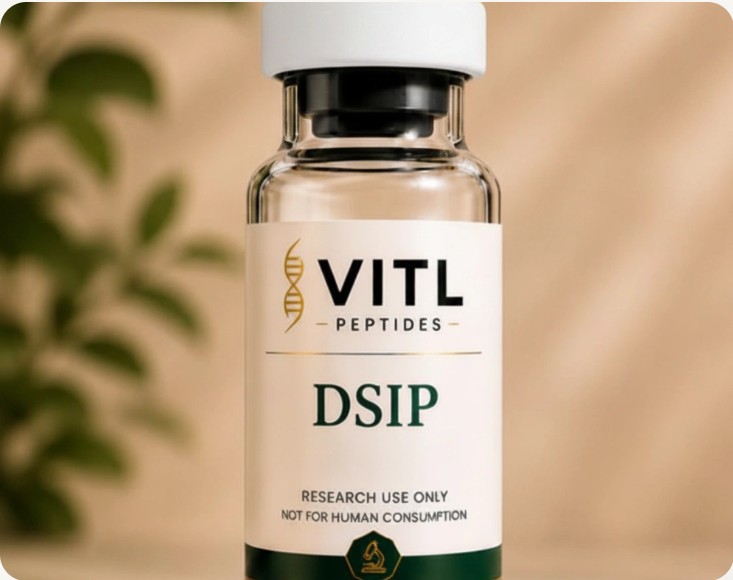
DSIP is frequently packaged into research vials containing specified milligram quantities.
These are generally marketed for laboratory investigation.
Emideltide
The internationally recognized pharmaceutical name for DSIP is emideltide.
FDA identifies emideltide and DSIP as the same active peptide.
Emideltide Acetate
The acetate salt has also been considered in the pharmacy-compounding context.
FDA reviewed both emideltide free base and emideltide acetate in 2026.
Potential Side Effects
One of the biggest problems with discussing DSIP safety is that much of the human research is old and involved relatively small numbers of participants.
Early studies frequently described the compound as well tolerated.
For example, the first six-person controlled human experiment reported no significant psychological, physiological, or biochemical adverse effects.
That does not establish long-term safety.
Modern FDA reviewers have specifically raised concerns about compounded emideltide products.
FDA notes potential concerns involving:
immunogenicity
peptide aggregation
peptide-related impurities
and difficulties with active pharmaceutical ingredient characterization.
More importantly, FDA states that it has not identified adequate safety information for the proposed routes of administration and therefore lacks enough evidence to determine whether compounded emideltide could harm humans.
This is a much more cautious assessment than statements sometimes made online that DSIP has “no side effects.”
Is DSIP FDA Approved?
No.
DSIP, or emideltide, is not FDA-approved for insomnia, sleep enhancement, narcolepsy, opioid withdrawal, anxiety, pain, anti-aging, athletic recovery, or any other medical indication.
Its U.S. regulatory status became particularly noteworthy in July 2026.
FDA’s Pharmacy Compounding Advisory Committee reviewed emideltide free base and emideltide acetate for possible inclusion on the Section 503A Bulks List.
FDA evaluated proposed uses including:
chronic insomnia
narcolepsy
and opioid withdrawal.
FDA staff recommended against adding the substances to the list.
On July 24, 2026, the advisory committee narrowly voted 6 in favor, 7 against, with 1 abstention, meaning the panel recommended that emideltide not be added to the compounding list.
That advisory recommendation is not the same as an FDA drug approval or a general prohibition, but it demonstrates the agency’s continuing concerns regarding evidence and safety.
What Does Current Research Say?
Perhaps the most striking feature of DSIP research in 2026 is how little modern clinical research exists.
The most frequently cited human sleep studies are now several decades old.
Researchers learned enough to establish that DSIP can produce biological effects in humans, but they did not establish it as an effective treatment for insomnia.
The 1992 double-blind insomnia study probably summarizes the clinical situation particularly well.
DSIP produced a few objectively measurable improvements, but the researchers concluded that the effects were weak and unlikely to provide major therapeutic benefit.
Meanwhile, fundamental questions remain unresolved:
Where is endogenous DSIP produced?
Is naturally occurring DSIP actually identical to the synthetic peptide?
What receptor does it activate?
What is its primary physiological function?
Does it meaningfully increase deep sleep?
What is its optimal human dose?
What is its long-term safety profile?
Those are surprisingly basic unanswered questions for a peptide studied for nearly half a century.
What Research Is Needed Next?
Modern DSIP research would benefit enormously from contemporary clinical methods.
Researchers could conduct randomized, double-blind, placebo-controlled trials using modern polysomnography and wearable sleep monitoring.
Useful endpoints could include:
sleep latency
total sleep time
sleep efficiency
slow-wave sleep duration
REM sleep
nighttime awakenings
next-day alertness
and subjective sleep quality.
Pharmacokinetic studies would also be valuable.
Researchers need better information regarding:
absorption
half-life
distribution
metabolism
blood-brain barrier penetration
and dose-response relationships in humans.
Most importantly, researchers still need to identify the receptor or molecular target responsible for DSIP’s biological activity.
The Bottom Line
DSIP is one of the more unusual peptides in sleep research.
Also known as emideltide, it is a nine-amino-acid peptide with the sequence:
Trp-Ala-Gly-Gly-Asp-Ala-Ser-Gly-Glu.
It was originally discovered during experiments involving slow-wave sleep and subsequently became known as Delta Sleep-Inducing Peptide.
Early research generated excitement because DSIP appeared to influence sleep without producing conventional pharmaceutical sedation.
Human studies demonstrated effects involving sleep latency, sleep efficiency, total sleep duration, and certain aspects of sleep architecture.
However, those results were inconsistent.
Later controlled studies found only modest changes, and some researchers concluded that the clinical benefit for chronic insomnia was minimal.
The peptide has also been investigated in connection with:
circadian rhythms
stress physiology
pain
opioid and alcohol withdrawal
narcolepsy
hormonal regulation
and neuroendocrine signaling.
But none of these uses has become an established medical indication.
Even DSIP’s natural physiological role remains uncertain.
A major scientific review described the connection between DSIP and sleep as poorly characterized and noted that the absence of an identified DSIP gene, precursor protein, or specific receptor leaves fundamental questions unresolved.
There is also no FDA-approved DSIP dosage or pharmaceutical product.
Historical human sleep studies frequently used approximately 25 nmol/kg intravenously, but that represents an experimental research protocol rather than a personal dosing recommendation.
Modern research suppliers commonly offer DSIP as lyophilized material, but laboratory availability does not establish safety, effectiveness, sterility, or suitability for human administration.
FDA’s current position is also cautious.
The agency identifies emideltide among bulk substances that may present safety concerns in compounding because of potential immunogenicity, peptide impurities, and inadequate human safety information.
In July 2026, FDA’s advisory committee narrowly voted against recommending emideltide for inclusion on the 503A pharmacy-compounding list after reviewing its proposed use for chronic insomnia, narcolepsy, and opioid withdrawal.
Perhaps the most accurate way to describe DSIP today is as a historically important experimental neuropeptide with intriguing but inconsistent human sleep findings, broad preclinical effects on neurological and endocrine systems, and major unanswered questions regarding its mechanism, effectiveness, optimal dosing, and long-term safety.
The name “Delta Sleep-Inducing Peptide” makes DSIP sound like a straightforward sleep compound.
The science suggests something far more complicated.
For researchers, that uncertainty is precisely what continues to make DSIP interesting.
For consumers, however, it is important to distinguish between a peptide that has biological effects related to sleep and one that has been clinically proven to safely and reliably treat insomnia or enhance deep sleep.
Those are not currently the same thing.
Educational and research notice: This article is intended for general scientific and educational information. It is not medical advice or a recommendation for human use of DSIP/emideltide. Doses mentioned are descriptions of historical research protocols and should not be interpreted as personal dosing instructions. DSIP is not FDA-approved for insomnia, narcolepsy, opioid withdrawal, sleep enhancement, athletic recovery, anti-aging, or any other medical condition.