

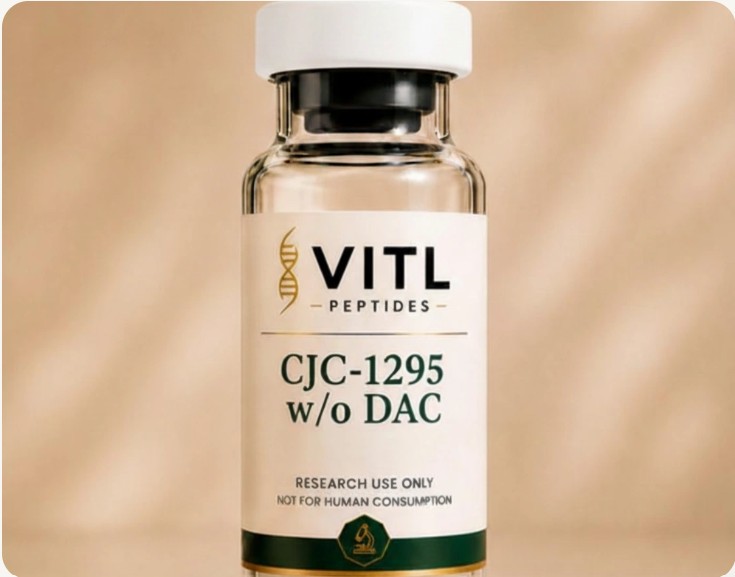
CJC-1295 Without DAC: A Comprehensive Guide to Uses, Research, Dosing, Forms, and Potential Benefits
CJC-1295 without DAC is a synthetic peptide commonly discussed in connection with growth hormone release, recovery, sleep, body composition, muscle preservation, fat metabolism, and healthy-aging research.
It belongs to a class of compounds known as growth hormone-releasing hormone analogues, or GHRH analogues. Rather than supplying growth hormone directly, these compounds are designed to stimulate the pituitary gland to release more of the body’s own growth hormone.
The “without DAC” part of the name is especially important.
CJC-1295 exists in two very different forms:
CJC-1295 with DAC, which is long acting and can remain biologically active for several days,
and
CJC-1295 without DAC, more accurately known as Modified GRF(1-29) or Mod GRF 1-29, which is short acting and is intended to produce a brief pulse of growth hormone.
These two forms are frequently confused online, even though their pharmacokinetic profiles are dramatically different.
Another important point is that almost all published human clinical data involving “CJC-1295” actually concerns the DAC-containing form, not the no-DAC version. A 2026 review of growth-hormone-axis peptides concluded that CJC-1295 without DAC remains essentially uncharacterized in peer-reviewed human clinical research, with no controlled human trials directly establishing its effects on body composition or performance.
CJC-1295 without DAC is also not FDA approved for any medical condition.
With those distinctions in mind, here is what researchers currently understand about the compound.
What Is CJC-1295 Without DAC?
CJC-1295 without DAC is a synthetic analogue of the naturally occurring hormone growth hormone-releasing hormone, or GHRH.
Natural human GHRH is a 44-amino-acid peptide produced primarily in the hypothalamus.
Its job is to signal the anterior pituitary gland to release growth hormone, or GH.
Researchers discovered that much of GHRH’s biological activity resides within its first 29 amino acids.
This shorter sequence is known as GHRH(1-29) or GRF(1-29).
CJC-1295 without DAC is based on this 29-amino-acid fragment but incorporates four amino-acid substitutions designed to make the molecule more resistant to enzymatic degradation.
For that reason, its more technically accurate name is:
Modified GRF(1-29)
or
Mod GRF 1-29.
It differs from native GHRH(1-29), sometimes associated with sermorelin, because the modified sequence is more resistant to breakdown by enzymes such as DPP-IV.
What Does “Without DAC” Mean?
DAC stands for Drug Affinity Complex.
The DAC modification was developed to allow CJC-1295 to bind strongly to serum albumin in the bloodstream.
Albumin circulates for a long time, so attaching the peptide to albumin dramatically extends its half-life.
The DAC-containing version of CJC-1295 has an estimated half-life measured in days.
In the well-known 2006 human study, CJC-1295 with DAC had an estimated half-life of approximately 5.8 to 8.1 days and increased growth hormone and IGF-1 levels for extended periods.
CJC-1295 without DAC lacks this albumin-binding component.
Consequently, it is cleared much more rapidly.
Research-oriented references generally estimate the half-life of Modified GRF(1-29) at approximately 30 minutes, although direct human pharmacokinetic characterization of this exact no-DAC form is sparse.
That difference changes the entire way the compound behaves.
Short Acting Versus Long Acting
The easiest way to understand the difference is to think about growth hormone pulses.
The body does not normally release growth hormone at one constant level.
Instead, GH is released in bursts throughout the day, with some of the largest pulses occurring during sleep.
CJC-1295 without DAC is intended to create a relatively short-lived GH-releasing signal.
CJC-1295 with DAC produces a much more sustained elevation in GH and IGF-1.
Supporters of the no-DAC approach often argue that the shorter exposure more closely resembles the body’s natural pulsatile pattern.
However, this theoretical physiological advantage has not been demonstrated through large human clinical trials specifically comparing the two formulations.
How Does CJC-1295 Without DAC Work?
CJC-1295 without DAC acts as an agonist at the GHRH receptor.
These receptors are found on specialized cells of the anterior pituitary called somatotrophs.
When GHRH receptors are activated, they stimulate intracellular signaling involving:
Gs proteins
adenylyl cyclase
and cyclic AMP, or cAMP.
This ultimately promotes the synthesis and secretion of growth hormone.
Growth hormone then circulates throughout the body and also stimulates production of another hormone called insulin-like growth factor 1, or IGF-1, primarily in the liver.
The overall pathway can be simplified as:
Hypothalamus → GHRH → Pituitary → Growth Hormone → IGF-1
CJC-1295 without DAC attempts to amplify the GHRH portion of this pathway.
Why Are Researchers Interested in Growth Hormone?
Growth hormone influences numerous tissues and metabolic processes.
It participates in:
- Protein synthesis
- Fat metabolism
- Bone remodeling
- Connective-tissue biology
- Muscle maintenance
- Glucose regulation
- Recovery
- Cellular growth
- IGF-1 signaling
Growth hormone secretion naturally declines with age.
This has contributed to substantial interest in compounds that may stimulate endogenous GH release rather than administering recombinant human growth hormone directly.
However, increasing GH or IGF-1 is not automatically beneficial.
Excessive growth hormone signaling can also produce significant metabolic and cardiovascular effects.
For this reason, maintaining appropriate regulation of the GH-IGF-1 axis is important.
What Do People Research CJC-1295 Without DAC For?
Because the no-DAC form has not been validated through controlled human clinical trials, these should be understood primarily as areas of interest and extrapolated uses, not established medical benefits.
Growth Hormone Release
This is the peptide’s primary purpose.
By activating pituitary GHRH receptors, Modified GRF(1-29) is expected to promote a brief increase in endogenous growth hormone secretion.
The biological principle itself is well established for GHRH agonists.
What remains poorly characterized is exactly how much GH the no-DAC form produces in humans at different doses and how consistently that translates into clinical benefits.
Recovery
Growth hormone participates in tissue repair and protein synthesis, so CJC-1295 without DAC is frequently discussed in connection with exercise recovery.
People interested in the peptide often associate it with:
faster recovery after training
connective-tissue support
muscle recovery
and reduced recovery time between workouts.
However, direct evidence demonstrating these outcomes in humans receiving CJC-1295 without DAC is lacking.
Body Composition
Another commonly discussed area is body composition.
Growth hormone can influence both fat metabolism and lean tissue.
For this reason, GHRH analogues are sometimes researched in relation to:
fat reduction
muscle preservation
lean body mass
and overall body composition.
A 2026 scientific review specifically cautioned that claims of improved body composition with no-DAC CJC-1295 are largely extrapolated from related compounds rather than direct clinical evidence.
Sleep
Growth hormone secretion is strongly linked to sleep.
One of the largest natural GH pulses typically occurs during deep sleep.
This relationship has contributed to interest in GHRH analogues and sleep quality.
People commonly discuss CJC-1295 without DAC in connection with:
deeper sleep
sleep quality
overnight recovery
and morning restoration.
However, these claims have not been established through large controlled studies specifically involving Mod GRF(1-29).
Healthy Aging
Because growth hormone secretion decreases with age, GHRH analogues have also become popular within longevity and healthy-aging research.
Supporters often discuss potential effects on:
energy
recovery
muscle maintenance
skin quality
body composition
and sleep.
These claims should be interpreted cautiously.
Aging involves far more than declining growth hormone, and there is no evidence that CJC-1295 without DAC extends lifespan or reverses human aging.
CJC-1295 Without DAC and IGF-1
Growth hormone stimulates production of IGF-1, particularly in the liver.
IGF-1 contributes to many of growth hormone’s downstream effects, including:
cellular growth
protein synthesis
bone metabolism
and tissue repair.
The best human CJC-1295 data involve the DAC form.
In the 2006 randomized study of healthy adults, a single injection of CJC-1295 with DAC increased mean growth hormone concentrations approximately 2- to 10-fold for six days or longer, while IGF-1 concentrations increased approximately 1.5- to 3-fold for nine to eleven days.
Those results cannot simply be applied to CJC-1295 without DAC.
The no-DAC molecule does not remain in circulation for days and therefore would be expected to produce a much shorter stimulus.
This distinction is one of the most important points when discussing CJC-1295 research.
Why Is CJC-1295 Without DAC Often Combined With Ipamorelin?
CJC-1295 without DAC is frequently discussed alongside ipamorelin, another peptide that influences growth hormone secretion.
The two compounds activate different signaling systems.
CJC-1295 without DAC stimulates the:
GHRH receptor pathway.
Ipamorelin acts primarily through the:
ghrelin/growth hormone secretagogue receptor pathway.
Because these pathways can complement one another, researchers have investigated the concept of stimulating both at the same time.
In theory, activating the GHRH pathway while simultaneously activating the ghrelin receptor may produce a larger GH pulse than either signal alone.
This concept is based on established physiology involving GHRH and growth-hormone secretagogues.
However, there is an important limitation:
there are no strong published controlled human trials demonstrating the safety or clinical effectiveness of the specific CJC-1295-without-DAC plus ipamorelin combination.
The popularity of the combination has therefore moved much faster than the clinical evidence.
CJC-1295 Without DAC Versus Sermorelin
Sermorelin and CJC-1295 without DAC are closely related.
Both are based on the active first 29 amino acids of GHRH.
Sermorelin is essentially GHRH(1-29).
CJC-1295 without DAC is Modified GHRH(1-29) with four substitutions intended to improve resistance to enzymatic degradation.
The practical concept is similar:
both stimulate the pituitary through the GHRH receptor.
The modified version is expected to persist longer than native GHRH(1-29), but still much less time than the DAC-containing form.
CJC-1295 Without DAC Versus CJC-1295 With DAC
This distinction deserves emphasis because product descriptions frequently blur the two.
CJC-1295 With DAC
- Long acting
- Binds serum albumin
- Half-life measured in several days
- Produces prolonged GH and IGF-1 elevations
- Has published human pharmacokinetic research
CJC-1295 Without DAC
- Also called Modified GRF(1-29)
- Does not contain the albumin-binding DAC modification
- Short acting
- Estimated half-life around 30 minutes
- Intended to produce more discrete GH pulses
- Has essentially no dedicated controlled human clinical evidence
The two compounds should therefore not be treated as interchangeable.
Human Research
This is where a major misconception surrounding CJC-1295 appears.
A person searching online can easily find references to “human CJC-1295 studies.”
Those studies do exist—but they predominantly involve CJC-1295 with DAC.
The landmark published study enrolled healthy adults and demonstrated prolonged increases in GH and IGF-1 following the long-acting DAC formulation.
A comprehensive 2026 review concluded that CJC-1295 without DAC has no controlled clinical studies directly evaluating the compound in humans. The authors classified it among compounds with essentially preclinical or extrapolated evidence.
This means claims involving:
muscle gain
fat loss
recovery
sleep improvement
anti-aging
or athletic performance
cannot currently be considered clinically established for CJC-1295 without DAC.
Dosing Information
There is no FDA-approved human dosage for CJC-1295 without DAC.
There is also no validated dosing schedule established through controlled clinical trials specifically involving this molecule.
Amounts commonly discussed online are generally based on:
extrapolation from other GHRH analogues
clinic protocols
research-supplier information
or anecdotal use.
These should not be confused with evidence-based dosing.
The human dosing data sometimes attributed to CJC-1295 generally comes from the DAC-containing version.
In the published CJC-1295 DAC study, investigators used subcutaneous doses expressed in micrograms per kilogram and reported that doses such as 30 or 60 micrograms/kg were generally well tolerated in that particular controlled study.
Those doses are not applicable instructions for the short-acting no-DAC version.
Because the pharmacokinetics are dramatically different, directly transferring a dose from one formulation to the other would be scientifically inappropriate.
How Often Is It Studied?
The short duration of CJC-1295 without DAC is the reason research protocols often discuss more frequent exposure than with the DAC form.
The theoretical aim is to create brief GH-release pulses rather than sustained elevation.
However, because controlled human pharmacokinetic and dose-ranging studies have not established an optimal schedule, there is no scientifically validated frequency for personal use.
Timing strategies found online—such as administering the compound around bedtime, fasting periods, or exercise—should be understood as speculative protocols rather than approved treatment recommendations.
What Forms Is CJC-1295 Without DAC Offered In?
CJC-1295 without DAC is primarily encountered through the laboratory research market.
Lyophilized Powder
The most common form is lyophilized, or freeze-dried, powder.
Peptides are often lyophilized because removing water can improve their stability during storage and transportation.
Research Vials
The powder is commonly packaged into small research vials containing specified milligram quantities.
These products are usually labeled:
research use only
and
not for human consumption.
A sealed vial should not automatically be assumed to be sterile, pharmaceutical grade, accurately dosed, or appropriate for injection.
Reconstituted Research Solutions
Laboratories may reconstitute lyophilized material using an appropriate solvent for specific experimental protocols.
The resulting stability depends on the formulation, concentration, temperature, storage conditions, and peptide quality.
There is no FDA-approved commercial CJC-1295-without-DAC injectable product.
Potential Side Effects and Safety Concerns
Because direct human research on the no-DAC version is minimal, its true safety profile is not established.
Potential effects associated with growth-hormone-axis stimulation could theoretically include:
- Headache
- Flushing
- Dizziness
- Water retention
- Tingling or numbness
- Joint discomfort
- Changes in blood glucose
- Increased appetite in some circumstances
- Injection-site reactions
- Changes in heart rate
However, these effects should not be interpreted as a complete or validated adverse-event profile for CJC-1295 without DAC.
The FDA has specifically raised concerns regarding CJC-1295 compounded products, including possible immunogenicity, peptide-related impurities, difficulties characterizing the active ingredient, and serious adverse events such as increased heart rate and systemic vasodilatory reactions. The agency also notes that available clinical data are limited.
Blood Sugar and Insulin Sensitivity
Growth hormone can influence glucose metabolism.
Higher GH exposure can decrease insulin sensitivity under some circumstances.
This does not mean CJC-1295 without DAC necessarily causes diabetes, but it illustrates why stimulating the GH-IGF-1 axis should not automatically be viewed as harmless.
People with impaired glucose regulation would be particularly important to study in future clinical trials.
Long-term human data evaluating glucose metabolism with the no-DAC form are currently lacking.
Growth Hormone and Cancer Concerns
IGF-1 participates in cellular growth and survival signaling.
For that reason, long-term manipulation of the GH-IGF-1 axis raises legitimate scientific questions about its effects in people with existing cancers or increased malignancy risk.
This does not establish that CJC-1295 causes cancer.
Rather, it reflects an important reason why therapies that substantially alter GH and IGF-1 should undergo careful long-term safety testing.
Such testing has not been completed for CJC-1295 without DAC.
Is CJC-1295 Without DAC FDA Approved?
No.
CJC-1295 without DAC is not FDA approved for muscle growth, fat loss, growth-hormone deficiency, anti-aging, recovery, sleep improvement, or any other medical indication.
It has no FDA-approved prescribing information or standardized human dosing regimen.
The FDA currently lists CJC-1295 among bulk substances for which compounded drug products may present significant safety risks, citing limited clinical information, immunogenicity concerns, peptide impurities, increased heart rate, and systemic vasodilatory reactions.
Competitive Sports
Athletes should also recognize that compounds that manipulate growth hormone signaling can create anti-doping concerns.
Growth hormone-releasing factors and related secretagogues are generally prohibited within competitive sports governed by World Anti-Doping Agency rules.
Athletes should therefore check current WADA regulations before exposure to any GHRH analogue or growth-hormone secretagogue.
What Research Is Needed Next?
CJC-1295 without DAC needs something surprisingly basic considering its popularity:
direct human clinical research.
Useful future studies would investigate:
human pharmacokinetics
actual plasma half-life
dose-response relationships
size and duration of GH pulses
effects on IGF-1
effects on body composition
effects on sleep
exercise recovery
glucose metabolism
cardiovascular effects
long-term safety
and potential interactions with other GH secretagogues such as ipamorelin.
Randomized, placebo-controlled trials would be especially important.
Until those studies exist, much of what is claimed about CJC-1295 without DAC remains an extrapolation from the physiology of GHRH, sermorelin, CJC-1295 with DAC, and other growth-hormone secretagogues.
The Bottom Line
CJC-1295 without DAC—more accurately called Modified GRF(1-29)—is a synthetic 29-amino-acid analogue of growth hormone-releasing hormone.
It contains several amino-acid substitutions intended to improve stability compared with native GHRH(1-29), while deliberately omitting the Drug Affinity Complex that gives conventional CJC-1295 its multi-day half-life.
As a result, the no-DAC form is relatively short acting, with research references generally estimating its half-life at roughly 30 minutes.
Its mechanism is straightforward in principle:
CJC-1295 without DAC stimulates GHRH receptors in the pituitary, which can promote the release of endogenous growth hormone.
That biological mechanism has created interest in research involving:
growth hormone release
recovery
muscle maintenance
fat metabolism
body composition
sleep
and healthy aging.
However, the evidence behind these proposed applications is considerably weaker than its popularity might suggest.
The strongest published human research involving CJC-1295 actually concerns the long-acting DAC-containing version. In that research, CJC-1295 substantially increased GH and IGF-1 for several days.
CJC-1295 without DAC is a different pharmacological entity.
A 2026 scientific review concluded that the no-DAC version currently has no controlled peer-reviewed human trials directly establishing its effectiveness for body composition or performance outcomes.
There is therefore:
no FDA-approved human dose,
no FDA-approved treatment indication,
no established long-term safety profile,
and no validated clinical protocol for combining it with ipamorelin or other secretagogues.
FDA has additionally identified safety concerns associated with CJC-1295 compounded products, including possible immunogenicity, peptide impurities, increased heart rate, and systemic vasodilatory reactions.
Perhaps the most accurate way to describe CJC-1295 without DAC in 2026 is as a short-acting experimental GHRH analogue with a biologically plausible mechanism for stimulating pulsatile growth-hormone release, but with remarkably little direct human clinical evidence supporting the broader recovery, body-composition, sleep, and anti-aging claims commonly associated with it.
For researchers studying the GH-IGF-1 axis, endogenous growth-hormone secretion, and the differences between short- and long-acting GHRH analogues, Modified GRF(1-29) remains a scientifically interesting peptide.
For consumers, however, distinguishing between established GHRH physiology and demonstrated clinical benefit from this particular peptide is essential.
Educational and research notice: This article is intended for general scientific and educational information only. It is not medical advice or a recommendation for human use of CJC-1295 without DAC. Doses mentioned describe research involving related compounds and should not be interpreted as personal dosing instructions. CJC-1295 without DAC is not FDA-approved for growth-hormone deficiency, muscle gain, fat loss, recovery, anti-aging, or any other medical condition.