

Understanding COAs: How to Read a Peptide Certificate of Analysis
When researching peptides, one abbreviation appears again and again: COA.
COA stands for Certificate of Analysis. It is one of the most important documents associated with laboratory chemicals, including research peptides. Yet it is also one of the most commonly misunderstood.
A COA may contain impressive-looking numbers, chromatograms, molecular weights and claims of 99% or greater purity. But what do those numbers actually mean? More importantly, how can researchers determine whether a COA provides meaningful evidence about a peptide sample?
Understanding how to read a peptide Certificate of Analysis is an essential part of understanding research peptide quality.
What Is a Certificate of Analysis?
A Certificate of Analysis is a document reporting the analytical results obtained from testing a particular material or batch.
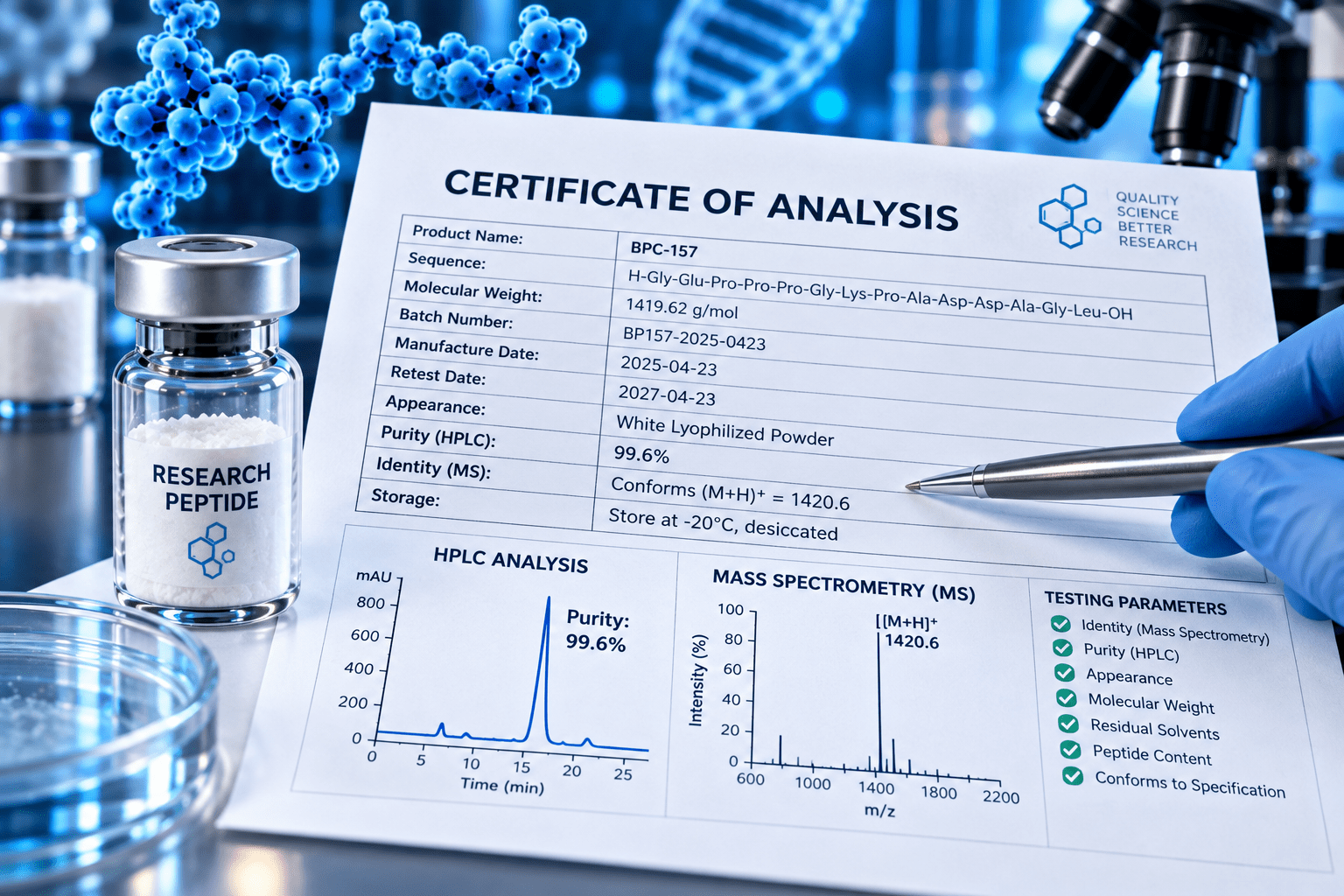
For a research peptide, the COA may contain information such as:
- Product or peptide name
- Batch or lot number
- Date of manufacture
- Date of testing
- Reported purity
- HPLC results
- Mass spectrometry results
- Molecular formula
- Expected molecular weight
- Observed molecular mass
- Appearance
- Quantity or content
- Storage recommendations
- Laboratory information
Not every COA contains all these elements.
The amount of information provided—and more importantly, the quality of the underlying testing—can vary dramatically.
A COA Is Only as Valuable as the Testing Behind It
One of the biggest mistakes people make is assuming that simply having a COA proves quality.
It does not.
A COA is a report of analytical results. Its value therefore depends on questions such as:
Who performed the analysis?
What sample was actually tested?
What analytical methods were used?
Can the report be traced to the particular batch being evaluated?
Was testing performed by the supplier itself or an independent laboratory?
Does the report provide enough raw analytical information to support its conclusions?
A professionally formatted PDF by itself answers none of those questions.
This is why evaluating a COA involves more than looking for a large purity percentage.
Start With the Batch or Lot Number
One of the first things to examine is the batch number or lot number.
Research materials are commonly manufactured in batches. Ideally, analytical results should correspond to the specific batch represented by the product.
Suppose a supplier sells a peptide identified as Batch PG0926.
The corresponding analytical report should clearly reference PG0926 or another traceable identifier tied to that batch.
A generic COA without meaningful batch identification provides much less information.
Batch-specific testing matters because manufacturing outcomes can vary from one production run to another.
A strong result from one batch does not automatically establish the characteristics of every future batch.
Understanding the Purity Percentage
The number that receives the most attention on peptide COAs is usually something like:
Purity: 99.4%
That sounds straightforward.
Unfortunately, it can easily be misunderstood.
If purity was determined using HPLC, the number generally represents the relative chromatographic purity observed under the conditions of that particular analysis.
In simplified terms, the instrument separates components in the sample. The resulting chromatogram contains peaks representing substances detected during the analysis.
The primary peptide ideally produces the dominant peak.
Smaller peaks may indicate other detectable components.
The relative areas of those peaks can then be used to estimate chromatographic purity.
But this does not necessarily mean that 99.4% of everything physically contained in the vial is the target peptide by mass.
That distinction is extremely important.
Water, salts, counterions and certain other materials may not be represented in the same way by a particular chromatographic purity measurement.
Therefore:
HPLC purity and total peptide content are not necessarily the same measurement.
Purity Is Not the Same as Identity
Another critical distinction is between purity and identity.
Imagine receiving an extremely pure sample of the wrong compound.
It might produce a beautiful chromatographic result.
That does not make it the peptide you intended to study.
Researchers therefore need analytical techniques capable of helping establish identity.
One of the most important is mass spectrometry.
If a peptide is expected to have a particular molecular mass, mass spectrometry can determine whether the sample produces ions consistent with that expected molecule.
This creates two complementary questions:
HPLC: How chromatographically pure does this sample appear?
Mass spectrometry: Is the detected compound consistent with the expected molecular mass?
Neither question should simply replace the other.
What Does the Chromatogram Show?
A useful peptide COA may include an HPLC chromatogram rather than only reporting a final percentage.
A chromatogram generally plots detector response against retention time.
You may see one very large peak and several smaller peaks.
The dominant peak is typically associated with the target peptide under the specified method.
Researchers can examine:
- Number of visible peaks
- Relative size of secondary peaks
- Retention time
- Integrated peak areas
- Reported purity calculation
- Testing method
The chromatogram gives readers more information than simply seeing “99.7%” printed on a page.
However, interpreting chromatograms properly requires knowledge of the analytical method and its limitations.
Why Peptide Impurities Matter
Synthetic peptide production is complicated.
Peptides consist of amino acids joined in a particular sequence. During synthesis, amino acids must be added correctly while chemical reactions are carefully controlled.
Things can go wrong.
FDA documents discussing synthetic peptides identify possible peptide-related impurities arising from incomplete coupling, truncations and side reactions. Process-related impurities can also include residual solvents, reagents, catalysts and other substances associated with manufacturing.
Some peptide impurities can be particularly challenging because they may be structurally very similar to the desired peptide.
For example, imagine a 30-amino-acid peptide in which one amino acid was omitted during synthesis.
The resulting impurity could resemble the target molecule closely while still being chemically different.
That is why advanced analytical techniques can become important.
What Does Mass Spectrometry Tell You?
Mass spectrometry measures ions according to their mass-to-charge ratio.
For peptide testing, the resulting spectrum can help determine whether the material contains a molecule consistent with the expected molecular mass.
A COA may list something like:
Calculated molecular mass: X
Observed molecular mass: approximately X
Agreement between expected and observed values supports the identity of the material.
More sophisticated mass spectrometric techniques can provide considerably more information, particularly when identifying related impurities.
FDA guidance concerning certain synthetic peptide products specifically discusses sensitive, high-resolution techniques such as UHPLC-HRMS for detecting and characterizing peptide-related impurities.
This illustrates an important principle:
A purity percentage alone does not describe everything scientists may want to know about a peptide sample.
What Does “Third-Party Tested” Mean?
Another term frequently encountered is third-party testing.
Generally, this means the analytical testing was performed by an organization separate from the company selling the material.
Independent testing can reduce an obvious conflict of interest, but “third-party tested” should not be treated as a magic phrase.
Researchers should still ask:
Who is the third party?
Can the laboratory be identified?
Is the report traceable?
What methods were performed?
Is the batch number shown?
When was testing performed?
Are actual analytical results included?
Independent testing is most meaningful when it is transparent and traceable.
Look at the Testing Date
Dates provide additional context.
A COA should ideally indicate when the analysis occurred.
If the same analytical report has appeared unchanged for years while numerous new batches have supposedly been manufactured, researchers may reasonably want additional information.
Testing dates also help establish the relationship between manufacturing, analysis and the material currently being offered.
Look for Laboratory Identification
A useful third-party analytical report should identify the laboratory responsible for testing.
Depending on the report, you might find:
- Laboratory name
- Address
- Report number
- Sample identification
- Testing date
- Analyst or authorization information
- Analytical methodology
Researchers should be able to determine who performed the analysis rather than relying entirely on the seller’s interpretation.
Does the COA Match the Product?
This sounds obvious, but it deserves attention.
Check:
Peptide name → batch number → analytical report → product batch
They should form a traceable chain.
A sophisticated analytical report for a peptide is not particularly helpful if there is no reasonable way to establish that the tested sample corresponds to the material being evaluated.
Why 99% Purity Doesn’t Tell the Whole Story
Consider two hypothetical peptide samples.
Sample A
HPLC purity: 99.5%
No mass spectrometry.
No identifiable laboratory.
No batch number.
No testing date.
Sample B
HPLC purity: 99.1%
Batch-specific report.
Identifiable independent laboratory.
Full chromatogram.
Mass spectrometry consistent with expected molecular mass.
Recent testing date.
Which provides researchers with more meaningful information?
The larger purity number isn’t automatically the better answer.
Analytical transparency matters.
What About Sterility and Endotoxins?
HPLC and mass spectrometry are chemical analytical tools. They do not automatically establish microbiological characteristics.
A chromatographically pure peptide is not automatically sterile.
Likewise, chemical purity does not by itself establish endotoxin levels.
Those require different testing methods.
This distinction is particularly important whenever someone attempts to infer properties from a COA that were never actually tested.
A good rule is simple:
A test demonstrates what it tests.
Do not assume it demonstrates unrelated characteristics.
Red Flags When Reviewing a Peptide COA
Researchers should be cautious when encountering:
- No batch number
- No identifiable laboratory
- No testing date
- Purity claims without analytical evidence
- COAs reused indefinitely
- Reports that do not identify the tested peptide
- Missing mass-spectrometry information when identity is being claimed
- Altered or suspicious-looking documents
- A seller’s own marketing graphic presented as laboratory evidence
None automatically proves that a material is unacceptable.
They simply mean the available documentation provides less confidence.
The Bigger Lesson
A Certificate of Analysis should not be viewed as a decorative document accompanying a research peptide.
It is supposed to communicate analytical information.
The most useful COAs help answer three fundamental questions:
What was tested?
How was it tested?
What did the analysis actually find?
The better researchers understand those questions, the less likely they are to be impressed by a purity percentage without understanding what that percentage represents.
In peptide research, the best evidence isn’t necessarily the document containing the biggest number.
It is the documentation that provides the clearest, most traceable and scientifically meaningful picture of the material being evaluated.