




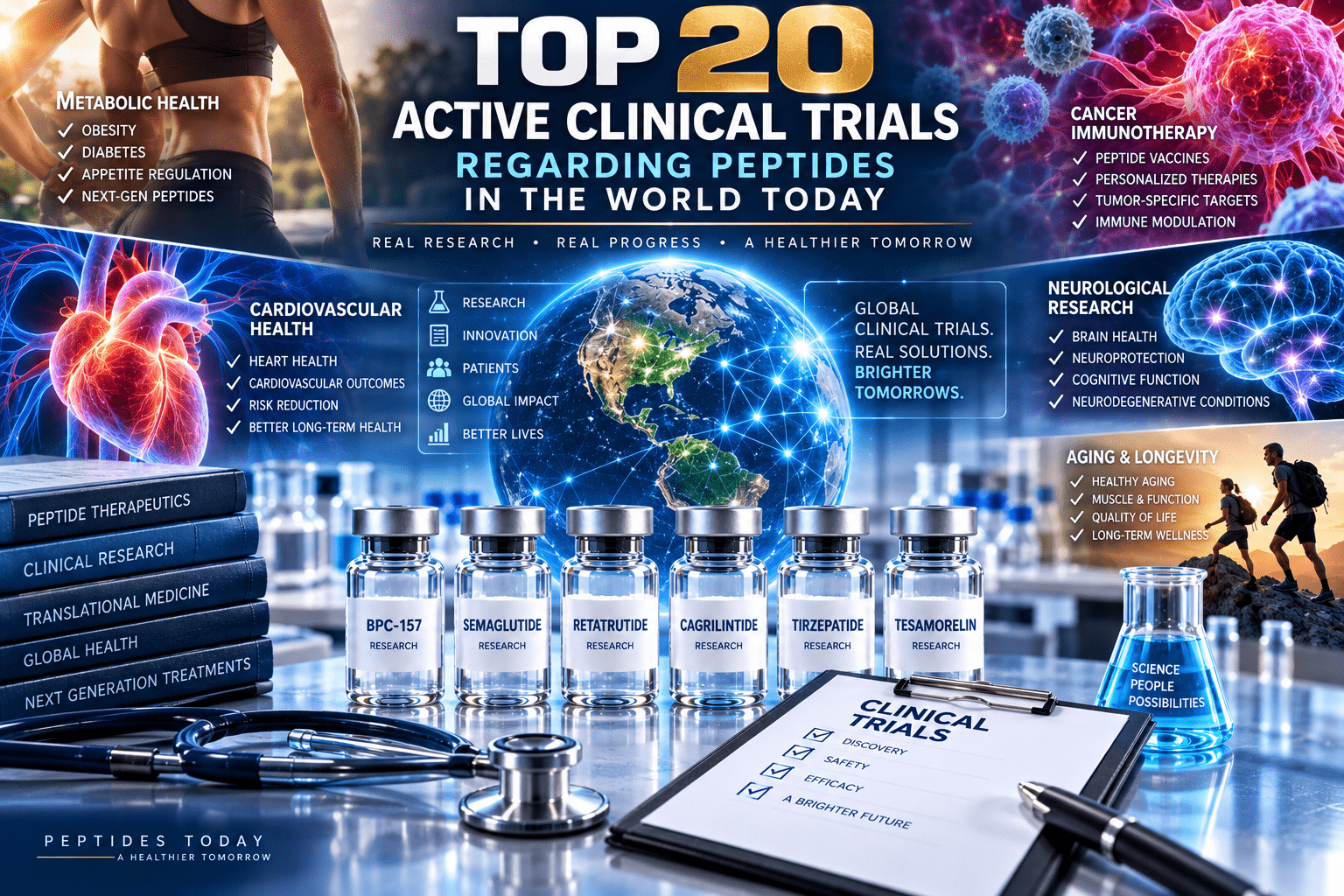
Top 20 Active Clinical Trials Regarding Peptides In The World Today
Peptide research is undergoing an extraordinary expansion.
What was once viewed primarily as a specialized corner of pharmaceutical research now includes enormous Phase 3 metabolic studies, personalized cancer vaccines, multi-receptor hormone agonists, immune-modulating peptides, cardiovascular outcome studies, and treatments designed around the unique genetic characteristics of an individual patient’s tumor.
One of the best resources for seeing this research in action is ClinicalTrials.gov, the clinical-study database maintained by the U.S. National Library of Medicine.
Thousands of studies involving peptide biology can be found in the database. The following 20 trials were selected because they represent particularly interesting examples of where peptide-related clinical research is heading.
This is not a ranking based on likelihood of success. Instead, these trials were selected for their scientific importance, scale, novelty, or potential implications for future medicine.
Trial status can change at any time, so readers should always consult the current ClinicalTrials.gov record for the latest information.
1. Retatrutide and Chronic Low Back Pain — TRIUMPH-7
ClinicalTrials.gov ID: NCT07035093
Retatrutide is one of the most closely watched investigational metabolic peptides in development.
Unlike traditional GLP-1 receptor agonists, retatrutide is designed to activate three receptors: GLP-1, GIP, and glucagon.
TRIUMPH-7 is particularly interesting because researchers are looking beyond weight loss.
This Phase 3 randomized, double-blind, placebo-controlled trial is evaluating whether retatrutide can improve chronic low back pain in people who have obesity or overweight. Participation lasts approximately 80 weeks.
The study illustrates an important shift in metabolic peptide research: investigators increasingly want to know whether significant changes in body weight and metabolism translate into improvements in obesity-associated medical conditions.
2. Enicepatide in Obesity Without Type 2 Diabetes
ClinicalTrials.gov ID: NCT07351045
Enicepatide, also known as RO7795068, is an investigational dual GLP-1/GIP receptor agonist.
This Phase 3 study is evaluating once-weekly enicepatide in people with obesity or overweight who do not have type 2 diabetes.
Approximately 2,000 participants are expected to participate.
Researchers are comparing multiple doses of enicepatide with placebo while evaluating weight management, safety, and related outcomes.
The scale of this study demonstrates just how competitive the next generation of incretin-based peptide development has become.
3. Enicepatide in Obesity and Type 2 Diabetes — Enith2
ClinicalTrials.gov ID: NCT07351058
A second major Phase 3 program is examining enicepatide specifically in participants who have obesity or overweight and type 2 diabetes.
The study began in March 2026 and has an estimated enrollment of approximately 1,600 participants.
Researchers are evaluating multiple doses against placebo, with both efficacy and safety being studied.
Together, these two large trials should help researchers understand whether this dual-receptor approach offers meaningful benefits across different metabolic populations.
4. Eloralintide — ENLIGHTEN-2
ClinicalTrials.gov ID: NCT07282600
Eloralintide, also known as LY3841136, represents another interesting direction in metabolic peptide research.
The Phase 3 ENLIGHTEN-2 study is evaluating once-weekly eloralintide in adults with obesity or overweight and type 2 diabetes.
Approximately 1,035 participants are expected to participate, with the study lasting roughly 75 weeks.
The primary objective is to determine the efficacy and safety of eloralintide compared with placebo for body-weight reduction.
Its development demonstrates that researchers are exploring hormonal pathways beyond simply producing additional GLP-1 analogues.
5. Macupatide Plus Eloralintide
ClinicalTrials.gov ID: NCT07215559
Combination peptide strategies may become increasingly important.
This Lilly-sponsored study investigates macupatide (LY3532226) and eloralintide (LY3841136) individually and in combination in adults with obesity or overweight and type 2 diabetes.
Combination research allows investigators to ask an important question:
Can two complementary biological mechanisms produce greater metabolic effects than either compound alone?
This type of research may ultimately lead to increasingly sophisticated multi-pathway treatments rather than therapies built around a single receptor.
6. Cagrilintide in People Unable to Tolerate GLP-1 Therapy
ClinicalTrials.gov ID: NCT07607587
One challenge associated with GLP-1 receptor agonist therapies is gastrointestinal tolerability.
Novo Nordisk is investigating whether cagrilintide may offer another approach for people who have experienced gastrointestinal adverse events with GLP-1 receptor agonists.
This Phase 1 study began in May 2026 and is expected to enroll approximately 114 participants.
Rather than simply asking whether a peptide produces weight loss, researchers are investigating who may tolerate one hormonal pathway better than another.
That could eventually become an important part of personalized metabolic medicine.
7. Cagrilintide and Appetite Research
ClinicalTrials.gov ID: NCT07557953
Another active cagrilintide study is examining something more fundamental: food intake and appetite.
Researchers are investigating how cagrilintide influences eating behavior in people with overweight or obesity.
Understanding appetite mechanisms is critical because body-weight regulation involves much more than calorie counting.
Signals traveling between the digestive system, pancreas, adipose tissue, and brain influence hunger, satiety, food preference, and energy balance.
Studies such as this can help researchers understand why certain metabolic peptides affect body weight rather than simply documenting the final number on a scale.
8. Maridebart Cafraglutide and Cardiovascular Outcomes — MARITIME-CV
ClinicalTrials.gov ID: NCT07037433
Modern obesity trials are increasingly interested in something much more important than weight reduction alone: whether treatment prevents serious disease.
MARITIME-CV is evaluating maridebart cafraglutide in people with overweight or obesity and established atherosclerotic cardiovascular disease.
Cardiovascular outcome trials are particularly important because heart attack, stroke, and cardiovascular death represent clinically meaningful endpoints.
A therapy capable of reducing body weight is useful.
A therapy that can demonstrate reductions in major cardiovascular complications could be substantially more important.
This is therefore one of the metabolic peptide-related programs worth watching closely.
9. Switching From GLP-1 Therapy to Maridebart Cafraglutide
ClinicalTrials.gov ID: NCT07575399
Another Phase 3 study, MARITIME-SWITCH, is investigating what happens when adults with obesity or overweight switch from existing GLP-1 receptor agonist therapy to maridebart cafraglutide.
Approximately 300 participants are expected to participate.
This is an interesting real-world clinical question.
As additional metabolic therapies become available, medicine will increasingly need evidence not only about starting treatment but also about transitioning patients from one therapy to another.
10. NNC0487-0111 and Obstructive Sleep Apnea — AMAZE 4
ClinicalTrials.gov ID: NCT07571109
The Phase 3 AMAZE 4 study is investigating NNC0487-0111 in people with overweight or obesity who also have obstructive sleep apnea treated with positive airway pressure.
Approximately 300 participants are expected.
Researchers are evaluating both weight reduction and improvement in sleep apnea.
This is another example of metabolic research expanding beyond the question of pounds lost.
Obesity can influence numerous organ systems, and researchers increasingly want to know whether treating metabolic dysfunction improves associated conditions.
11. KAI-9531 for Obesity, Overweight, and Diabetes
ClinicalTrials.gov ID: NCT07284901
KAI-9531 is another investigational once-weekly metabolic therapy currently being evaluated in participants living with obesity or overweight and diabetes.
The active study is examining both efficacy and safety.
Its presence alongside retatrutide, enicepatide, eloralintide, cagrilintide and other investigational compounds demonstrates how quickly metabolic peptide science is evolving.
Researchers are no longer investigating only one dominant hormonal pathway. Multiple receptor combinations and engineered molecules are now competing to determine which biological strategies offer the best balance of effectiveness, tolerability, durability, and safety.
12. MET097 — VESPER-4
ClinicalTrials.gov ID: NCT07311850
MET097 is being investigated as a once-weekly treatment for people with overweight or obesity.
The VESPER-4 study is sponsored by Pfizer and is actively recruiting.
Like several other major metabolic programs, researchers are examining whether newer engineered molecules can provide substantial and sustainable weight-management effects while maintaining acceptable tolerability.
The growing number of competing clinical programs is significant because future obesity treatment may ultimately include several different peptide-based options selected according to individual patient characteristics.
13. Personalized Peptide Vaccines for Solid Tumors
ClinicalTrials.gov ID: NCT07002203
Some of today’s most fascinating peptide research has nothing to do with obesity.
This recruiting trial investigates personalized neoantigen peptide vaccines for patients with solid tumors.
Researchers analyze mutations found within an individual’s cancer and create a vaccine containing peptide targets corresponding to those tumor-specific abnormalities.
The objective is to teach the immune system to recognize characteristics of that person’s cancer.
Instead of manufacturing precisely the same treatment for every patient, personalized cancer vaccines represent a future in which portions of the therapy itself may be designed around an individual’s tumor.
14. Personalized Cancer Vaccines and Molecular Residual Disease
ClinicalTrials.gov ID: NCT06529822
Washington University School of Medicine is sponsoring another recruiting personalized cancer-vaccine study.
This program focuses on patients with solid tumors and molecular residual disease.
Molecular residual disease can sometimes be detected using extremely sensitive molecular technologies even when conventional imaging does not reveal obvious cancer.
That creates an intriguing therapeutic opportunity.
If scientists can identify residual cancer at the molecular level, perhaps personalized immune therapies could be used when the tumor burden is extremely small.
The trial demonstrates how peptide vaccines, genomic sequencing, and precision oncology are beginning to converge.
15. Personalized Neoantigen Vaccine Plus Pembrolizumab — PNeoVCA
ClinicalTrials.gov ID: NCT05269381
Mayo Clinic is conducting a Phase 1/2 trial involving personalized neoantigen peptide-based vaccination for advanced solid tumors.
The experimental vaccine is being evaluated both alone and in combination with pembrolizumab, an immune-checkpoint inhibitor.
The vaccine is designed to expose the immune system to tumor-specific neoantigens, while checkpoint inhibition attempts to remove some of the biological brakes that can prevent immune cells from attacking cancer.
Combining these two approaches could potentially create a stronger anti-tumor immune response than either strategy alone.
16. Personalized Peptide Vaccines for Melanoma, Breast Cancer and Lung Cancer
ClinicalTrials.gov ID: NCT05098210
Fred Hutchinson Cancer Center is recruiting participants for another personalized neoantigen peptide-vaccine program.
This study includes patients with advanced melanoma, hormone-receptor-positive/HER2-negative metastatic refractory breast cancer, and advanced non-small-cell lung cancer.
The trial illustrates one of the central ideas behind personalized peptide immunotherapy:
The specific organ where a cancer originated may not be the only important consideration.
The molecular abnormalities within the tumor can potentially provide targets for individually designed immune therapies.
17. Peptide Vaccine to Prevent Resistance in ALK-Positive Lung Cancer
ClinicalTrials.gov ID: NCT05950139
Johns Hopkins researchers are investigating a particularly creative strategy in advanced ALK-positive non-small-cell lung cancer.
Instead of waiting for treatment resistance to develop, researchers are testing a peptide vaccine intended to potentially prevent or delay acquired resistance while patients receive ALK-targeted therapy.
The Phase 1/2 pilot study has an estimated enrollment of 12 participants and is expected to continue for several years.
The small size reflects its early-stage nature, but the concept is scientifically important: peptide vaccination might someday complement targeted therapy by helping the immune system recognize cancer before resistant disease becomes dominant.
18. IO102-IO103 Peptide Immunotherapy for Bladder Cancer
ClinicalTrials.gov ID: NCT05843448
The University of California, Davis is investigating IO102-IO103 in patients with certain forms of non-muscle-invasive bladder cancer.
IO102-IO103 is a peptide-based immune-modulatory therapeutic targeting IDO and PD-L1.
Researchers are combining it with pembrolizumab.
This Phase 1 study is primarily investigating safety and side effects, but the broader concept is fascinating.
Rather than using peptides simply as hormone mimics, scientists can engineer peptide-based approaches intended to influence specific components of the immune environment surrounding cancer.
19. SurVaxM Peptide Vaccine for Neuroendocrine Cancer
ClinicalTrials.gov ID: NCT06202066
SurVaxM is a peptide vaccine directed against survivin, a protein associated with cancer-cell survival.
A Phase 2 study is investigating SurVaxM together with temozolomide in patients with progressing metastatic neuroendocrine carcinomas.
The study has an estimated enrollment of approximately 60 participants.
Researchers are investigating whether stimulating an immune response against survivin can contribute to controlling cancers that express this target.
SurVaxM is particularly interesting because survivin is associated with multiple tumor types, potentially making peptide-based survivin targeting relevant beyond a single form of cancer.
20. PeptiCRAd-1 Plus Checkpoint Inhibitors — START
ClinicalTrials.gov ID: NCT05492682
The START trial represents one of the more technologically sophisticated examples on this list.
PeptiCRAd-1 combines peptide technology with an oncolytic adenovirus platform.
The recruiting first-in-human Phase 1 study is examining PeptiCRAd-1 together with checkpoint-inhibitor therapy across multiple cancer types.
Researchers are investigating the immunological mechanism of action as well as obtaining early information regarding safety.
This approach demonstrates just how broad the term “peptide research” has become.
Peptides can be hormones.
They can be receptor agonists.
They can be tumor antigens.
They can become personalized vaccines.
And they can become components of complex engineered immunotherapy platforms.
What These 20 Trials Tell Us About the Future of Peptides
Taken together, these studies reveal several major trends.
The first is the rapid development of multi-pathway metabolic therapies.
Researchers are moving beyond traditional single-receptor strategies toward dual agonists, multi-receptor agonists, amylin-based compounds and combinations designed to coordinate several metabolic systems simultaneously.
The second trend is the expansion of endpoints beyond simple weight loss.
Investigators are increasingly examining cardiovascular outcomes, sleep apnea, chronic pain, diabetes, appetite, muscle preservation and other clinically meaningful outcomes.
The third—and perhaps most futuristic—trend involves personalized cancer treatment.
Genetic sequencing can reveal mutations within an individual patient’s tumor. Researchers can then identify peptide sequences associated with those abnormalities and potentially manufacture a personalized vaccine intended to direct the patient’s immune system toward those targets.
That represents an extraordinary convergence of genomics, peptide synthesis, immunology and precision medicine.
Understanding What “Active Clinical Trial” Really Means
It is important to interpret these studies correctly.
Being listed on ClinicalTrials.gov does not mean a treatment has been proven effective, approved by the FDA, or endorsed by the U.S. government.
A recruiting Phase 1 trial and a 2,000-person Phase 3 trial represent very different levels of clinical development.
Phase 1 studies generally emphasize safety, tolerability, dosing and early biological signals.
Phase 2 studies begin evaluating whether a treatment appears sufficiently effective to justify larger investigations.
Phase 3 trials generally involve much larger populations and attempt to establish stronger evidence regarding efficacy and safety.
Even successful Phase 3 research does not automatically guarantee regulatory approval.
ClinicalTrials.gov Is an Excellent Peptide Research Tool
For anyone seriously interested in peptide research, ClinicalTrials.gov is one of the most valuable resources available.
Rather than relying exclusively on social media discussions, vendor descriptions, forums, or marketing materials, readers can examine what legitimate research institutions are actually studying.
Each study record can provide information regarding:
the investigational compound, sponsor, trial phase, participant population, eligibility criteria, study design, enrollment, primary outcomes, secondary outcomes, locations, estimated completion dates, and current recruitment status.
That makes it possible to follow peptide development almost in real time.
The Bigger Picture
Perhaps the biggest takeaway from these 20 trials is that the future of peptide research is unlikely to revolve around one famous compound.
The field is becoming much larger.
One branch is engineering metabolic molecules capable of coordinating multiple hormonal pathways.
Another is exploring new approaches to appetite and body-weight regulation.
Another is examining cardiovascular and metabolic disease.
And an entirely different branch is creating personalized peptide vaccines designed around the genetic fingerprint of individual cancers.
The common thread is the remarkable versatility of peptides.
Because peptides can interact very specifically with biological receptors and cellular processes, scientists can increasingly design them around particular biological objectives.
That means tomorrow’s important peptide may not simply be discovered.
It may be engineered for a specific purpose.
The 20 active clinical trials highlighted here provide only a snapshot of that rapidly developing field, but they demonstrate something clearly:
Peptide research has moved far beyond the laboratory curiosity stage. It is now part of serious, large-scale clinical medicine—and some of the most interesting work may still be ahead.
Research Disclaimer: This article is provided strictly for educational and informational purposes. Inclusion of a compound or clinical trial does not constitute an endorsement of the compound, study, sponsor, or treatment. Investigational compounds may ultimately prove ineffective or unsafe and should not be interpreted as appropriate for personal use merely because they are being studied clinically. Clinical-trial status, enrollment, study design and completion dates can change. Readers should consult the current ClinicalTrials.gov record and qualified healthcare professionals for the most current information.