


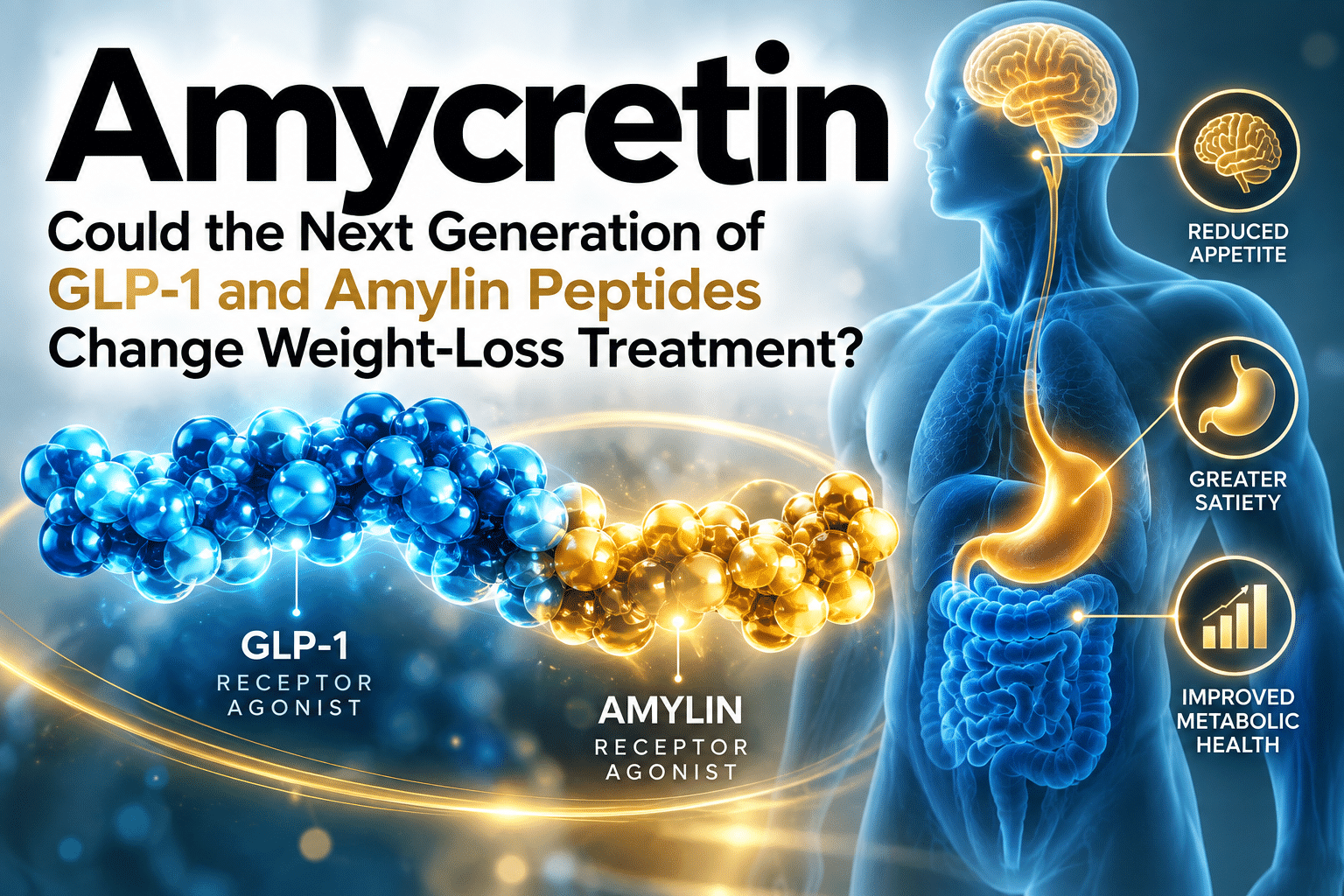
Amycretin: Could the Next Generation of GLP-1 and Amylin Peptides Change Weight-Loss Treatment?
The modern weight-management revolution has largely been driven by one hormone pathway: GLP-1.
Semaglutide demonstrated how dramatically GLP-1 receptor activation could affect appetite, body weight and metabolic health. Tirzepatide then expanded the concept by simultaneously targeting GIP and GLP-1 receptors. Retatrutide is pushing the science further by investigating combined GIP, GLP-1 and glucagon receptor activation.
But another approach is rapidly emerging.
Instead of adding GIP or glucagon to GLP-1, researchers are increasingly interested in combining GLP-1 with another powerful satiety hormone:
Amylin.
One of the most exciting compounds emerging from this field is amycretin, now formally known as zenagamtide.
Developed by Novo Nordisk, zenagamtide is a single long-acting peptide designed to activate both GLP-1 and amylin receptors.
Early clinical results have produced substantial weight reduction and improvements in blood glucose, and the compound has now progressed into a large Phase 3 development program.
Could combining GLP-1 and amylin signaling represent another major step forward in metabolic peptide science?
The answer may begin emerging over the next several years.
What Is Amycretin?
Amycretin was the development name given to an experimental peptide developed by Novo Nordisk.
The compound is now known as:
Zenagamtide
It is being developed as a:
Unimolecular GLP-1 and amylin receptor agonist.
“Unimolecular” is an important word.
Rather than administering two completely separate medications, researchers have engineered one molecule capable of activating both hormonal pathways.
Those pathways are:
GLP-1 receptor signaling
and
amylin receptor signaling.
Zenagamtide is being investigated in both subcutaneous and oral formulations, potentially providing different administration options if the compound eventually reaches regulatory approval.
It remains investigational and is not currently FDA approved.
Why Combine GLP-1 and Amylin?
GLP-1 and amylin are both naturally involved in the body’s regulation of food intake and metabolism, but they work through overlapping and complementary mechanisms.
This creates an interesting therapeutic possibility.
Instead of pushing one biological pathway harder and harder, researchers may be able to influence multiple systems involved in hunger, satiety and glucose regulation simultaneously.
This is broadly similar to the thinking behind dual and triple metabolic agonists.
The difference is the pathways being targeted.
What Does GLP-1 Do?
GLP-1 stands for:
Glucagon-like peptide-1.
It is a naturally occurring incretin hormone released primarily from intestinal cells after eating.
GLP-1 participates in several metabolic functions.
These include:
- Stimulating glucose-dependent insulin secretion
- Reducing inappropriate glucagon secretion
- Slowing gastric emptying
- Increasing satiety
- Reducing food intake
- Influencing appetite-related brain pathways
The enormous success of GLP-1-based medications has demonstrated that this hormonal system can be an extremely powerful therapeutic target.
But GLP-1 is not the body’s only satiety signal.
That is where amylin enters the story.
What Is Amylin?
Amylin is a peptide hormone naturally produced by pancreatic beta cells.
Interestingly, it is released alongside insulin after eating.
While insulin plays a major role in glucose regulation, amylin helps coordinate what happens after food enters the body.
Its physiological effects include signaling associated with:
- Satiety
- Meal size
- Gastric emptying
- Glucagon regulation
- Energy intake
One of amylin’s particularly interesting functions involves signaling to the brain that sufficient food has been consumed.
In simple terms, amylin participates in the biological process of:
“I’ve eaten enough.”
That makes it an obvious target for obesity research.
The GLP-1 + Amylin Concept
GLP-1 and amylin overlap in certain metabolic effects, but they are not identical.
Both can influence appetite and food intake.
Both interact with the brain.
Both participate in post-meal metabolic regulation.
But they act through different receptor systems.
Researchers therefore hypothesize that activating both pathways simultaneously could produce greater metabolic effects than targeting either pathway alone.
Zenagamtide was specifically engineered around this idea.
Rather than combining two separate injections, the goal is to create a single molecule capable of providing both activities.
How Is Amycretin Different From CagriSema?
This distinction is particularly important.
Novo Nordisk is developing another amylin-based therapy known as CagriSema.
CagriSema combines:
Cagrilintide + semaglutide
Cagrilintide is a long-acting amylin analogue.
Semaglutide is a GLP-1 receptor agonist.
CagriSema therefore combines two separate molecular components in one treatment strategy.
Zenagamtide takes a different approach.
It is a single molecule engineered to activate both GLP-1 and amylin receptors.
Conceptually:
CagriSema = amylin analogue + GLP-1 agonist
while:
Zenagamtide = one molecule with GLP-1 + amylin receptor activity.
This unimolecular design is one of the most interesting features of zenagamtide.
Early Obesity Research
Early clinical studies of amycretin generated considerable attention because of the magnitude of weight reduction observed.
A Phase 1b/2a study evaluated once-weekly subcutaneous amycretin in 125 adults with overweight or obesity.
Researchers examined multiple doses over treatment periods extending as long as 36 weeks.
The trial was designed primarily to evaluate:
- Safety
- Tolerability
- Pharmacokinetics
- Dose response
- Proof of concept
Weight reduction was substantial.
At the highest investigated dose and longest treatment duration, Novo Nordisk reported average weight reduction of approximately:
22% after 36 weeks.
Participants receiving placebo lost approximately:
2% of body weight.
Perhaps equally interesting, researchers reported that the weight-loss curve had not clearly reached a plateau by the end of treatment.
That observation suggested participants might potentially have continued losing weight with longer treatment.
Whether that occurs during longer Phase 3 studies is now one of the important questions researchers are investigating.
Amycretin and Type 2 Diabetes
Zenagamtide has now also produced encouraging results in people with type 2 diabetes.
Novo Nordisk’s Phase 2 study included 448 participants whose diabetes was inadequately controlled with metformin, with or without an SGLT2 inhibitor.
Researchers evaluated both:
once-weekly subcutaneous zenagamtide
and
once-daily oral zenagamtide.
This makes the trial particularly interesting because both delivery methods were investigated within the same broader clinical program.
Treatment lasted as long as:
36 weeks.
Subcutaneous Zenagamtide Results
Participants receiving once-weekly subcutaneous zenagamtide demonstrated dose-dependent reductions in HbA1c.
The largest reported average reduction was approximately:
1.8 percentage points.
By comparison, the placebo group experienced an approximately:
0.2 percentage-point reduction.
Novo Nordisk also reported that as many as:
89.1%
of participants receiving subcutaneous zenagamtide achieved an HbA1c below 7%.
Weight reduction was also substantial.
From an average starting body weight of approximately 99.2 kilograms, subcutaneous treatment produced average weight loss of as much as:
14.5% at 36 weeks
compared with approximately:
2.6% with placebo.
These findings are important because weight loss can sometimes be more difficult to achieve in populations with type 2 diabetes than in obesity trials excluding diabetes.
Oral Zenagamtide Results
The oral formulation is another potentially important part of the zenagamtide story.
Participants receiving once-daily oral zenagamtide achieved HbA1c reductions of up to approximately:
1.5 percentage points
from an average baseline around 8.0%.
Approximately:
77.6%
achieved an HbA1c below 7% at the higher studied exposures.
The oral formulation also produced weight reduction of up to approximately:
10.1%
at 36 weeks.
Placebo participants lost approximately:
2.5%.
These results suggest that meaningful GLP-1/amylin activity may potentially be achieved without injection.
That possibility could become extremely important if oral zenagamtide successfully progresses through Phase 3 development.
Why an Oral Peptide Matters
Peptides traditionally present a significant challenge for oral delivery.
The gastrointestinal system is specifically designed to break proteins and peptides into smaller components.
Peptides entering the digestive tract face:
- Stomach acid
- Digestive enzymes
- Intestinal barriers
- Limited absorption
- Rapid degradation
This is why many peptide medications have historically required injection.
Successful oral peptide technologies attempt to overcome some of these barriers.
If an oral formulation of zenagamtide ultimately provides sufficient efficacy, tolerability and convenience, it could broaden the options available within metabolic medicine.
But oral and injectable formulations should not be assumed to be equivalent.
They may require very different doses because their absorption and bioavailability differ dramatically.
Amycretin Dosing in Clinical Research
Because zenagamtide remains investigational, there is currently:
No FDA-approved amycretin or zenagamtide dose.
The available numbers describe experimental clinical-trial protocols.
In the Phase 2 type 2 diabetes program, researchers investigated subcutaneous weekly doses ranging from:
0.4 mg through 40 mg.
Oral daily doses included:
6 mg
25 mg
and
50 mg.
These dramatically different numbers demonstrate why route of administration matters.
A 50 mg oral dose should not be compared directly with a much smaller subcutaneous dose.
Oral peptide absorption is fundamentally different from injection.
The amounts used in these studies should therefore be understood strictly as investigational research doses.
What About Side Effects?
The safety profile reported so far has generally resembled what researchers expect from incretin- and amylin-based therapies.
The most common adverse events have been:
Gastrointestinal.
These have included issues such as:
- Nausea
- Vomiting
- Diarrhea
- Other gastrointestinal symptoms
Novo Nordisk reported that the large majority of adverse events were mild to moderate.
However, early and mid-stage clinical studies cannot fully establish long-term safety.
Phase 3 development is especially important because substantially larger populations and longer treatment periods provide researchers with more opportunity to detect:
- Uncommon adverse events
- Dose-related problems
- Discontinuation rates
- Longer-term tolerability
- Potential safety signals
Safety will therefore be just as important as weight loss when evaluating zenagamtide’s ultimate clinical value.
Phase 3 Begins: The AMAZE Program
One of the biggest developments in 2026 is that zenagamtide has advanced into Phase 3 obesity research.
Novo Nordisk calls this development program:
AMAZE.
The company reports that the obesity Phase 3 program began during the first quarter of 2026.
Both subcutaneous and oral formulations are included within the broader development strategy.
The program is ambitious.
Rather than investigating body weight alone, planned studies examine obesity and several important obesity-related conditions.
What Will AMAZE Study?
Selected Phase 3 studies include research involving:
Obesity
Longer-term studies will investigate weight reduction compared with placebo.
Type 2 Diabetes
Researchers will investigate zenagamtide in people who have obesity or overweight combined with diabetes.
Obstructive Sleep Apnea
Another trial will investigate both weight reduction and changes in sleep-apnea severity.
Knee Osteoarthritis
One especially interesting planned study evaluates people with obesity and knee osteoarthritis.
Weight reduction itself can influence mechanical stress on the knee, making this a potentially important clinical population.
Oral Zenagamtide
A dedicated Phase 3 study is evaluating the oral formulation for weight management.
The larger program may ultimately provide much more information about whether GLP-1/amylin dual signaling affects obesity-related diseases beyond simply reducing body weight.
Type 2 Diabetes Phase 3 Development
The 2026 Phase 2 diabetes results also prompted Novo Nordisk to move zenagamtide into Phase 3 development specifically for type 2 diabetes.
The company has indicated that the diabetes Phase 3 program is planned to begin during the second half of 2026.
This means zenagamtide is effectively developing along two major tracks:
Obesity and weight management
and
Type 2 diabetes.
That could eventually make the molecule relevant across a broad cardiometabolic population if Phase 3 results confirm the earlier findings.
Amycretin vs. Semaglutide
Semaglutide primarily activates:
GLP-1 receptors.
Zenagamtide activates:
GLP-1 + amylin receptors.
The key scientific question is whether adding amylin activity can produce additional benefits involving:
- Appetite
- Satiety
- Weight reduction
- Eating behavior
- Glucose control
- Cardiometabolic health
Early zenagamtide studies are encouraging, but cross-trial comparisons should be approached cautiously.
Different studies enroll different populations, use different durations and apply different statistical methods.
A 20% weight reduction in one trial cannot automatically be interpreted as superior to an 18% reduction in another trial involving a different population.
Direct randomized comparisons provide much stronger evidence.
Amycretin vs. Retatrutide
These two experimental compounds represent very different strategies.
Zenagamtide:
GLP-1 + amylin
GIP + GLP-1 + glucagon
Both attempt to move beyond conventional single-receptor GLP-1 therapy.
But they do so through different biological pathways.
Retatrutide adds metabolic signaling through GIP and glucagon.
Zenagamtide instead combines GLP-1 signaling with the powerful satiety biology of amylin.
This may eventually become one of the most interesting questions in obesity medicine:
Which combination of metabolic signals produces the best balance of weight reduction, metabolic improvement, tolerability and long-term safety?
Is Amycretin FDA Approved?
No.
As of 2026, amycretin/zenagamtide remains:
Investigational.
Neither the injectable nor oral formulation is currently an FDA-approved medication.
The progression into Phase 3 represents an important milestone, but Phase 3 entry does not guarantee eventual approval.
Researchers must still establish sufficient evidence regarding:
- Efficacy
- Safety
- Dose selection
- Manufacturing
- Long-term tolerability
- Benefit-risk balance
Regulatory authorities ultimately review the complete evidence package.
What About “Research Amycretin” Sold Online?
Consumers should be extremely cautious about assuming that products marketed online under names such as:
Amycretin
or
Zenagamtide
are equivalent to Novo Nordisk’s investigational product.
Clinical-trial material is manufactured under controlled conditions and subjected to extensive quality requirements.
A commercial research vendor advertising a product as “high purity” does not automatically establish:
- Correct molecular identity
- Accurate quantity
- Pharmaceutical sterility
- Endotoxin levels
- Stability
- Manufacturing consistency
- Clinical equivalence
A certificate reporting chromatographic purity alone does not answer all of these questions.
The compound used in clinical trials and an online research product carrying the same name should therefore not automatically be considered interchangeable.
Could Amylin Be the Next Big Peptide Target?
Perhaps the most interesting part of the zenagamtide story is bigger than zenagamtide itself.
The obesity-treatment field increasingly appears to be moving from:
single-hormone pharmacology
toward:
multi-hormone pharmacology.
GLP-1 demonstrated what one pathway could accomplish.
Tirzepatide demonstrated the potential of GLP-1 plus GIP.
Retatrutide is testing GLP-1, GIP and glucagon simultaneously.
Cagrilintide and CagriSema have increased attention around amylin.
Zenagamtide now asks whether GLP-1 and amylin activity can be engineered into one molecule.
This is a fascinating development.
Rather than simply searching for a stronger GLP-1 drug, researchers are attempting to reproduce more of the body’s complex network of appetite and metabolic signals.
The Bottom Line on Amycretin
Amycretin—now known as zenagamtide—is one of the most interesting next-generation metabolic peptides currently moving through clinical development.
Its defining feature is its ability to activate:
GLP-1 and amylin receptors within a single molecule.
Early obesity research produced average weight reductions approaching 22% at 36 weeks at the highest investigated exposure, while researchers reported no clear weight-loss plateau at the end of treatment.
More recent Phase 2 research in people with type 2 diabetes found that once-weekly subcutaneous zenagamtide produced weight reductions up to approximately 14.5% and HbA1c reductions up to approximately 1.8 percentage points at 36 weeks.
The oral formulation produced weight reductions up to approximately 10.1% and HbA1c reductions up to approximately 1.5 percentage points.
These results have moved zenagamtide into the next stage.
The AMAZE Phase 3 obesity program began in 2026, while Novo Nordisk is also advancing the compound toward Phase 3 research specifically for type 2 diabetes.
Perhaps most importantly, zenagamtide represents a broader shift in metabolic peptide research.
The question is no longer simply:
How strongly can we activate GLP-1?
Researchers are increasingly asking:
Which combination of the body’s natural metabolic signals can produce the greatest health benefits while maintaining acceptable safety and tolerability?
Zenagamtide’s answer is:
GLP-1 + amylin.
Whether that combination ultimately becomes a major new obesity and diabetes treatment will depend on the Phase 3 evidence now being generated.
But in 2026, amycretin has clearly moved beyond being an interesting early-stage experiment.
It has become one of the next-generation metabolic peptides worth watching closely.
Disclaimer
This article is provided for educational and informational purposes only and does not constitute medical advice, diagnosis, prescribing information or a recommendation to use amycretin/zenagamtide. Zenagamtide remains an investigational compound and is not currently FDA approved. Doses described in this article refer to controlled clinical-research protocols and should not be interpreted as personal dosing instructions or recommendations for human use. Products sold online as research amycretin or zenagamtide should not be assumed to have the identity, purity, concentration, sterility, stability, manufacturing quality or clinical characteristics of the investigational products used in Novo Nordisk-sponsored clinical trials. Individuals seeking treatment for obesity, type 2 diabetes or another medical condition should consult an appropriately licensed healthcare professional.