





GLP-1, GIP, and Glucagon: Understanding the Science Behind Multi-Receptor Peptides
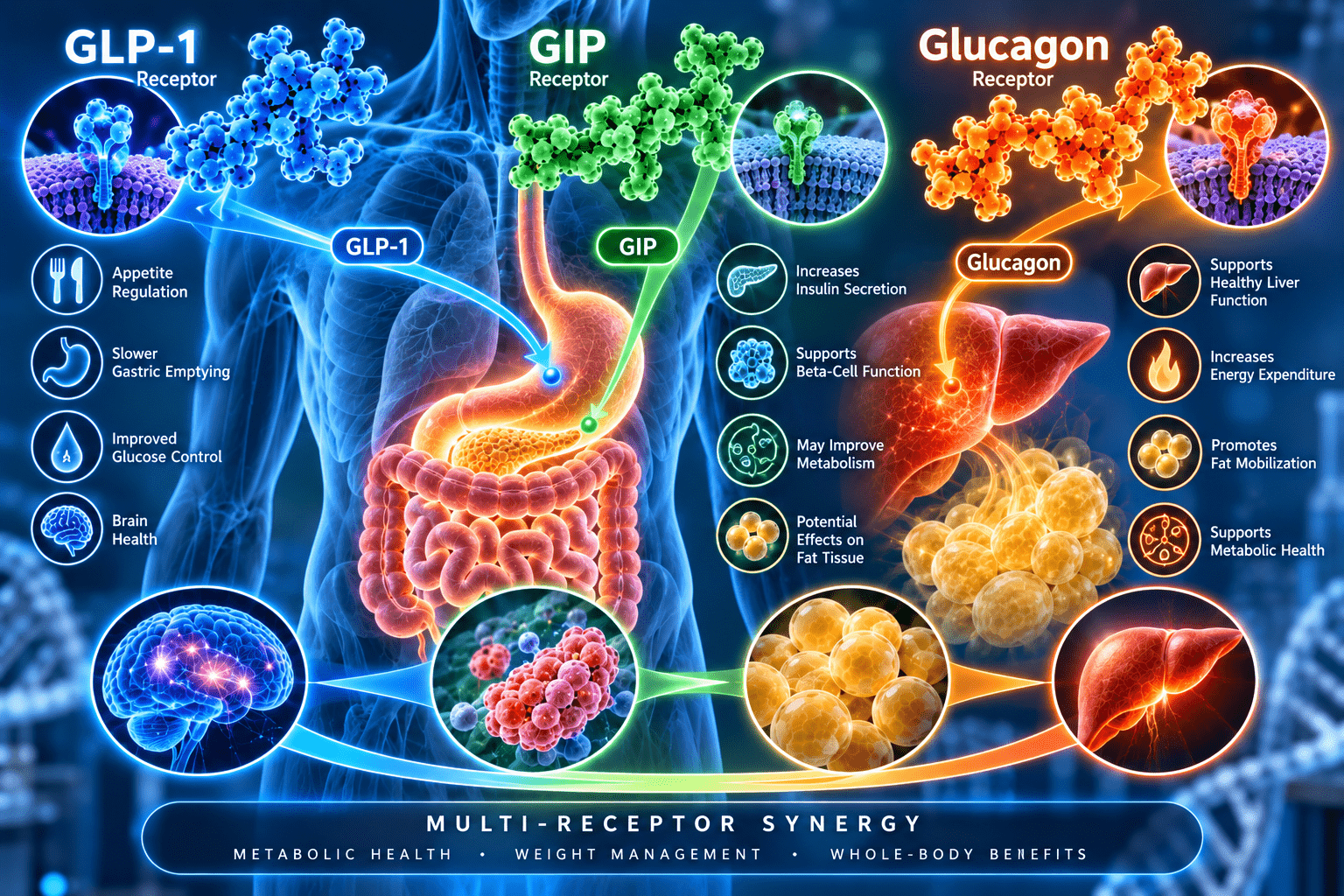
Some of the most exciting research in metabolic science centers around three hormones:
Individually, each participates in the complicated biological system controlling glucose, appetite, digestion and energy metabolism.
Increasingly, scientists are asking a fascinating question:
What happens when one engineered molecule influences two—or even all three—of these receptor systems simultaneously?
The answer has created an entirely new research field involving multi-receptor agonists.
Understanding why requires looking at each hormone individually.
What Is GLP-1?
GLP-1 stands for glucagon-like peptide-1.
It is an incretin hormone released primarily from intestinal cells in response to food.
GLP-1 communicates with receptors in several tissues and participates in regulation of glucose and energy intake.
Among its important physiological actions, GLP-1 can:
- enhance glucose-dependent insulin secretion
- influence glucagon secretion
- slow gastric emptying
- influence appetite and food intake
- participate in central nervous system signaling
GLP-1 does something particularly useful from a metabolic standpoint: its stimulation of insulin secretion is glucose dependent.
That means the effect changes according to glucose availability rather than simply forcing insulin secretion continuously.
The Problem With Natural GLP-1
Naturally occurring GLP-1 does not remain active for very long.
The body rapidly breaks it down, including through the enzyme DPP-4.
Researchers therefore developed molecules capable of activating the GLP-1 receptor while surviving much longer in circulation.
This eventually led to long-acting GLP-1 receptor agonists.
But success with GLP-1 generated another question.
Could scientists combine its effects with another incretin pathway?
Enter GIP.
What Is GIP?
GIP stands for glucose-dependent insulinotropic polypeptide.
Like GLP-1, it is an incretin hormone released in response to nutrients.
GIP also stimulates insulin secretion in a glucose-dependent manner.
For many years, the therapeutic significance of GIP in obesity and diabetes was debated.
More recent development of dual GIP/GLP-1 receptor agonists dramatically increased interest in the pathway. A 2026 review describes GIP and GLP-1 as central incretin hormones involved in metabolic regulation and notes that development of dual agonists changed how the GIP pathway is viewed.
The science is still more complicated than simply saying that activating GIP is always beneficial.
Researchers continue debating the precise mechanisms through which GIP receptor agonism—and intriguingly, in some experimental strategies even GIP receptor antagonism—may influence weight regulation.
That scientific debate is one of the reasons this field remains so interesting.
Tirzepatide Changed the Conversation
Tirzepatide demonstrated the practical potential of combining GIP and GLP-1 receptor activity within one molecule.
According to its FDA labeling, tirzepatide selectively binds to and activates both GIP and GLP-1 receptors. The molecule also contains a fatty diacid component that promotes albumin binding and extends its half-life.
Instead of treating metabolic pathways as isolated switches, scientists could increasingly think about coordinating multiple hormonal signals.
That concept is known broadly as multi-agonism or polyagonism.
And researchers weren’t finished.
Enter Glucagon
Glucagon has traditionally been associated with raising blood glucose.
It is secreted primarily by pancreatic alpha cells and helps protect the body against excessively low glucose.
Among its physiological functions, glucagon stimulates the liver to make glucose available.
At first glance, activating the glucagon receptor might seem counterproductive when developing therapies for metabolic disease.
Why would researchers want to stimulate a pathway associated with increasing glucose?
Because glucagon biology is more complicated.
Glucagon signaling also influences:
- energy expenditure
- lipid metabolism
- amino-acid metabolism
- hepatic metabolism
- mobilization of stored energy
Scientists began investigating whether glucagon receptor activation could be carefully balanced with GLP-1 activity.
GLP-1 could help counterbalance some undesirable glycemic consequences while glucagon receptor activity might contribute additional metabolic effects.
A 2025 review describes GLP-1/glucagon combinations as an emerging strategy designed in part to leverage glucagon-related effects on energy expenditure, fat oxidation and mobilization of energy stores.
From Single to Dual to Triple Agonists
This gives us an evolutionary sequence.
First generation concept
GLP-1 receptor agonism
One primary receptor system.
Dual-receptor concept
GIP + GLP-1
or
GLP-1 + glucagon
Two coordinated receptor systems.
Triple-receptor concept
GIP + GLP-1 + glucagon
Three receptor systems incorporated into a single molecular strategy.
Retatrutide is the best-known example of the triple-agonist approach.
Why Not Simply Combine Three Separate Drugs?
This is where peptide engineering becomes fascinating.
Researchers can design a single peptide molecule with activity across multiple receptors.
This potentially allows them to tune the molecule’s relative activity at each receptor.
Think of an audio mixing board.
There isn’t simply an ON/OFF button for:
GLP-1
GIP
Glucagon
Instead, scientists can investigate whether different balances of receptor activity produce different metabolic effects.
The ideal balance is a major research question.
What Scientists Hope to Accomplish
The rationale behind multi-receptor peptides is not simply “more receptors equals better.”
Instead, researchers are investigating whether complementary mechanisms can produce beneficial effects that are difficult to achieve through a single pathway.
For example:
GLP-1 signaling
may contribute to satiety, glucose-dependent insulin secretion and reduced food intake.
GIP signaling
interacts with insulin secretion and multiple metabolic pathways.
Glucagon signaling
may contribute to energy expenditure, fat oxidation and mobilization of energy stores.
The challenge is balancing these pathways.
Recent reviews conclude that dual and triple agonists show considerable promise for glycemic control and body-weight reduction, while emphasizing that more direct comparative and longer-duration studies remain necessary.
The Brain Is Part of the Story
These hormones aren’t acting only in the pancreas and digestive tract.
The brain plays an important role.
FDA labeling for tirzepatide notes that GIP and GLP-1 receptors are present in brain areas involved in appetite regulation, and the medication reduces calorie intake, likely through effects on appetite.
This helps explain why modern metabolic peptide research increasingly considers the entire gut-brain-metabolic axis.
The intestine communicates with the pancreas.
The pancreas communicates with the liver.
Hormonal signals influence the brain.
The brain influences eating behavior.
Adipose tissue participates in endocrine signaling.
Metabolism is a network.
Multi-receptor peptides attempt to interact with that network rather than one isolated component.
What About the Liver?
The liver is another important research target.
Metabolic dysfunction-associated steatotic liver disease—MASLD—and its inflammatory form, MASH, have become major areas of metabolic drug development.
Researchers are studying whether GLP-1-based and multi-receptor strategies can improve liver fat, metabolic function and potentially other disease characteristics.
A 2025 review reported encouraging findings with several GLP-1, dual and multi-receptor strategies while emphasizing that larger and longer studies are still required for newer GIP- and glucagon-containing approaches.
This illustrates how peptide research initially associated with glucose or weight can expand into broader metabolic disease.
Why Glucagon Is Particularly Interesting
The glucagon component may be one of the most scientifically intriguing parts of next-generation multi-agonists.
GLP-1 tends to suppress glucagon under certain glucose conditions.
Yet researchers are deliberately developing molecules that activate the glucagon receptor.
That apparent contradiction illustrates the sophistication of metabolic physiology.
Scientists are not simply attempting to maximize or minimize one hormone.
They are attempting to create a controlled balance among several signaling systems.
The goal is to potentially capture useful aspects of glucagon biology while other components help manage its less desirable metabolic effects.
What About Side Effects?
Multi-receptor agonism doesn’t automatically eliminate limitations associated with GLP-1-based therapy.
Gastrointestinal adverse events remain important in clinical research.
A 2025 literature review concluded that although dual and triple agonism has shown promising efficacy, gastrointestinal adverse effects have not necessarily disappeared compared with conventional GLP-1 receptor agonists.
This is another reminder that greater biological activity does not automatically mean an ideal therapeutic profile.
Safety and tolerability matter alongside efficacy.
Beyond Three Receptors
The field isn’t stopping at GLP-1, GIP and glucagon.
Researchers are investigating other hormonal combinations and complementary metabolic pathways.
Amylin is one prominent example.
Other strategies involve combinations of peptide agonists, engineered molecules and even non-peptide small molecules capable of activating receptors historically targeted by peptides.
A 2025 review of the obesity pipeline describes GLP-1 mono-agonists, GIP/GLP-1 dual agonists, GLP-1/glucagon co-agonists, triple agonists and GLP-1/amylin combinations as parts of a rapidly developing therapeutic landscape.
A New Way of Thinking About Metabolic Medicine
The significance of multi-receptor peptides extends beyond any single compound.
They represent a different philosophy of drug design.
Traditional pharmacology often searches for:
one drug → one target → one effect
Metabolic biology doesn’t necessarily work that way.
Appetite, glucose regulation, fat metabolism and energy expenditure involve interconnected hormonal networks.
Multi-receptor peptide engineering asks whether medicines can be designed to work more like those networks:
one engineered molecule → several coordinated targets → integrated physiological response
That concept may influence peptide development for decades.
What Comes Next?
Researchers still need to answer important questions.
Which receptor combinations are optimal?
What relative activity should occur at each receptor?
Can efficacy improve without sacrificing tolerability?
How durable are the metabolic effects?
What happens during long-term treatment?
Can additional benefits occur in cardiovascular, hepatic or other metabolic disease?
Which individuals respond best to particular receptor combinations?
These questions are why the field remains firmly rooted in ongoing scientific investigation.
The Bigger Picture
GLP-1 began as a naturally occurring intestinal hormone.
Researchers learned how to engineer molecules capable of activating its receptor for much longer periods.
Then they combined GLP-1 signaling with GIP.
Then with glucagon.
Now researchers are investigating increasingly sophisticated combinations.
The progression tells us something important about the world of peptides.
Scientists are no longer limited to finding a naturally occurring peptide and asking what it does.
Increasingly, they can ask:
What biological signals do we want—and can we engineer a peptide capable of producing that combination?
That is the real scientific importance of GLP-1, GIP and glucagon multi-receptor research.
The story isn’t simply about three hormones.
It’s about learning how to engineer biological communication itself.


I always wondered what GIP actually was. Interesting.
Great question, PapaH! GIP (Glucose-dependent Insulinotropic Polypeptide, formerly known as Glucose-dependent Insulinotropic Peptide) is really fascinating once you dig into it. Like GLP-1, it’s an incretin hormone that helps regulate blood sugar by stimulating insulin release in response to nutrient intake—but it works through a completely separate receptor pathway.
What makes the current research so exciting is that scientists discovered GIP has additional metabolic effects beyond glucose control, including influences on appetite and energy expenditure. This is why compounds like retatrutide that activate multiple receptors simultaneously are generating so much interest. By targeting GIP, GLP-1, and glucagon receptors all at once, researchers are exploring whether they can achieve more comprehensive metabolic benefits than single-receptor agonists alone.
The real challenge researchers are investigating is understanding how these three systems interact when activated together—do they complement each other, or do they create unintended effects? If you’re curious about this topic, you might want to explore the discussion on retatrutide research that’s already been shared in the forum, as it dives deeper into triple-receptor agonism specifically. What aspects of multi-receptor peptides interest you most—the glucose control side, or the appetite and weight management potential?