

SNAP-8: A Comprehensive Guide to Uses, Research, Forms, Concentrations, and Potential Benefits
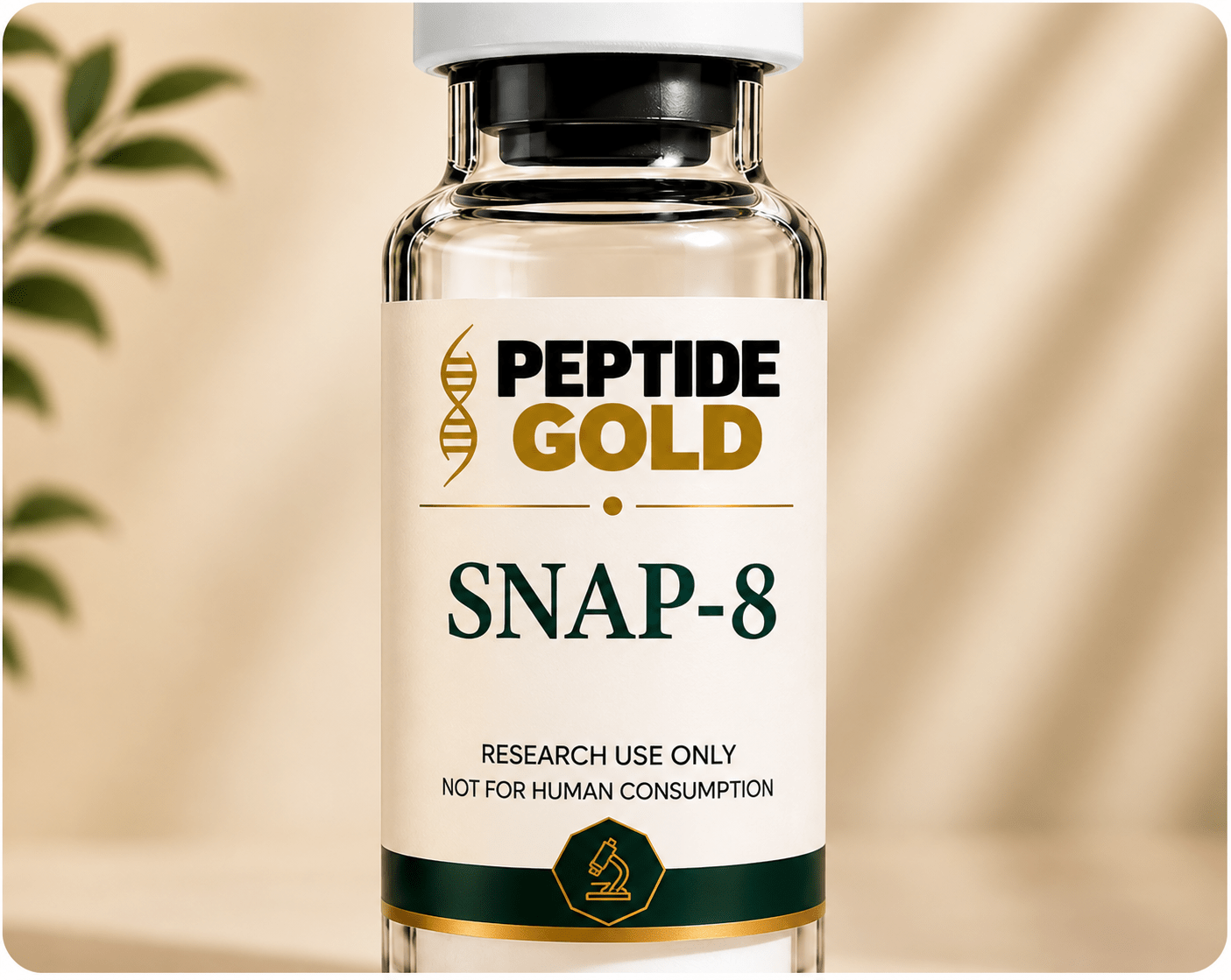
SNAP-8, also known as Acetyl Octapeptide-3, is a synthetic cosmetic peptide designed primarily for research and use in topical anti-aging skin-care products.
It is most commonly associated with:
- Expression lines
- Forehead wrinkles
- Crow’s feet
- Fine lines around the mouth
- Cosmetic skin smoothing
- Facial muscle-related wrinkle formation
- Anti-aging skin-care formulations
Unlike many of the peptides discussed in regenerative medicine or metabolic research, SNAP-8 is not primarily intended as an injectable or systemic compound.
It is best understood as a topical cosmetic peptide.
SNAP-8 is composed of eight amino acids and is commonly represented as:
Ac-Glu-Glu-Met-Gln-Arg-Arg-Ala-Asp-NH₂
or more simply:
Ac-EEMQRRAD-NH₂.
The peptide was designed around part of the biological machinery involved in neurotransmitter release and facial muscle contraction.
This has led to its frequent marketing as a:
“Botox-like peptide”
or even:
“Botox in a bottle.”
Those descriptions should be treated cautiously.
SNAP-8 and botulinum toxin are fundamentally different molecules with dramatically different delivery, potency, clinical evidence, and mechanisms.
SNAP-8 is applied to the surface of the skin.
Botulinum toxin is injected directly into targeted muscles and has a large body of clinical evidence demonstrating neuromuscular blockade.
The independent human evidence supporting SNAP-8 is far more limited. As of 2026, much of the frequently quoted wrinkle-reduction data still traces back to manufacturer-sponsored cosmetic testing rather than large independent randomized trials.
What Is SNAP-8?
SNAP-8 is a synthetic octapeptide, meaning it contains eight amino-acid residues.
Its cosmetic name is:
Acetyl Octapeptide-3.
The “acetyl” portion refers to a chemical modification at one end of the molecule.
This modification can affect:
stability
solubility
and how the peptide behaves in cosmetic formulations.
The peptide was engineered to resemble part of a naturally occurring protein called:
SNAP-25.
SNAP-25 plays an important role in the cellular machinery that allows nerve cells to release neurotransmitters.
That machinery is known as the:
SNARE complex.
Understanding this system helps explain why SNAP-8 became associated with expression wrinkles.
What Is the SNARE Complex?
Nerve cells communicate with other cells by releasing chemical messengers called neurotransmitters.
At a neuromuscular junction, the neurotransmitter:
acetylcholine
is released from a nerve ending.
Acetylcholine then binds receptors on a muscle cell and triggers muscle contraction.
For acetylcholine to be released, small membrane-bound vesicles inside the nerve ending must fuse with the outer cell membrane.
This process depends on several proteins working together.
Collectively, these proteins form the SNARE complex.
One of the important proteins involved is:
SNAP-25.
The simplified pathway looks like this:
SNARE complex → acetylcholine release → muscle contraction
Repeated facial muscle contraction contributes to what dermatologists call:
dynamic wrinkles.
Examples include:
forehead lines
frown lines
and crow’s feet.
SNAP-8 was designed around the idea that interfering slightly with this signaling machinery might reduce the appearance of those expression-related lines.
How Is SNAP-8 Supposed to Work?
The proposed mechanism is that SNAP-8 mimics part of SNAP-25 and may compete with normal SNAP-25 during assembly of the SNARE complex.
In theory:
SNAP-8 → altered SNARE signaling → less acetylcholine release → reduced muscle contraction → softer appearance of expression lines
This is why SNAP-8 is grouped among neurotransmitter-inhibiting cosmetic peptides. A 2026 review of peptide safety in cosmetics specifically includes Acetyl Octapeptide-3 in this category.
However, there is a major biological challenge.
For this mechanism to produce a meaningful effect on facial muscles, a topical peptide would need to:
penetrate the outer skin barrier
remain intact
reach sufficient depth
and interact with relevant neuromuscular structures.
That has not been convincingly demonstrated for SNAP-8.
This is arguably the biggest unresolved question surrounding the ingredient.
The Skin-Penetration Problem
Human skin is designed to keep foreign molecules out.
The outer layer, called the stratum corneum, is an extremely effective barrier.
Large, water-soluble molecules generally penetrate intact skin poorly.
Peptides can therefore be challenging topical ingredients.
SNAP-8 is both:
relatively large compared with conventional small-molecule skin-care ingredients
and highly hydrophilic, meaning it prefers water rather than lipids.
Those properties can make passive skin penetration difficult.
Research involving the related peptide Acetyl Hexapeptide-8, or Argireline, suggests peptide penetration depends heavily on the formulation and delivery vehicle.
There is much less direct penetration research involving SNAP-8 itself.
This means that even though SNAP-8 has an interesting molecular mechanism in theory, scientists still need better evidence showing that ordinary topical application delivers enough intact peptide to the biological target required for a true neuromuscular effect.
SNAP-8 Versus Argireline
SNAP-8 is closely related conceptually to Argireline, whose cosmetic ingredient name is:
Acetyl Hexapeptide-8.
Argireline contains six amino acids.
SNAP-8 contains eight.
The two additional amino acids were intended to expand on the same SNARE-related strategy.
This has led to SNAP-8 sometimes being described as a:
next-generation Argireline peptide.
However, that does not automatically mean it works better.
Argireline has a larger published cosmetic literature and has undergone a formal Cosmetic Ingredient Review safety assessment.
SNAP-8 has considerably less independent human evidence.
It is therefore more accurate to say:
SNAP-8 is a related octapeptide designed around a similar SNARE-targeting concept, rather than claiming it has been clinically demonstrated to outperform Argireline.
SNAP-8 Versus Botox
This comparison deserves special attention because SNAP-8 is frequently marketed as a topical Botox alternative.
Botulinum Toxin
Botulinum toxin is injected directly into specific muscles.
It enzymatically cleaves proteins involved in acetylcholine release.
The result is a strong temporary reduction in neuromuscular signaling.
This can produce visible reduction in dynamic wrinkles.
SNAP-8
SNAP-8 is generally applied topically.
Its proposed effect is far less powerful and depends heavily on whether enough peptide reaches the correct biological target.
There are no large trials demonstrating that SNAP-8 produces wrinkle reduction comparable with injectable botulinum toxin.
Therefore:
SNAP-8 should not be described as topical Botox in a literal pharmacological sense.
The comparison is primarily a cosmetic marketing shorthand.
What Is SNAP-8 Used For?
SNAP-8 is mainly used in anti-aging cosmetic formulations.
Forehead Lines
Horizontal forehead wrinkles are strongly influenced by repeated contraction of the frontalis muscle.
SNAP-8 serums are therefore commonly marketed for this area.
Frown Lines
Vertical lines between the eyebrows develop partly from repeated activity of the corrugator and related facial muscles.
These are another common target.
Crow’s Feet
Repeated contraction around the eyes produces fine lines extending outward from the corners of the eyes.
Cosmetic peptides such as SNAP-8 are frequently incorporated into eye-area products.
Fine Lines Around the Mouth
Lip movement and facial expression contribute to lines surrounding the mouth.
SNAP-8 may be included in serums intended for these dynamic lines.
General Anti-Aging Skin Care
Many formulations combine SNAP-8 with other ingredients targeting different aspects of aging.
These may include:
hyaluronic acid
niacinamide
retinoids
antioxidants
Matrixyl peptides
or Argireline.
This combination approach makes biological sense because facial aging is not caused by one mechanism alone.
Dynamic Versus Static Wrinkles
This distinction is important when evaluating SNAP-8.
Dynamic Wrinkles
Dynamic wrinkles occur primarily during facial movement.
Examples include:
smile lines
forehead lines
and frown lines.
Muscle-related cosmetic peptides theoretically make the most sense for these.
Static Wrinkles
Static wrinkles remain visible even when the face is relaxed.
These are more strongly influenced by:
collagen loss
sun damage
skin thinning
loss of elasticity
and changes in facial structure.
SNAP-8 would theoretically have less influence over these mechanisms.
Ingredients targeting collagen remodeling, such as retinoids or certain signal peptides, may be more relevant to static wrinkles.
Does SNAP-8 Stimulate Collagen?
SNAP-8 is not primarily considered a collagen-stimulating peptide.
Its proposed mechanism focuses on neurotransmitter release and expression-related movement.
This distinguishes it from peptides such as:
GHK-Cu
palmitoyl pentapeptides
and other matrix-signaling peptides.
A product containing SNAP-8 may still improve the overall appearance of skin if it contains moisturizing or collagen-supporting ingredients, but those effects should not automatically be attributed to SNAP-8 itself.
What Does the Human Research Show?
The evidence is much thinner than the marketing surrounding SNAP-8 might suggest.
The most frequently quoted commercial results describe reductions in wrinkle depth after approximately four weeks of topical use.
Numbers around:
35% average wrinkle reduction
and up to roughly:
60% or more in some participants
are commonly repeated.
However, these figures appear to trace largely to manufacturer-sponsored testing involving small participant groups rather than independent large randomized controlled trials.
Independent reviews conducted in 2026 continue to identify a major gap in the evidence:
there is little high-quality peer-reviewed human research evaluating SNAP-8 alone against a proper vehicle placebo.
Therefore, the ingredient should be described as promising but not strongly clinically validated.
Combination-Product Research
Another challenge is that cosmetic studies frequently test products containing several active ingredients simultaneously.
If a serum contains:
SNAP-8
plus another peptide,
plus humectants,
plus antioxidants,
and wrinkles improve,
researchers cannot necessarily determine which ingredient produced the benefit.
Some human studies involving Acetyl Octapeptide-3 have used combination systems rather than isolated SNAP-8, making it difficult to determine its individual contribution.
This is extremely common in cosmetic science.
It does not mean the peptide is ineffective.
It means the evidence cannot cleanly assign the result to SNAP-8 alone.
How Fast Is SNAP-8 Supposed to Work?
Commercial formulations commonly describe visible effects developing over several weeks.
The most frequently cited manufacturer testing used approximately:
28 days.
This fits the way topical skin-care products are generally evaluated.
SNAP-8 is not expected to behave like injected botulinum toxin, where a clinically meaningful neuromuscular effect becomes evident relatively quickly.
If topical SNAP-8 has an effect, it is likely to be more:
subtle
gradual
and dependent on continuous application.
Does SNAP-8 Permanently Remove Wrinkles?
No evidence supports permanent wrinkle removal.
Even botulinum toxin does not permanently eliminate expression lines.
Skin aging continues, and facial muscles continue functioning.
Any cosmetic benefit from SNAP-8 would presumably require continued topical exposure.
Additionally, deeper static wrinkles caused by collagen loss and structural aging would not be expected to disappear simply from modifying superficial expression-related signaling.
SNAP-8 Concentration and Dosing Information
SNAP-8 should not really be described as having a medical dose.
It is a cosmetic ingredient used in topical formulations.
There is:
no FDA-approved SNAP-8 dose
no injectable dosing regimen
no therapeutic dosing schedule
and no established systemic exposure target.
Commercial formulators may describe SNAP-8 concentrations as percentages of a finished serum or as percentages of a diluted manufacturer-supplied ingredient solution.
These numbers should not be confused.
A product claiming:
10% SNAP-8 solution
does not necessarily contain 10% pure Acetyl Octapeptide-3.
Commercial peptide raw materials are frequently supplied already diluted in water, glycerin, preservatives, or other carriers.
This is one reason comparing percentages between cosmetic brands can be misleading.
Is There an Established Optimal Concentration?
No independently established optimal concentration exists.
Manufacturer-related testing often forms the basis for suggested cosmetic use levels.
The commonly repeated 28-day wrinkle study used a formulation described commercially as approximately a 10% SNAP-8 preparation, but this referred to a cosmetic formulation system rather than necessarily 10% pure peptide.
There is not enough independent research to conclude that:
more SNAP-8 automatically produces better results.
Increasing concentration can also create formulation problems and potentially greater irritation.
What Forms Is SNAP-8 Offered In?
SNAP-8 is primarily found in topical cosmetic products.
Serums
This is probably the most common form.
Serums allow cosmetic formulators to combine SNAP-8 with water-based ingredients such as:
hyaluronic acid
niacinamide
and other peptides.
Eye Serums
Because crow’s feet are dynamic expression lines, SNAP-8 is commonly included in products intended for the eye area.
Creams and Moisturizers
SNAP-8 may also appear in creams designed for broader facial use.
Concentrated Cosmetic Raw Material
Cosmetic formulators can purchase Acetyl Octapeptide-3 as a raw ingredient or diluted peptide solution.
Research-Grade Powder
Some peptide suppliers may offer SNAP-8 as laboratory material.
This should not be interpreted as evidence that injectable use is established.
Injectable SNAP-8
There is no established injectable use for SNAP-8.
This deserves strong emphasis.
SNAP-8 was developed as a cosmetic peptide.
There is no recognized:
FDA-approved injectable product
human injection protocol
systemic pharmacokinetic database
or established safety profile for injection.
The absence of evidence is particularly important because injecting a peptide bypasses the skin barrier completely.
A compound that appears relatively benign when applied topically cannot automatically be assumed safe when injected.
These are fundamentally different routes of exposure.
Does SNAP-8 Have a Known Half-Life?
There is no established clinically relevant systemic human half-life for SNAP-8.
Because it is primarily used topically, standard pharmaceutical pharmacokinetic measurements have not been adequately established.
Sources that present precise injectable half-life numbers for SNAP-8 should therefore be treated cautiously.
The meaningful questions for a topical ingredient are more likely:
How stable is the peptide in the cosmetic formulation?
How much penetrates the stratum corneum?
How long does it remain intact within skin?
Those questions still require better research.
Potential Side Effects
Topical SNAP-8 appears to be generally tolerated in cosmetic use, but its independent safety database is not extensive.
Potential topical reactions could include:
- Mild redness
- Stinging
- Itching
- Dryness
- Irritation
- Sensitivity to other ingredients in the formula
Often, a reaction to a serum may come from:
preservatives
fragrance
acids
or another active ingredient
rather than SNAP-8 itself.
People with sensitive skin may therefore respond differently to different products containing the same peptide.
Long-Term Safety
One limitation is the shortage of long-term independent safety data specifically for Acetyl Octapeptide-3.
A 2026 framework for evaluating cosmetic peptides emphasized that peptide ingredients require safety assessment that considers their specific structure, biological activity, exposure, and potential systemic availability. Acetyl Octapeptide-3 is explicitly included among cosmetic peptides that act or are intended to act on neurotransmitter-related pathways.
This does not mean SNAP-8 has been shown to be dangerous.
It means long-term safety should not be overstated simply because serious problems have not been widely reported.
SNAP-8 and Sensitive Skin
SNAP-8 itself is not generally considered a strong exfoliant or irritating acid.
That potentially makes peptide serums attractive to people who cannot tolerate aggressive actives.
However, finished-product tolerability depends on the entire formulation.
For example, a SNAP-8 serum containing:
glycolic acid
retinol
or high concentrations of alcohol
may be considerably more irritating than a simple peptide moisturizer.
SNAP-8 and Retinoids
SNAP-8 and retinoids target different aspects of aging.
SNAP-8 theoretically targets expression-related signaling.
Retinoids have much stronger evidence for:
collagen production
epidermal turnover
fine wrinkles
pigmentation
and photoaging.
There is no reason the mechanisms must be mutually exclusive.
Cosmetic products may incorporate peptides into routines that also use retinoids.
However, based on current evidence, SNAP-8 should not be considered a replacement for prescription tretinoin or other well-studied retinoids when treating photoaging.
SNAP-8 and GHK-Cu
These two peptides are also very different.
SNAP-8 is designed primarily around expression wrinkles and neurotransmitter-related signaling.
GHK-Cu is associated more strongly with:
collagen
fibroblast activity
wound repair
and extracellular-matrix remodeling.
In theory, a cosmetic formula could combine the two because they target different aspects of skin aging.
There is little high-quality evidence proving that the combination provides synergistic clinical results.
SNAP-8 and Hyaluronic Acid
Hyaluronic acid is a humectant that attracts and holds water.
It can make the skin appear:
plumper
smoother
and less lined.
Because hydration can produce immediate cosmetic improvement, it is important to account for this when interpreting peptide-serum studies.
If SNAP-8 is delivered in a formulation rich in hyaluronic acid or glycerin, some visible wrinkle improvement may result simply from better hydration.
A well-designed controlled trial should therefore compare SNAP-8 with the same base formulation without the peptide.
Is SNAP-8 FDA Approved?
SNAP-8 is not an FDA-approved drug.
However, that does not mean it must receive drug approval simply to appear in a cosmetic.
In the United States, cosmetic ingredients operate under a different regulatory framework from prescription medications.
A product marketed to:
improve the appearance of fine lines
can fall within cosmetic claims.
A product claiming to:
paralyze facial muscles
or medically alter neuromuscular function
could create a very different regulatory issue.
This is another reason responsible product descriptions generally say SNAP-8 may:
reduce the appearance of expression lines
rather than claiming that it medically blocks muscle contraction.
Is SNAP-8 a Peptide or a Cosmetic Ingredient?
It is both.
Chemically, SNAP-8 is a genuine synthetic peptide.
Practically, its primary use is as a cosmetic ingredient.
That puts it in a very different category from peptides such as:
or semaglutide,
which are pharmaceutical drugs with systemic effects and FDA-approved formulations.
Current Research in 2026
SNAP-8 remains commercially popular, but its scientific evidence base has not advanced as rapidly as the marketing surrounding it.
Modern peptide-cosmetic research is increasingly focused on:
skin penetration
delivery systems
microneedles
nanocarriers
liposomes
and better methods of transporting peptides through the stratum corneum.
These technologies may ultimately be important for SNAP-8 because penetration is one of the major barriers to achieving its proposed mechanism.
Current independent assessments continue to characterize the evidence for SNAP-8 itself as limited, with much of the commonly cited efficacy data coming from manufacturer or formulation studies rather than large independent randomized trials.
By comparison, research on the related Acetyl Hexapeptide-8 continues to expand. A 2026 clinical study investigated a combination serum containing Acetyl Hexapeptide-8, another neuroactive peptide, and gluconolactone and reported improvements in wrinkles and skin texture—but because multiple active ingredients were present, the findings cannot be transferred directly to SNAP-8.
What Research Is Still Needed?
SNAP-8 would benefit greatly from a straightforward independent randomized controlled trial.
An ideal study would compare:
SNAP-8 serum
with
the exact same serum without SNAP-8.
Researchers could measure:
forehead wrinkle depth
crow’s-feet depth
skin roughness
facial movement
and patient-reported appearance.
Modern imaging techniques could provide objective measurements over:
4 weeks
8 weeks
and 12 weeks.
Skin-biopsy or penetration studies could also determine whether intact Acetyl Octapeptide-3 actually reaches the anatomical depth necessary to influence neuromuscular signaling.
That may ultimately be more important than simply conducting more cosmetic before-and-after studies.
The Bottom Line
SNAP-8, or Acetyl Octapeptide-3, is an eight-amino-acid synthetic peptide developed primarily for topical cosmetic use.
Its sequence is commonly represented as:
Ac-Glu-Glu-Met-Gln-Arg-Arg-Ala-Asp-NH₂.
The peptide was designed around part of the SNAP-25/SNARE neurotransmitter-release system.
Its proposed cosmetic mechanism is:
reduced neurotransmitter-related signaling → less repetitive facial contraction → softer appearance of expression wrinkles.
This makes SNAP-8 especially interesting for:
forehead lines
frown lines
crow’s feet
and other dynamic facial wrinkles.
However, several important limitations remain.
SNAP-8 is not botulinum toxin.
It does not have the same mechanism, potency, delivery route, or clinical evidence.
The major biological uncertainty is whether a relatively large, hydrophilic octapeptide applied to intact skin reaches the neuromuscular structures necessary to produce the mechanism proposed in marketing claims. Independent evaluations continue to identify skin penetration and the shortage of high-quality human trials as major unanswered questions.
The commonly repeated claims of roughly 35% average wrinkle reduction and reductions exceeding 60% in some participants appear to originate largely from manufacturer-sponsored cosmetic testing rather than large independent randomized trials.
There is therefore:
no FDA-approved SNAP-8 medication,
no medically established SNAP-8 dose,
no validated injectable use,
no established systemic half-life,
and no clinical evidence that SNAP-8 provides results equivalent to Botox.
Its most appropriate category is:
topical cosmetic peptide for expression-line research and anti-aging skin-care formulations.
Perhaps the most accurate way to describe SNAP-8 in 2026 is:
a biologically plausible topical octapeptide designed to influence pathways related to facial expression lines, with an interesting SNARE-inspired mechanism and substantial cosmetic popularity, but with relatively limited independent human evidence and an unresolved question about whether enough intact peptide penetrates the skin to reach its proposed target.
For cosmetic researchers, SNAP-8 remains interesting because it represents a different approach to anti-aging.
Instead of primarily attempting to stimulate collagen, exfoliate damaged skin, or increase hydration, it attempts to influence the mechanical component of wrinkle formation.
For consumers, however, the distinction between:
a cosmetic peptide that may soften the appearance of expression lines
and
an injectable neuromuscular drug capable of reliably reducing muscle contraction
is essential.
SNAP-8 belongs firmly in the first category.
Educational and cosmetic notice: This article is intended for general scientific and educational information. SNAP-8/Acetyl Octapeptide-3 is primarily a topical cosmetic ingredient and is not an FDA-approved injectable medication or therapeutic alternative to botulinum toxin. There is no validated injectable or systemic dosing protocol for SNAP-8, and research-market material should not be assumed suitable for injection or other systemic use.