
AOD-9604: A Comprehensive Guide to Uses, Research, Dosing, Forms, and Potential Benefits
AOD-9604 is an experimental peptide that has attracted attention for more than two decades because of its potential effects on fat metabolism, lipolysis, body composition, and obesity research.
Unlike many newer metabolic peptides that act through GLP-1, GIP, or glucagon receptors, AOD-9604 originated from research involving human growth hormone, or hGH. Scientists were interested in determining whether they could isolate the portion of growth hormone associated with fat metabolism while avoiding many of the broader growth-promoting and hormonal effects of full-length hGH.
That research led to the development of AOD-9604.
The compound showed promising results in animal studies and progressed into human obesity trials. However, the later clinical results were disappointing, and its original development as an obesity medication was discontinued.
Today, AOD-9604 continues to appear in laboratory research and peptide research markets, particularly in connection with metabolic and fat-loss research.
There is an important distinction to understand from the beginning:
AOD-9604 is not an FDA-approved weight-loss medication, and the available human evidence does not demonstrate that it produces clinically meaningful weight loss.
Its history is nevertheless scientifically interesting because it represents an early attempt to isolate the metabolic effects of growth hormone without reproducing all of growth hormone’s biological activity.
What Is AOD-9604?
AOD-9604 is a synthetic peptide derived from the C-terminal region of human growth hormone.
Human growth hormone consists of 191 amino acids. Researchers discovered that a small sequence near the end of the hormone appeared to retain some of its effects on fat metabolism.
AOD-9604 is based on the growth hormone sequence commonly referred to as hGH fragment 176-191 or 177-191, with a modification designed to improve stability and biological activity.
Its amino-acid sequence contains 16 amino acids and is often represented as:
Tyr-Leu-Arg-Ile-Val-Gln-Cys-Arg-Ser-Val-Glu-Gly-Ser-Cys-Gly-Phe
AOD stands for Anti-Obesity Drug, reflecting the compound’s original development objective.
During the early 2000s, Australian biotechnology company Metabolic Pharmaceuticals developed AOD-9604 as a potential pharmaceutical treatment for obesity. By 2002, Phase II clinical trials were underway.
Why Was AOD-9604 Developed?
Researchers had already observed that growth hormone could influence fat metabolism.
Human growth hormone can encourage lipolysis, meaning the breakdown of stored triglycerides in fat cells into fatty acids and glycerol that can subsequently be used as energy.
Growth hormone can also influence:
- Muscle growth
- Bone growth
- IGF-1 production
- Glucose metabolism
- Insulin sensitivity
- Organ and tissue growth
Those broader effects make simply administering growth hormone a very different proposition from selectively manipulating fat metabolism.
Scientists therefore asked a fascinating question:
Could the fat-metabolizing portion of growth hormone be separated from the rest of the molecule?
The goal was to create a peptide that might retain growth hormone’s lipolytic properties while minimizing effects involving growth, IGF-1, and glucose regulation.
AOD-9604 emerged from this research.
How Does AOD-9604 Work?
The exact mechanism of AOD-9604 is still not completely understood.
Early laboratory and animal studies suggested that the peptide could:
increase lipolysis, or fat breakdown,
while potentially
decreasing lipogenesis, or the formation and storage of new fat.
This generated considerable interest because the compound appeared to influence fat metabolism without behaving exactly like full-length human growth hormone.
One of the most important preclinical studies examined obese mice and animals genetically lacking beta-3 adrenergic receptors.
Beta-3 adrenergic receptors are found predominantly in adipose tissue and participate in the regulation of fat breakdown.
Researchers found that chronic treatment with AOD-9604 reduced body weight and body fat in obese mice and increased expression of beta-3 adrenergic receptors. Animals lacking functioning beta-3 receptors were much less responsive to the peptide’s metabolic effects.
These findings suggest that at least part of AOD-9604’s metabolic activity may involve the beta-adrenergic pathway.
However, FDA reviewers have noted that the mechanism remains incompletely established and is unlikely to simply involve conventional growth hormone receptor signaling.
AOD-9604 Versus Human Growth Hormone
One of the original selling points of AOD-9604 as a pharmaceutical candidate was that it did not appear to reproduce all the effects of human growth hormone.
Full-length hGH stimulates growth hormone receptors throughout the body and increases production of insulin-like growth factor 1, or IGF-1.
In contrast, early studies suggested AOD-9604 could influence fat metabolism without substantially stimulating IGF-1.
This was potentially important because excessive growth hormone activity can affect:
blood glucose
insulin sensitivity
fluid retention
joint and connective tissue
and organ growth.
Researchers hoped that an isolated metabolic fragment could provide some of the fat-related effects without the broader endocrine consequences.
Preclinical studies reviewed by FDA indicated that, unlike hGH, AOD-9604 did not significantly affect plasma glucose or insulin concentrations in the animal models examined.
That distinction was central to the compound’s original development.
What Is AOD-9604 Studied For?
The primary historical research area for AOD-9604 has been obesity and fat metabolism.
However, discussion of the peptide has expanded into several related areas.
Fat Metabolism
The most established research interest involves lipolysis.
Animal studies showed that AOD-9604 could increase fat breakdown and reduce body-weight gain in obese animals.
This has made it popular within laboratory research involving adipocytes and metabolic signaling.
Body Composition
Because the peptide was designed to influence fat tissue rather than overall growth signaling, researchers have also been interested in whether it could alter fat mass without significantly affecting lean tissue.
Human evidence demonstrating a meaningful body-composition benefit remains limited.
Obesity
AOD-9604 was originally developed specifically as an anti-obesity drug.
This area produced the compound’s most important human clinical research—and ultimately the reason its original development program was abandoned.
Metabolic Research
AOD-9604 continues to be used experimentally to investigate:
- Lipolysis
- Lipogenesis
- Adrenergic signaling
- Adipose tissue
- Growth-hormone fragments
- Energy metabolism
These mechanistic questions remain scientifically relevant even though AOD-9604 itself failed to become an approved obesity medication.
What Happened in the Human Weight-Loss Trials?
This is perhaps the most important part of the AOD-9604 story.
Early research produced enough encouraging data for the compound to advance into human obesity trials.
Some earlier studies appeared to show modest reductions in body weight.
However, larger and later trials failed to demonstrate a sufficiently strong benefit.
FDA reviewed the historical clinical development of AOD-9604 during its 2024 consideration of the compound for potential pharmacy compounding.
The agency identified multiple studies and concluded that most did not demonstrate a significant weight-loss benefit compared with placebo.
Most importantly, a study involving 536 people with obesity failed to find statistically significant weight loss compared with placebo.
Following the disappointing Phase IIb results, the developer announced in 2007 that the findings did not support commercial viability as an obesity treatment, and development for that indication was terminated.
This is an important contrast with some of the claims made about AOD-9604 online.
The compound demonstrated metabolic activity in animals, but that activity did not translate into convincing clinical weight loss in humans.
Why Can Animal Results Be Different From Human Results?
AOD-9604 provides an excellent example of a broader challenge in drug development.
Mice and humans share many metabolic pathways, but they are not metabolically identical.
The beta-3 adrenergic receptor system involved in fat metabolism is particularly important in rodents.
A compound that produces dramatic effects through that system in mice may produce a much smaller effect in humans.
This is one reason animal research is considered a starting point rather than proof that a treatment will work clinically.
Drug-development programs commonly begin with:
cell studies → animal studies → early human safety studies → larger human efficacy trials.
AOD-9604 progressed through much of this pathway but ultimately did not demonstrate sufficient human efficacy for obesity.
AOD-9604 Dosing in Human Research
AOD-9604 does not have an FDA-approved dosage.
Any dosing information associated with the compound should therefore be understood as a description of historical clinical research rather than instructions for personal use.
Different doses and administration routes were investigated during the development program.
Some clinical studies evaluated oral administration, while earlier research also investigated injected formulations.
Historical obesity trials included daily dosing over periods lasting several weeks or months.
For example, research programs evaluated daily doses around 1 mg per day in certain obesity studies, although protocols varied between trials.
The important point is that even where specific doses were evaluated, the development program ultimately failed to establish sufficient efficacy.
Consequently, there is no scientifically validated “optimal dose” for human weight loss.
Online discussions sometimes describe very different amounts, injection schedules, or cycles. These should not be confused with an approved medical protocol.
Why Animal Doses Should Not Be Converted Directly to Human Doses
Many discussions of experimental peptides quote doses from mouse or rat studies.
For example, FDA’s review noted animal studies using approximately:
500 micrograms per kilogram per day orally in obese rats
and
250 micrograms per kilogram per day in obese mice through continuous subcutaneous infusion.
These are experimental animal doses.
A dose expressed in micrograms per kilogram in a mouse cannot simply be multiplied by a person’s body weight.
Differences in metabolism, receptor activity, clearance, body-surface area, and pharmacokinetics make direct extrapolation inappropriate.
Animal doses should therefore be understood as part of research methodology rather than a guide for human dosing.
How Was AOD-9604 Administered in Research?
Several routes have been explored over AOD-9604’s history.
Subcutaneous Administration
Injectable AOD-9604 was investigated during portions of its development program.
Subcutaneous delivery places the peptide beneath the skin, allowing it to enter systemic circulation.
Oral Administration
Researchers were particularly interested in whether AOD-9604 could demonstrate oral activity.
Unlike many peptides, which are rapidly degraded in the gastrointestinal tract, AOD-9604 was studied in oral formulations during the obesity development program.
The late-stage obesity trial that ultimately failed to demonstrate adequate efficacy involved oral administration.
Other Experimental Routes
Sublingual, transdermal, and other formulations have occasionally been discussed or studied experimentally.
However, none has resulted in an FDA-approved product or standardized clinical dosing regimen.
What Forms Is AOD-9604 Offered In?
Although there is no approved pharmaceutical AOD-9604 product in the United States, the compound is available through the research-material market.
Lyophilized Powder
The most common laboratory format is lyophilized, or freeze-dried, powder.
Lyophilization removes water from the peptide and can improve stability during transportation and storage.
The powder can then be used according to an established laboratory protocol.
Research Vials
Laboratory suppliers commonly package lyophilized AOD-9604 into research vials containing a specified quantity of peptide.
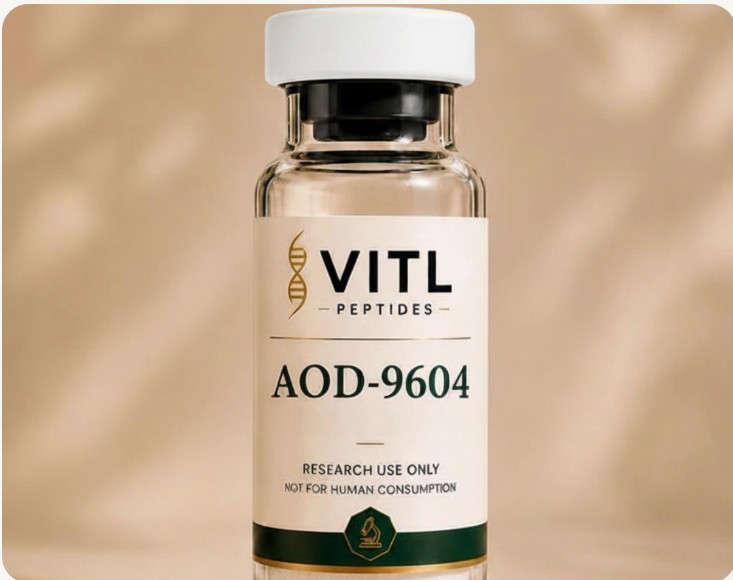
For example, VITL Peptides currently offers AOD-9604 as a 5 mg research-use-only vial, with batch-specific HPLC purity documentation and a stated purity of greater than 99%. The product is expressly labeled for laboratory research and not for human or veterinary consumption.
Oral or Sublingual Products
Some online sellers advertise capsules, tablets, lozenges, or sublingual formulations.
However, these products are not FDA-approved AOD-9604 medications, and their bioavailability and clinical effectiveness should not be assumed based simply upon the product format.
Topical Products
AOD-9604 has sometimes been marketed in topical preparations, usually with claims related to localized fat reduction.
There is currently insufficient high-quality human evidence demonstrating that topical AOD-9604 produces meaningful localized fat loss.
Does AOD-9604 Target Specific Areas of Fat?
Claims that AOD-9604 can selectively remove abdominal fat, “love handles,” or other specific fat deposits should be treated cautiously.
There is no strong clinical evidence demonstrating that the peptide can direct meaningful fat loss toward a particular location.
Fat distribution is influenced by:
genetics
sex hormones
age
overall energy balance
insulin sensitivity
and adrenergic receptor distribution.
Even compounds capable of increasing systemic lipolysis do not necessarily permit a person to choose where fat is removed.
AOD-9604 and Appetite
AOD-9604 is fundamentally different from modern GLP-1-based weight-loss medications.
Semaglutide, tirzepatide, and retatrutide affect powerful appetite and satiety pathways.
AOD-9604 was instead designed primarily to influence fat metabolism.
It is therefore not generally considered an established appetite suppressant.
This is one reason comparing AOD-9604 directly with GLP-1 drugs can be misleading.
AOD-9604 Versus Semaglutide and Tirzepatide
The compounds operate through completely different mechanisms.
AOD-9604: experimental growth-hormone fragment primarily investigated for lipolysis.
Semaglutide: GLP-1 receptor agonist that influences appetite, gastric emptying, insulin secretion, and glucose regulation.
Tirzepatide: GLP-1/GIP dual agonist with substantial effects on appetite, glucose control, and body weight.
Modern GLP-1-based medications have demonstrated large and reproducible reductions in body weight through extensive randomized human trials.
AOD-9604 did not demonstrate comparable effectiveness during its obesity-development program.
That does not make the underlying science uninteresting, but it is important not to portray the evidence as equivalent.
Potential Side Effects and Safety
The safety profile of AOD-9604 is not as completely characterized as that of an FDA-approved medication.
Historical clinical research included reports of adverse events, although establishing causality can be difficult.
During its regulatory review, FDA noted concerns including reported events such as:
- Diarrhea
- Chest tightness
- Euphoria
- Other adverse events observed during development
FDA also highlighted uncertainty surrounding potential immunogenicity, particularly with injectable formulations.
Peptides can sometimes form impurities, aggregates, or altered molecular species capable of triggering immune responses.
FDA specifically noted insufficient information regarding the immunogenicity and safety risks of compounded AOD-9604 preparations.
The agency emphasized that limited data prevent regulators from confidently determining the safety of many proposed formulations.
Is AOD-9604 FDA Approved?
No.
AOD-9604 has never been approved by the FDA as a medication for obesity, fat loss, or any other medical condition.
Its obesity drug-development program was abandoned following disappointing Phase IIb results.
AOD-9604 and AOD-9604 acetate were later considered in connection with FDA’s Section 503A bulk drug substances process.
In December 2024, FDA’s Pharmacy Compounding Advisory Committee reviewed the compounds.
FDA concluded that the evidence regarding effectiveness and safety weighed against placing AOD-9604 on the 503A Bulks List. The agency cited insufficient evidence of effectiveness for obesity, limited safety information, product-characterization concerns, and possible immunogenicity risks.
The nominations were subsequently withdrawn, and FDA continues to identify AOD-9604 among substances for which potential safety concerns have been raised in connection with compounding.
Is AOD-9604 Banned in Competitive Sports?
Athletes should also be aware that AOD-9604 has historically been prohibited under anti-doping rules because it is a growth-hormone-derived peptide.
Professional and competitive athletes should check the most current World Anti-Doping Agency rules before exposure to any peptide or experimental compound.
The regulatory status of a compound for medical use and its status under anti-doping rules are separate issues.
Current Research and Future Potential
AOD-9604 is no longer being actively developed as a mainstream obesity medication in the way it was during the early 2000s.
Modern obesity research has largely shifted toward compounds such as:
GLP-1 agonists
GLP-1/GIP dual agonists
GLP-1/GIP/glucagon triple agonists
amylin analogs
and combinations of these pathways.
Nevertheless, AOD-9604 remains scientifically useful because it helps researchers understand the relationship between human growth hormone and lipid metabolism.
Research involving growth-hormone fragments may continue to provide insights into:
adrenergic regulation of adipose tissue
lipolysis
lipogenesis
growth-hormone signaling
and metabolic drug design.
In that sense, AOD-9604’s scientific importance may eventually prove greater than its effectiveness as a therapeutic drug.
The Bottom Line
AOD-9604 is a 16-amino-acid synthetic peptide derived from the C-terminal portion of human growth hormone.
It was developed with an ambitious goal: separate growth hormone’s apparent fat-metabolizing activity from its growth-promoting and broader endocrine effects.
Early laboratory and animal studies produced encouraging findings.
In obese mice, AOD-9604 increased lipolytic activity, influenced beta-3 adrenergic receptor expression, reduced body fat, and decreased weight gain.
These results justified advancing the compound into human clinical research.
However, the human story was much less impressive.
Although some early studies suggested modest effects, larger obesity trials failed to demonstrate sufficient weight loss compared with placebo. A study involving 536 participants did not achieve a significant weight-loss advantage, and development as an obesity drug was discontinued in 2007.
Therefore, AOD-9604 should not be described as a clinically proven weight-loss treatment.
There is no FDA-approved human dose, no FDA-approved AOD-9604 medication, and no established treatment protocol for obesity or fat loss.
Today, AOD-9604 is encountered primarily as a research peptide, generally in lyophilized laboratory vials. VITL Peptides, for example, currently lists a 5 mg AOD-9604 research vial that is explicitly designated for laboratory research only and not for human or veterinary consumption.
Despite its failure as a commercial obesity medication, AOD-9604 remains an interesting chapter in metabolic research.
It demonstrates how researchers can isolate specific regions of a much larger hormone and investigate whether individual biological effects can be separated from the hormone’s broader activity.
Perhaps the most accurate way to describe AOD-9604 today is as an experimental growth-hormone fragment with genuine preclinical activity involving fat metabolism, but limited evidence of clinically meaningful weight loss in humans.
For researchers studying adipose tissue, lipolysis, growth-hormone fragments, and metabolic signaling, that history still makes AOD-9604 an interesting laboratory compound.
For consumers, however, the distinction between promising animal research and demonstrated human effectiveness is essential.
Educational and research notice: This article is provided for scientific and educational information only. It is not medical advice or a recommendation for human use of AOD-9604. Doses mentioned are descriptions of historical animal or human research protocols and should not be interpreted as personal dosing instructions. AOD-9604 is not FDA-approved for weight loss, obesity, or any other medical condition.