

HPLC and Mass Spectrometry: How Research Peptide Purity and Identity Are Tested
Two abbreviations appear constantly in discussions about research peptide quality:
HPLC and MS.
HPLC stands for High-Performance Liquid Chromatography.
MS stands for Mass Spectrometry.
Together, these analytical technologies provide researchers with powerful tools for examining peptide samples.
Yet the two techniques do very different things.
Understanding the difference helps explain why reputable peptide analysis frequently uses both.
The Challenge of Testing Peptides
A peptide isn’t simply a generic white powder.
Its biological and chemical properties depend heavily on its amino-acid sequence and molecular structure.
During chemical peptide synthesis, numerous unwanted products can potentially form.
FDA documents note that solid-phase peptide synthesis can produce peptide-related impurities through mechanisms including incomplete coupling reactions, truncations and side reactions. Residual process materials can potentially arise as well.
Researchers therefore need analytical techniques capable of separating and identifying substances within complex samples.
That’s where HPLC and mass spectrometry become extremely useful.
What Is HPLC?
High-Performance Liquid Chromatography is a technique used to separate components in a mixture.
Imagine having several substances mixed together in a solution.
If researchers could separate those substances as they moved through an instrument, they could begin determining how many detectable components were present and their relative amounts.
That is essentially what chromatography accomplishes.
How HPLC Works
The peptide sample is dissolved and introduced into a flowing liquid known as the mobile phase.
That liquid carries the sample through a column containing a stationary phase.
Different compounds interact differently with these two phases.
Some move through the column more quickly.
Others are retained longer.
The result is separation over time.
As substances exit the column, a detector measures them.
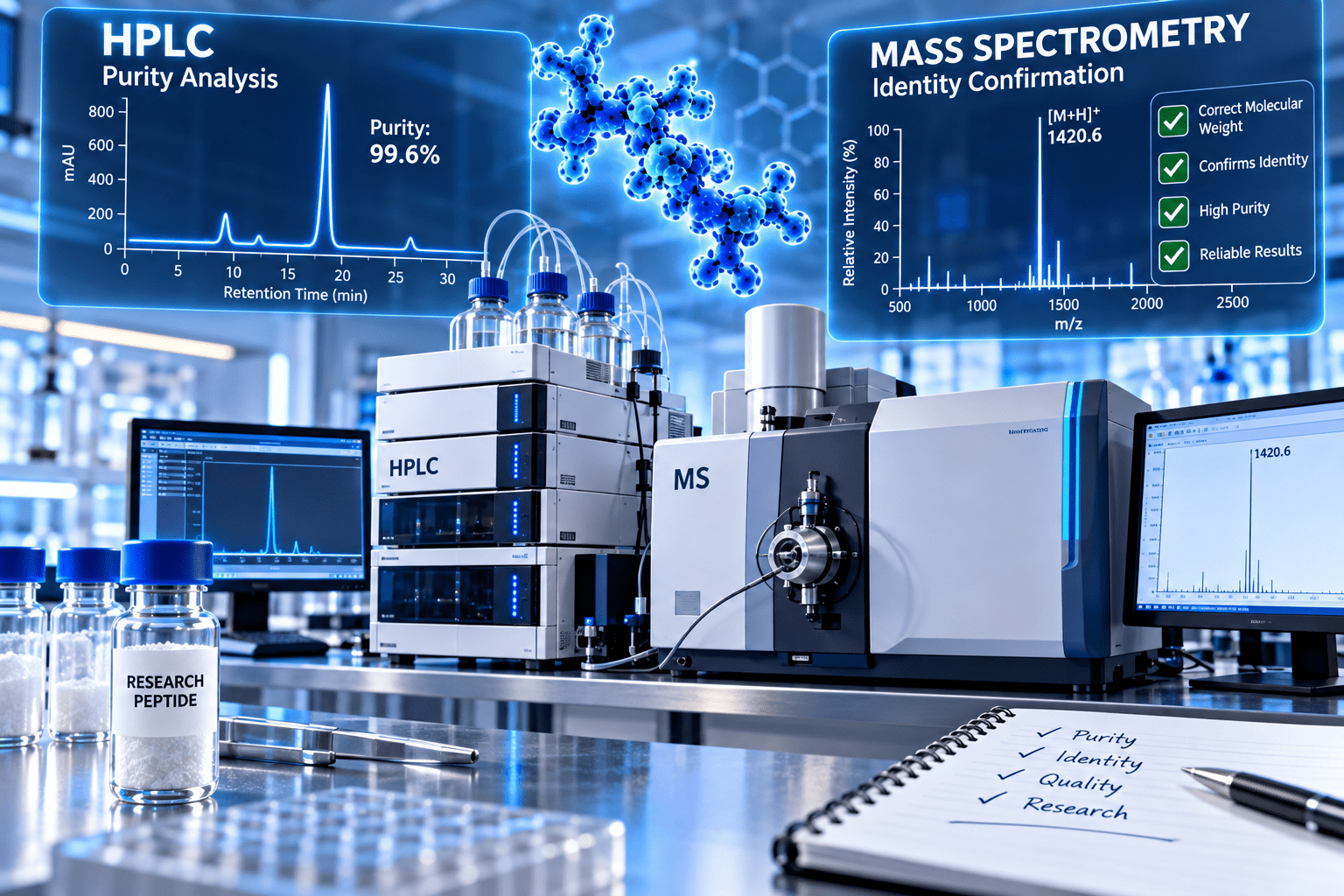
The instrument then generates a graph known as a chromatogram.
Understanding the Chromatogram
A typical chromatogram contains a horizontal axis representing retention time and a vertical axis representing detector response.
Peaks appear as compounds are detected.
Ideally, a highly purified peptide produces one dominant peak corresponding to the target material.
Smaller peaks may represent other detectable substances.
Software integrates the area under the peaks and can calculate relative chromatographic purity.
For example, if the principal peak accounts for approximately 99.2% of the integrated detectable peak area under the analytical conditions, the sample may be reported as approximately:
99.2% HPLC purity
But that statement requires an important qualification.
What HPLC Purity Does NOT Necessarily Mean
A reported 99.2% chromatographic purity does not necessarily mean that 99.2% of the total physical mass inside a vial consists of peptide molecules.
Why?
Because different substances may respond differently—or not at all—to a particular detector and analytical method.
A sample can contain things such as:
- water
- counterions
- salts
- residual solvents
- other non-peptide components
depending on its manufacturing and formulation history.
Therefore, HPLC purity should be understood as a method-dependent analytical measurement, not automatically interpreted as total peptide content by weight.
Reverse-Phase HPLC
One of the most commonly used approaches for peptide analysis is reverse-phase HPLC, often abbreviated RP-HPLC.
Peptides can be separated according to differences in their interactions with the stationary phase and mobile phase.
Researchers can modify solvent composition during the run, producing a gradient that helps different compounds elute from the column.
This makes RP-HPLC useful for peptide purification as well as analytical characterization.
But HPLC Has a Limitation
Suppose HPLC reveals one enormous peak.
Excellent.
But what molecule produced it?
Chromatography alone does not always provide definitive structural identity.
This is where mass spectrometry becomes extremely valuable.
What Is Mass Spectrometry?
Mass spectrometry analyzes ionized molecules according to their mass-to-charge ratio, usually written as m/z.
The basic process involves:
- Introducing the sample
- Ionizing molecules
- Separating ions according to m/z
- Detecting those ions
- Producing a mass spectrum
Peptides often form ions carrying multiple charges.
Analytical software can use the observed charge states to determine the molecular mass associated with the peptide.
Why Molecular Mass Matters
A particular peptide sequence has a predictable molecular mass.
If researchers know the expected sequence, they can calculate what molecular mass should result.
Mass spectrometry then provides an experimental measurement.
When the experimentally observed mass agrees closely with the expected mass, that provides important evidence supporting identity.
Thus:
HPLC helps evaluate separation and chromatographic purity.
Mass spectrometry helps evaluate molecular identity.
The two methods complement each other.
LC-MS: Combining the Technologies
Scientists frequently combine liquid chromatography directly with mass spectrometry.
This is known as LC-MS.
Instead of simply separating compounds and detecting them through a conventional chromatographic detector, compounds exiting the chromatography system enter a mass spectrometer.
Researchers can then ask not merely:
“How many peaks are present?”
but also:
“What molecular species are associated with those peaks?”
This can dramatically improve analytical capability.
High-Resolution Mass Spectrometry
More advanced instruments can measure molecular masses with extremely high precision.
High-resolution mass spectrometry becomes especially useful when researchers need to characterize compounds that are structurally similar.
FDA guidance concerning synthetic peptides specifically recommends sensitive, high-resolution analytical procedures such as UHPLC-HRMS when evaluating certain peptide-related impurities.
UHPLC stands for Ultra-High-Performance Liquid Chromatography.
HRMS stands for High-Resolution Mass Spectrometry.
Combining them gives scientists powerful separation plus highly precise mass information.
Why Peptide Impurities Can Be Difficult
Consider a simplified peptide containing dozens of amino acids.
Now imagine that during synthesis:
- one amino acid is omitted
- an incorrect amino acid is incorporated
- a side reaction modifies part of the molecule
- part of the sequence becomes truncated
The resulting molecule may be remarkably similar to the desired peptide.
Simple analytical methods may have difficulty distinguishing closely related substances.
FDA’s synthetic-peptide guidance recognizes this problem and discusses identification of peptide-related impurities because differences may potentially affect physicochemical properties, biological activity or immunogenicity risk.
What Is Retention Time?
When examining an HPLC report, researchers often see a value called retention time.
This refers to how long a compound takes to travel through the chromatographic system and reach the detector under a specific analytical method.
Retention time can help characterize a substance.
However, retention time isn’t an absolute universal fingerprint.
Changing factors such as the column, solvents, gradient, temperature or flow conditions can change retention behavior.
That’s why analytical reports should ideally provide information about the method used.
What Does Peak Area Mean?
Chromatography software can calculate the area underneath each detected peak.
Those areas may be compared to determine relative chromatographic composition.
If the principal peak accounts for almost all integrated peak area, the material demonstrates high chromatographic purity under those analytical conditions.
But once again:
Peak-area percentage should not automatically be treated as total mass percentage.
Understanding that distinction prevents one of the most common misconceptions surrounding peptide testing.
Why Identity and Purity Should Be Evaluated Separately
Consider two hypothetical scenarios.
Scenario One
Mass spectrometry finds the expected molecular mass.
That’s encouraging.
But HPLC reveals numerous secondary peaks.
The target peptide may be present, but the sample may contain substantial related impurities.
Scenario Two
HPLC produces one beautiful dominant peak.
But mass analysis does not correspond to the expected peptide.
The material may be chromatographically pure—but potentially the wrong compound.
This is why the combination is powerful.
Researchers want evidence supporting both:
IDENTITY + PURITY
Can HPLC/MS Prove Sterility?
No.
This is another extremely important distinction.
HPLC and mass spectrometry are chemical analytical methods.
They do not automatically establish:
- sterility
- bacterial contamination
- fungal contamination
- endotoxin concentration
Those characteristics require appropriate microbiological or other specialized tests.
A sample can have excellent chromatographic purity while still lacking evidence concerning microbiological characteristics.
Why Independent Testing Can Be Valuable
Peptide testing performed by an independent analytical laboratory can provide additional confidence because the laboratory performing the analysis is separate from the company selling the material.
But researchers should examine the actual report rather than relying solely on the phrase “third-party tested.”
Useful questions include:
- Which laboratory performed the test?
- Which batch was analyzed?
- When was it tested?
- Was HPLC performed?
- Was mass spectrometry performed?
- Is the chromatogram included?
- Is the mass spectrum included?
- Does the observed mass correspond with expectation?
These questions transform analytical testing from marketing language into something researchers can actually evaluate.
Analytical Science Is Continuing to Improve
Peptide testing is becoming increasingly sophisticated.
As researchers design longer, modified and multi-functional peptides, analytical methods must evolve with them.
High-resolution LC-MS can provide information about related impurities that simpler measurements may miss.
FDA guidance reflects this reality by emphasizing sensitive, high-resolution analytical approaches for characterization of certain synthetic-peptide impurity profiles.
The future of peptide quality control will therefore involve more—not less—analytical sophistication.
The Bottom Line
HPLC and mass spectrometry answer different questions.
Think of them this way:
HPLC asks:
How well separated is the target from other detectable components, and what does the chromatographic purity profile look like?
Mass spectrometry asks:
Does the molecular mass of the detected substance correspond with what we expect?
Together, they provide researchers with a far more useful picture than either a product label or an unsupported purity claim.
When someone says a research peptide is “99% pure,” the scientifically useful response isn’t simply:
“Great.”
It is:
How was that determined—and was its identity independently confirmed?
That question is at the heart of meaningful peptide analysis.