


AHK-Cu: A Comprehensive Guide to Uses, Research, Dosing Information, Forms, and Potential Benefits
AHK-Cu is one of the lesser-known members of the copper peptide family, but it has attracted growing interest among researchers and cosmetic formulators—particularly in the area of hair follicle biology, scalp health, tissue remodeling, and regenerative research.
AHK-Cu is closely related to the much better-known copper peptide GHK-Cu. The two compounds differ by only one amino acid, yet they should not be treated as interchangeable. GHK-Cu has accumulated a considerably larger body of scientific literature, while direct research specifically involving AHK-Cu remains relatively limited.
That distinction is important. AHK-Cu has produced some intriguing laboratory findings, particularly involving human hair follicles and dermal papilla cells, but it has not been established through large controlled human clinical trials as a treatment for hair loss or another medical condition.
So what exactly is AHK-Cu, why are researchers interested in it, and what does the available science actually tell us?
What Is AHK-Cu?
AHK-Cu is a copper-binding tripeptide composed of three amino acids:
Alanine – Histidine – Lysine
The abbreviation AHK comes directly from these amino acids:
- A = Alanine
- H = Histidine
- K = Lysine
The peptide binds, or chelates, a copper ion—hence the designation AHK-Cu.
Chemically, it is generally described as the copper(II) complex of L-alanyl-L-histidyl-L-lysine.
This makes AHK-Cu extremely similar structurally to GHK-Cu. GHK-Cu consists of:
Glycine – Histidine – Lysine
AHK-Cu consists of:
Alanine – Histidine – Lysine
In other words, alanine replaces glycine at the first position.
That appears to be a relatively minor molecular modification, but even small structural changes can influence how a peptide interacts with biological systems.
Unlike naturally occurring GHK-Cu, AHK-Cu is generally considered a synthetic copper-binding peptide analogue.
Why Copper Peptides Are Interesting
Copper is an essential trace element involved in numerous biological processes. Among other functions, copper participates in enzymes involved with connective tissue formation, antioxidant defense, cellular metabolism and tissue remodeling.
Free copper, however, must be carefully controlled within biological systems. Peptides capable of binding copper provide researchers with an interesting mechanism through which copper may be transported or presented to cells.
This has led to decades of investigation into copper-binding peptides.
AHK-Cu belongs to this broader family, although its direct research history is far smaller than that of GHK-Cu.
Its most interesting research area to date is undoubtedly hair follicle biology.
AHK-Cu and Hair Research
The study most frequently cited in discussions of AHK-Cu examined its effects on human hair follicles and cultured dermal papilla cells.
Dermal papilla cells are specialized cells located near the base of hair follicles. They play an important role in regulating hair-follicle development, cycling and growth.
Researchers therefore investigate compounds capable of influencing dermal papilla cells when studying the biological mechanisms behind hair growth.
In a published 2007 study, researchers evaluated AHK-Cu using isolated human hair follicles maintained outside the body as well as cultured human dermal papilla cells.
The researchers reported that very low concentrations of AHK-Cu—between approximately 10⁻¹² and 10⁻⁹ M—stimulated elongation of human hair follicles in the experimental model.
AHK-Cu also increased proliferation of cultured dermal papilla cells.
The researchers concluded that AHK-Cu appeared to promote hair-follicle growth in this laboratory model, potentially in part through increased dermal papilla cell proliferation and effects on pathways associated with programmed cell death.
These results help explain why AHK-Cu has become particularly interesting in the hair and scalp research community.
There is, however, an extremely important limitation.
These experiments involved isolated human follicles and cultured cells outside the human body. They were not clinical trials in which people with hair loss applied AHK-Cu and experienced measured hair regrowth.
That distinction should not be overlooked.
Dermal Papilla Cell Proliferation
One of the more interesting observations from the AHK-Cu research involved dermal papilla cell proliferation.
Hair follicles are dynamic mini-organs that repeatedly move through different phases, including:
Anagen: active growth
Catagen: transition
Telogen: resting
The dermal papilla plays an important regulatory role within this process.
Researchers found that AHK-Cu stimulated proliferation of dermal papilla cells under laboratory conditions.
This finding provides a plausible biological explanation for the follicle elongation observed in the same research.
It does not prove that applying AHK-Cu to a person’s scalp will produce clinically significant hair regrowth, but it provides an interesting mechanism worthy of further investigation.
AHK-Cu and Cellular Survival
Researchers have also investigated whether AHK-Cu could influence apoptosis.
Apoptosis is programmed cell death—a highly regulated biological mechanism cells use to eliminate damaged or unnecessary cells.
In the AHK-Cu hair study, researchers examined several molecular markers associated with apoptosis.
Treatment with AHK-Cu was associated with changes in proteins involved in cellular survival, including an increased Bcl-2/Bax ratio and reduced levels of cleaved caspase-3 and PARP.
These observations led researchers to propose that AHK-Cu’s effects on dermal papilla cells could involve both encouraging proliferation and reducing certain signals associated with apoptosis.
Again, these are laboratory findings rather than demonstrated clinical effects in humans.
AHK-Cu and VEGF
Another frequently discussed area surrounding copper peptides involves vascular endothelial growth factor, better known as VEGF.
VEGF plays an important role in angiogenesis—the biological formation of new blood vessels.
Hair follicles are metabolically active structures, particularly during the growth phase, and vascular support surrounding follicles is an important component of normal follicular biology.
Copper-peptide research has therefore generated interest in possible relationships between copper peptides, VEGF and tissue vascularization.
This is one reason AHK-Cu continues to attract attention as a research compound for scalp and follicular biology.
However, broader findings involving copper peptides should not automatically be attributed specifically to AHK-Cu. Much of the larger copper-peptide literature involves GHK-Cu or other copper-peptide compounds, not AHK-Cu itself.
AHK-Cu vs. GHK-Cu
AHK-Cu and GHK-Cu are easy to confuse.
Both are tripeptides.
Both contain histidine and lysine.
Both bind copper.
Both have been discussed within cosmetic and regenerative research.
But they are different molecules.
GHK-Cu
Sequence:
Gly-His-Lys-Cu
GHK-Cu has been investigated extensively in connection with areas such as:
- Extracellular matrix remodeling
- Collagen
- Fibroblast biology
- Skin appearance
- Wound biology
- Inflammation
- Hair and follicular biology
AHK-Cu
Sequence:
Ala-His-Lys-Cu
The direct published evidence surrounding AHK-Cu is substantially smaller and has focused particularly on:
- Human hair follicles ex vivo
- Dermal papilla cells
- Cellular proliferation
- Apoptosis-related pathways
- Hair-follicle biology
This means it would be scientifically inappropriate to simply take every reported benefit of GHK-Cu and assume AHK-Cu produces exactly the same result.
Structural similarity is interesting—but it is not the same thing as clinical evidence.
Potential Hair and Scalp Applications
Because of the laboratory findings involving follicles and dermal papilla cells, AHK-Cu has found its way into discussions surrounding cosmetic hair products.
Potential areas of interest include research into:
Hair density
Researchers are interested in whether modulation of follicular signaling could eventually influence hair density.
Hair-follicle growth
The direct AHK-Cu study found increased follicular elongation under ex vivo experimental conditions.
Dermal papilla health
AHK-Cu’s effects on dermal papilla cell proliferation remain one of its most interesting characteristics.
Scalp environment
Copper peptides are broadly investigated for their interactions with skin and connective tissue, generating interest in scalp-oriented formulations.
None of these should be interpreted as proof that AHK-Cu treats androgenetic alopecia or other forms of hair loss.
Potential Skin Applications
AHK-Cu is sometimes marketed as a skin or anti-aging peptide because of its structural relationship with GHK-Cu.
Claims commonly encountered include potential effects involving:
- Skin firmness
- Collagen
- Elasticity
- Fine lines
- Tissue remodeling
- Antioxidant activity
- Wound repair
These ideas are scientifically interesting, but this is an area where separating AHK-Cu evidence from GHK-Cu evidence becomes especially important.
GHK-Cu has a much more substantial body of published skin research.
Direct evidence establishing the same skin benefits specifically for AHK-Cu is much thinner.
Therefore, descriptions of AHK-Cu as a proven anti-aging or collagen-restoring ingredient go beyond what the current AHK-specific evidence can firmly establish.
Forms of AHK-Cu
AHK-Cu may be encountered in several forms within the research and cosmetic marketplace.
Topical Serums
Topical serum is perhaps the most logical and commonly discussed form because AHK-Cu has generated interest primarily in hair, scalp and cosmetic research.
These formulations may be designed for application to either the scalp or skin.
Hair and Scalp Formulations
AHK-Cu may appear as an ingredient in specialized scalp products.
These can include:
- Hair serums
- Scalp serums
- Leave-in formulations
- Cosmetic hair-growth-support products
- Multi-peptide scalp formulations
The actual amount of AHK-Cu can vary considerably among formulations.
Creams and Lotions
AHK-Cu can also be incorporated into cosmetic creams or lotions, although much of the enthusiasm surrounding topical copper peptides in skin care historically derives from research involving GHK-Cu.
Lyophilized Research Material
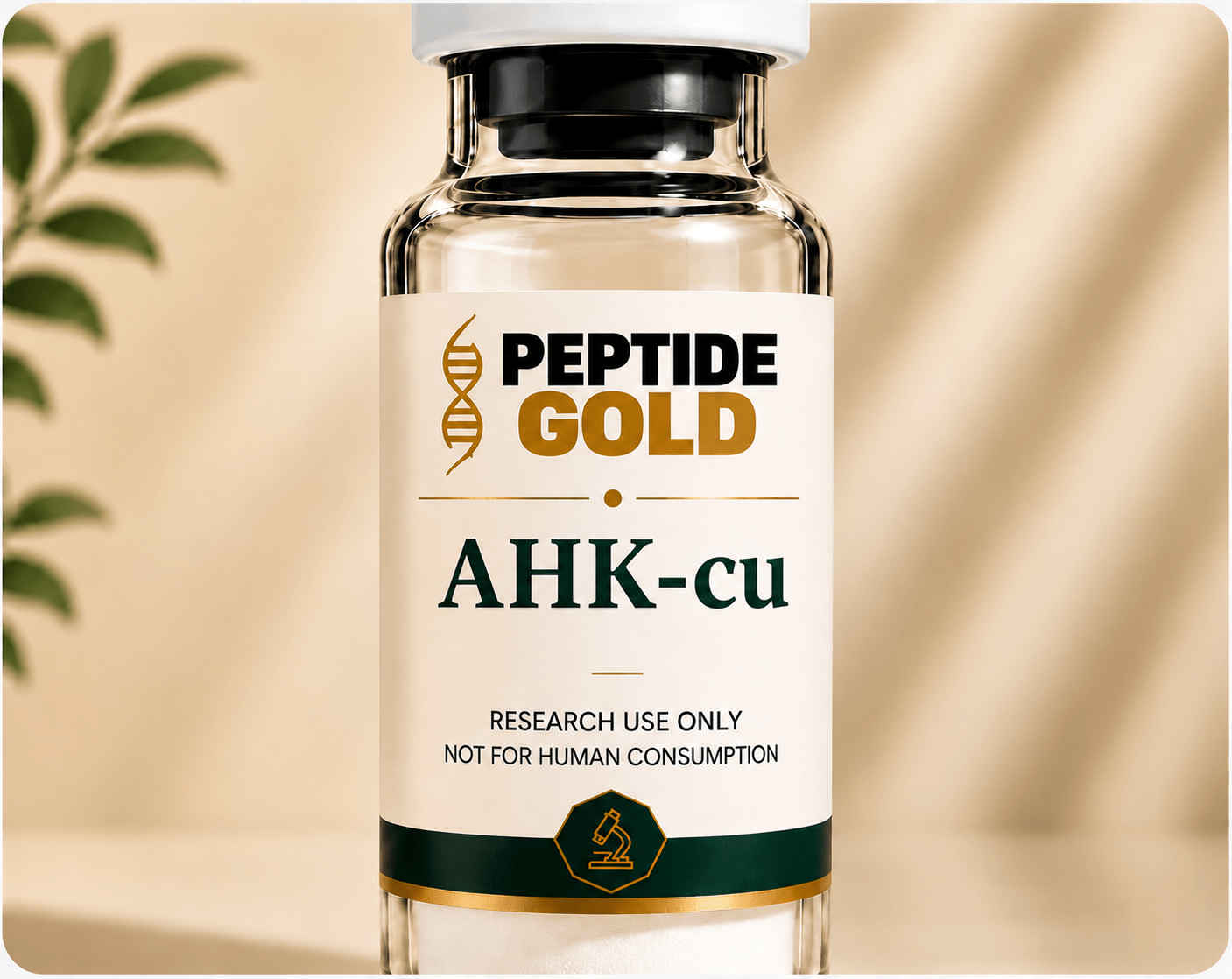
AHK-Cu may also be supplied to laboratories as a research material or powder for experimental purposes.
The presence of a compound in a research vial does not establish that it has been approved, tested or manufactured for injection into humans.
AHK-Cu Dosing and Concentration Information
This is one of the areas where considerable caution is necessary.
There is currently no FDA-approved AHK-Cu medication and no established FDA-approved human dosing schedule for AHK-Cu.
There is also no well-established clinical titration schedule comparable to approved medicines such as semaglutide, tirzepatide or tesamorelin.
The strongest direct AHK-Cu research instead used laboratory concentrations.
In the frequently cited human hair-follicle study, researchers evaluated concentrations approximately between:
10⁻¹² M and 10⁻⁹ M
These are extremely small experimental molar concentrations used in cultured follicles and cells.
Importantly, these values should not be converted into an injection dose or personal treatment schedule.
They describe concentrations in a laboratory experimental environment—not dosing in a living person.
Some commercial cosmetic sources provide concentrations for topical AHK-Cu products, but there is currently no universally established clinical concentration demonstrated through large randomized human trials to regrow hair.
Therefore, claims that there is a scientifically established AHK-Cu “hair-loss dose” should be treated cautiously.
Is There an Injectable AHK-Cu Dose?
No validated clinical injectable dose for AHK-Cu has been established.
Research vendors may sell AHK-Cu in vial form, and online communities may discuss experimental injection protocols. Neither establishes an evidence-based medical dosage.
There are no robust human pharmacokinetic studies defining parameters such as:
- Injectable bioavailability
- Human half-life
- Optimal systemic exposure
- Maximum tolerated dose
- Long-term injectable safety
- Therapeutic injection frequency
For that reason, presenting a specific injectable AHK-Cu protocol as an established dosage would be misleading.
Does AHK-Cu Require Titration?
There is no recognized clinical AHK-Cu titration schedule.
Titration generally involves progressively changing a medication dose to achieve a therapeutic target or improve tolerability.
Because AHK-Cu does not have an established pharmaceutical treatment protocol, there is no standardized medical titration schedule to reference.
Is More AHK-Cu Better?
Not necessarily.
This is an especially important concept with biologically active signaling compounds.
Biological responses are not always linear.
A concentration that produces an interesting cellular response does not mean that doubling, tripling or multiplying that concentration will produce an even stronger beneficial response.
Indeed, laboratory data suggest that the relationship between AHK-Cu concentration and follicular response may be concentration-dependent rather than simply “more equals better.”
This reinforces why laboratory concentration data should not be casually converted into consumer dosing instructions.
How Strong Is the Current Research?
This is where AHK-Cu needs to be placed in perspective.
There is legitimate published research supporting biological interest in the compound.
The 2007 human follicle study is particularly interesting because researchers worked with human-derived hair follicles and human dermal papilla cells rather than relying exclusively on an unrelated animal model.
Researchers observed follicular elongation and dermal papilla cell proliferation at low experimental concentrations.
Those are meaningful findings.
But the next step would ideally be controlled human clinical trials.
Researchers would need to determine questions such as:
- Does topical AHK-Cu increase hair count?
- Does it increase terminal hair density?
- Does it increase hair-shaft diameter?
- What concentration works best?
- How effectively does AHK-Cu penetrate human scalp?
- How often should it be applied?
- How does it compare with placebo?
- How does it compare with established hair-loss treatments?
- How does it compare directly with GHK-Cu?
- What happens after six months or one year?
- Are there meaningful long-term adverse effects?
At present, these questions remain largely unanswered.
Potential Benefits Being Investigated or Discussed
Based on the existing laboratory evidence and broader copper-peptide research, AHK-Cu is associated with several areas of interest.
1. Hair-Follicle Growth
This is the strongest AHK-Cu-specific research area.
AHK-Cu stimulated elongation of isolated human hair follicles under experimental conditions.
2. Dermal Papilla Cell Proliferation
AHK-Cu increased proliferation of cultured dermal papilla cells, which are important components of hair-follicle biology.
3. Cellular Survival
Experimental findings involving apoptosis-related proteins suggest another possible mechanism through which AHK-Cu could influence dermal papilla cell biology.
4. Tissue Remodeling
Copper peptides broadly participate in research surrounding tissue remodeling, although much of the evidence in this category involves GHK-Cu rather than AHK-Cu specifically.
5. Cosmetic Skin Research
AHK-Cu appears in some cosmetic formulations, but its skin evidence should not be confused with the considerably larger GHK-Cu literature.
6. Future Hair-Loss Research
Perhaps the most compelling potential benefit of AHK-Cu today is simply that it provides researchers with another molecular pathway worth investigating.
A compound that can influence human hair follicles and dermal papilla cells in controlled laboratory experiments deserves further study.
Whether those laboratory findings ultimately translate into meaningful hair restoration in people remains an open question.
Safety Considerations
Because clinical AHK-Cu research is limited, comprehensive human safety data are also limited.
Topical cosmetic exposure is fundamentally different from systemic administration.
Consumers should not assume that because a compound appears in topical cosmetic products, it has therefore been demonstrated safe for injection.
Copper itself is biologically essential, but excessive copper exposure can also be harmful. Copper homeostasis is tightly regulated within the human body.
Product quality is another consideration.
For research materials, analytical testing may include characteristics such as:
- Compound identity
- Peptide purity
- Copper content
- Molecular characterization
- Contaminant testing
- Batch documentation
If material is intended for sterile laboratory experiments, chemical purity alone does not establish sterility.
A product described as “99% pure,” for example, is not automatically sterile, endotoxin-free or appropriate for human administration.
Where AHK-Cu Research Could Go Next
AHK-Cu is an excellent example of why peptide research can be so fascinating.
A molecule consisting of only three amino acids complexed with copper produced measurable effects in laboratory models involving human hair follicles.
That raises numerous possibilities for future investigation.
Researchers could eventually examine AHK-Cu alone and in combination with established approaches to hair loss.
Direct comparisons between AHK-Cu and GHK-Cu would also be particularly valuable.
Other important research questions include scalp penetration, delivery systems, optimal topical formulation, follicular targeting and long-term biological effects.
Advanced delivery technologies could potentially become especially relevant because getting a peptide to the appropriate location within skin or follicular structures can be just as important as the biological activity of the peptide itself.
The Bottom Line on AHK-Cu
AHK-Cu is a fascinating but still relatively under-researched copper peptide.
Its structure is simple:
Alanine + Histidine + Lysine + Copper
Yet its effects in experimental human hair-follicle models have generated considerable interest.
The strongest direct evidence indicates that low experimental concentrations of AHK-Cu can stimulate human hair-follicle elongation and dermal papilla cell proliferation under laboratory conditions.
That makes AHK-Cu an intriguing candidate for continued hair, scalp and follicular research.
At the same time, enthusiasm should remain proportional to the evidence.
AHK-Cu does not currently have the extensive clinical literature associated with established hair-loss treatments, nor does it possess the decades of broader copper-peptide research associated with GHK-Cu.
There is no established FDA-approved AHK-Cu dose, no validated injectable protocol, and no standardized clinical titration schedule.
For now, AHK-Cu is best viewed as an interesting copper tripeptide with promising laboratory findings—particularly in hair-follicle biology—that deserves considerably more controlled human research.
That combination of intriguing early science and substantial unanswered questions is precisely what makes AHK-Cu worth watching as peptide research continues to evolve.
Disclaimer
This article is provided for educational and informational purposes only and is intended to discuss AHK-Cu, copper peptides and the current state of scientific research. AHK-Cu is not FDA approved as a drug for treating hair loss, skin aging or other medical conditions. References to laboratory concentrations, experimental protocols, commercial formulations or research findings are provided to explain published research and should not be interpreted as medical advice, prescribing information, or instructions for human use. Laboratory and ex vivo concentrations cannot be directly translated into safe or effective human dosing. Research peptides sold for laboratory use should not be assumed to be sterile, pharmaceutical-grade or appropriate for human administration. Anyone considering a medical treatment for hair loss, skin conditions or another health concern should consult an appropriately licensed healthcare professional.