
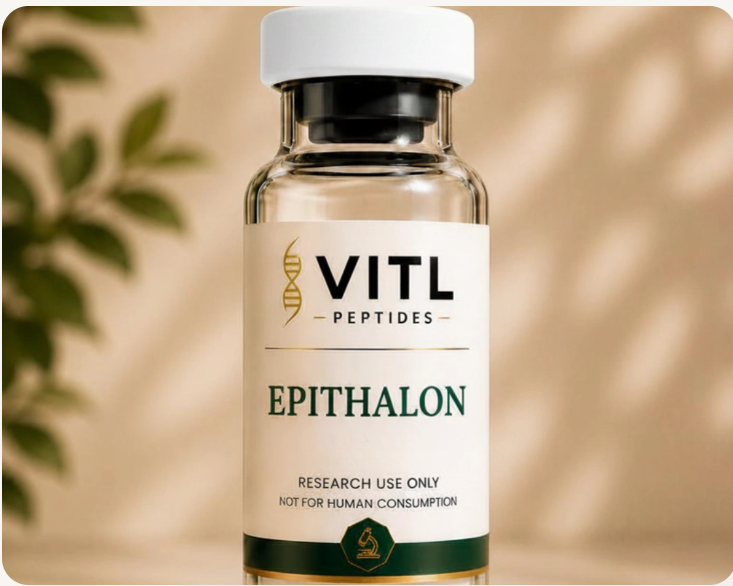
Epithalon: A Comprehensive Guide to Uses, Research, Dosing, Forms, and Potential Benefits
Epithalon, also commonly spelled Epitalon, is an experimental peptide that has attracted attention primarily because of research involving telomeres, telomerase, cellular aging, melatonin production, circadian rhythms, and longevity.
Unlike many metabolic or growth-hormone-related peptides, Epithalon is extremely small. It consists of only four amino acids:
Ala-Glu-Asp-Gly
or
AEDG.
That makes it a tetrapeptide.
Epithalon was developed from research involving the pineal gland and a related preparation known as Epithalamin, a complex extract derived from pineal tissue. Researchers led by Vladimir Khavinson in Russia subsequently developed the defined four-amino-acid peptide now known as Epithalon.
Over the years, extraordinary claims have accumulated around the compound.
Epithalon is frequently described online as a peptide that may:
lengthen telomeres
activate telomerase
slow aging
extend lifespan
improve sleep
restore melatonin production
and potentially protect against age-related disease.
Some of these ideas are based on real laboratory findings.
However, the quality of evidence varies enormously.
The strongest telomere-related findings come from cells grown in laboratories, not people treated with the peptide. Animal studies have produced intriguing longevity findings, but no clinical study has demonstrated that Epithalon extends human lifespan.
As of 2026, Epithalon remains investigational and is not FDA-approved for aging, insomnia, longevity, telomere lengthening, or any other medical condition. FDA’s most recent review also found no clinical studies specifically assessing its safety in humans.
What Is Epithalon?
Epithalon is a synthetic four-amino-acid peptide with the sequence:
Alanine – Glutamic Acid – Aspartic Acid – Glycine
The abbreviation AEDG comes from the standard one-letter codes for these amino acids.
The compound was developed from research involving Epithalamin, a mixture of peptides extracted from the pineal gland.
It is important not to confuse the two.
Epithalamin is a complex biological extract containing multiple substances.
Epithalon is a precisely defined synthetic tetrapeptide.
This distinction becomes especially important when evaluating historical studies because some older research involved Epithalamin rather than Epithalon itself.
Results involving one substance should not automatically be attributed to the other.
Why the Pineal Gland?
The pineal gland is a small endocrine structure located deep within the brain.
Its best-known function is producing melatonin, the hormone closely involved in sleep-wake cycles and circadian rhythm.
Melatonin production generally changes with age.
Older adults commonly produce less nighttime melatonin than younger individuals, and circadian rhythms can become less robust.
Researchers studying pineal peptides became interested in whether specific molecules derived from or associated with the pineal gland might influence age-related changes in:
sleep
circadian rhythm
hormonal regulation
and perhaps broader processes associated with aging.
This line of investigation eventually led to Epithalon.
Why Is Epithalon Associated With Longevity?
The longevity reputation of Epithalon primarily comes from two areas:
animal lifespan research
and
telomere biology.
Some animal studies from the Russian research group associated with the development of Epithalon reported increased lifespan or changes in age-related pathology following peptide administration.
However, animal lifespan findings cannot be directly applied to humans.
The more widely discussed mechanism involves telomeres.
What Are Telomeres?
Telomeres are protective structures located at the ends of chromosomes.
A useful analogy is the plastic cap on the end of a shoelace.
Just as the cap protects the shoelace from fraying, telomeres help protect chromosomes from damage and inappropriate fusion.
Telomeres consist of repeating DNA sequences.
Each time many normal cells divide, their telomeres become slightly shorter.
Eventually, telomeres can become sufficiently short that cells stop dividing and enter a state known as cellular senescence.
This relationship between telomere shortening and cellular aging led scientists to investigate whether maintaining telomeres could influence aspects of aging.
What Is Telomerase?
Telomerase is an enzyme capable of rebuilding telomere sequences.
Most normal adult somatic cells have relatively little telomerase activity.
Some stem cells and reproductive cells maintain greater telomerase activity because they need to divide repeatedly.
Telomerase is also active in many cancer cells.
That allows malignant cells to continue dividing instead of reaching the normal replicative limit associated with telomere shortening.
This dual role makes telomerase scientifically fascinating.
Activating it could theoretically help maintain cellular replicative capacity.
But uncontrolled telomerase activity could potentially also have undesirable consequences.
Epithalon and Telomerase Research
One of the best-known Epithalon studies was published in 2003.
Researchers exposed human fibroblast cells to Epithalon in laboratory culture.
They reported that the peptide induced expression of the catalytic component of telomerase, increased telomerase activity, and produced telomere elongation.
Follow-up work from the same research group reported that Epithalon-treated aging fibroblasts continued dividing beyond the point at which untreated cells had lost proliferative capacity.
These findings form much of the scientific basis for claims that Epithalon is a “telomere peptide.”
However, there is a crucial distinction:
These were cells in a laboratory dish.
Researchers did not administer Epithalon to people and demonstrate that their telomeres became longer.
That human evidence does not currently exist.
Newer Telomere Research
Interest in Epithalon has recently resurfaced.
A 2025 study published in Biogerontology investigated Epithalon in several human cell lines and again found evidence of telomere-length changes.
Researchers reported dose-dependent telomere elongation in normal cells involving increased hTERT expression and telomerase activity.
This newer research is important because it provides additional laboratory evidence outside the earliest studies.
But it also raises an interesting safety question.
The researchers observed telomere-length effects in cancer cell lines as well, involving a process known as alternative lengthening of telomeres, or ALT.
That does not mean Epithalon causes cancer.
It does mean that manipulating telomere-maintenance mechanisms deserves considerably more safety research than simply assuming longer telomeres must always be beneficial.
Does Epithalon Lengthen Human Telomeres?
This is one of the most important misconceptions surrounding the compound.
At present:
No controlled human clinical trial has demonstrated that administering Epithalon lengthens telomeres in living people.
The telomere evidence comes primarily from cultured human cells.
That distinction matters enormously.
A compound can alter cells in laboratory culture without producing the same result in a complete human organism.
Questions involving:
absorption
distribution
metabolism
dose
tissue exposure
and immune effects
all become relevant once a compound is administered to a person.
FDA’s 2026 review specifically found that human pharmacokinetic data for Epithalon free base or Epithalon acetate were unavailable.
Does Epithalon Extend Lifespan?
There is currently no evidence demonstrating that Epithalon extends human lifespan.
Some animal experiments from the Khavinson research program reported longevity-related effects.
Those findings are one reason the compound became associated with anti-aging research.
But no trial has treated humans with Epithalon and demonstrated that those people lived longer.
Human lifespan research would require enormous studies lasting many years.
No such Epithalon program exists.
Claims that the compound has been “proven to extend human life” therefore go substantially beyond the available evidence.
Epithalon and Melatonin
The relationship between Epithalon and the pineal gland has also generated interest in melatonin production.
One small human study involved women working night shifts who had reduced urinary levels of a melatonin metabolite.
Participants received 0.5 mg per day of Epithalon sublingually for 20 days.
Researchers reported an increase in urinary 6-sulfatoxymelatonin, a commonly measured metabolite used to estimate melatonin production.
They also observed changes in expression of several genes involved in circadian regulation.
A 2025 scientific review reported that melatonin-related output increased roughly 1.6-fold compared with placebo in this study.
These findings are interesting because they suggest that Epithalon may influence circadian biology.
However, the study did not establish that participants slept better.
Epithalon and Sleep
Because Epithalon may affect melatonin-related pathways, it is often marketed as a sleep peptide.
People commonly discuss it in relation to:
falling asleep more easily
deeper sleep
better sleep quality
normalized circadian rhythm
and age-related sleep disruption.
But the clinical evidence is weak.
FDA evaluated Epithalon specifically for a proposed insomnia indication in 2026.
The agency concluded that it could not identify a clinical study evaluating Epithalon in patients who actually had insomnia.
The human melatonin study involved healthy night-shift workers and measured biological markers—not sleep onset, nighttime awakenings, sleep duration, sleep quality, or insomnia symptoms.
Therefore, describing Epithalon as a proven insomnia treatment would be inaccurate.
Epithalon and Circadian Rhythm
The circadian system controls approximately 24-hour biological rhythms involving:
sleep
body temperature
hormonal secretion
metabolism
and alertness.
In the human study mentioned above, Epithalon administration changed expression of several circadian-related genes, including Clock, Cry2, and Csnk1e.
Researchers interpreted these findings as evidence that Epithalon could potentially influence pineal function and biological timing.
This remains one of the more plausible and interesting research directions for the peptide.
However, changing gene expression does not automatically mean producing a meaningful clinical improvement.
Future trials would need to measure actual outcomes such as sleep timing, sleep efficiency, daytime alertness, or circadian phase.
Epithalon and Cellular Aging
Epithalon is also studied in connection with cellular senescence.
Senescent cells are cells that have stopped dividing but remain metabolically active.
They can accumulate with aging and contribute to inflammatory signaling and tissue dysfunction.
Because telomere shortening can trigger senescence, researchers have investigated whether Epithalon’s effects on telomerase could allow some cells to maintain proliferative capacity longer.
Laboratory experiments reported that Epithalon-treated fibroblasts exceeded their usual replicative limit.
This is scientifically interesting.
But again, maintaining cell division is not automatically equivalent to slowing human aging.
Aging involves many processes beyond telomeres, including:
mitochondrial dysfunction
epigenetic changes
DNA damage
protein aggregation
immune aging
stem-cell exhaustion
and metabolic changes.
Epithalon and Cancer Research
The relationship between Epithalon and cancer is particularly complicated.
Some older animal studies associated with the peptide’s original research program reported lower tumor incidence or delayed tumor development.
This contributed to claims that Epithalon might have cancer-protective effects.
However, those findings should not be interpreted as evidence that Epithalon prevents or treats cancer in humans.
The telomerase issue makes this especially important.
Many cancer cells depend upon telomerase or other telomere-maintenance mechanisms to continue dividing.
The 2025 cell study found that Epithalon influenced telomere-maintenance processes in cancer cell lines as well as normal cells.
It is therefore premature to assume that telomerase activation would always be desirable.
No controlled human evidence establishes Epithalon as a cancer-prevention or cancer-treatment compound.
Other Areas of Research
Epithalon has been discussed in connection with numerous additional potential effects.
These include:
antioxidant activity
immune regulation
retinal function
neuroendocrine regulation
stress resistance
skin aging
and general geroprotection.
Some older publications investigated retinal conditions, including retinitis pigmentosa.
Others examined age-related cellular changes and chromatin structure. For example, research involving cultured lymphocytes from older adults reported changes in chromatin activity after exposure to Epithalon.
These studies help explain why Epithalon became associated with broad “anti-aging” claims.
However, most of these findings have not been independently confirmed through modern large-scale clinical trials.
Epithalon Dosing Information
There is currently no FDA-approved human dose of Epithalon.
There is also no accepted clinical dosing schedule for:
longevity
anti-aging
sleep
telomere maintenance
or any other use.
Human research has used several very different experimental protocols.
One of the clearest modern examples involved 0.5 mg per day sublingually for 20 days in the circadian and melatonin study.
Other older Russian literature has described short parenteral courses involving milligram quantities, although many of those studies are difficult to interpret because some involve Epithalamin rather than the defined AEDG peptide.
FDA’s review is particularly important here.
The agency found no human pharmacokinetic data for either Epithalon free base or Epithalon acetate.
That means researchers still lack basic clinical information such as:
how long the compound remains in human circulation
how quickly it is metabolized
how exposure differs by route
and which doses produce biologically meaningful tissue concentrations.
Therefore, specific “anti-aging cycles” circulating online should not be confused with clinically validated dosing.
What Forms Is Epithalon Offered In?
Epithalon appears primarily in the research-material and compounding markets.
Lyophilized Powder
The most common research format is lyophilized, or freeze-dried, Epithalon.
Lyophilization removes water and can improve stability during transportation and storage.
The material is typically supplied in research vials containing specified milligram quantities.
Epithalon Free Base
The peptide may be encountered as the free-base form.
Epithalon Acetate
Epithalon acetate is another form used in research and considered in pharmacy-compounding discussions.
FDA reviewed both Epithalon free base and Epithalon acetate during its July 2026 Pharmacy Compounding Advisory Committee meeting.
Sublingual Preparations
Sublingual administration has been used in at least one human circadian study.
The study used 0.5 mg daily for 20 days.
Injectable Research Preparations
Epithalon is also sold in research markets as material that may be reconstituted experimentally.
However, a lyophilized vial should not automatically be assumed to be:
sterile
pharmaceutical grade
accurately concentrated
or suitable for human injection.
Potential Side Effects
A major challenge with Epithalon is that the human safety database is extremely limited.
It is common to find online claims that the peptide has very few side effects.
That statement is not supported by adequate clinical data.
FDA conducted a broad safety search covering PubMed, Embase, the Cochrane database, ClinicalTrials.gov, and adverse-event reporting systems.
The agency stated that it did not identify clinical studies specifically assessing the safety of Epithalon-related substances in humans.
FDA also found no relevant adverse-event reports in FAERS through December 2025, but the agency emphasized that absence of reports does not establish safety because under-reporting is substantial, particularly for compounded or research products.
Immunogenicity and Product Quality
As with many experimental peptides, some potential risks have less to do with the intended biological effect and more to do with the product itself.
FDA identifies possible concerns involving:
peptide aggregation
immunogenicity
peptide-related impurities
and difficulty characterizing compounded active ingredients.
The agency currently states that compounded Epithalon products may pose immunogenicity risks for certain routes of administration and that it lacks sufficient information to determine whether the compound could cause harm in humans.
This is particularly important for injectable formulations.
Is Epithalon FDA Approved?
No.
Epithalon is not FDA-approved for any medical condition.
There is no approved indication for:
anti-aging
longevity
telomere extension
insomnia
melatonin restoration
or age-related disease prevention.
In July 2026, FDA’s Pharmacy Compounding Advisory Committee formally considered Epithalon free base and Epithalon acetate for possible inclusion on the Section 503A Bulks List.
The specific use evaluated was insomnia.
FDA staff concluded that the available evidence did not establish effectiveness for insomnia and that adequate human safety information was lacking.
Importantly, consideration for pharmacy compounding is entirely separate from FDA drug approval.
Even if a substance is eventually permitted in certain compounded preparations, that does not mean FDA has approved it as safe and effective.
Current Research in 2026
Epithalon has recently received renewed scientific attention because of the 2025 telomere research.
That study provided modern evidence that Epithalon can influence telomerase, hTERT expression, and telomere length in cultured human cells.
This is meaningful mechanistic research.
But the major questions now require human trials.
Researchers need to determine whether administration to people actually changes:
telomerase activity
telomere length
biological aging markers
circadian rhythm
melatonin production
sleep quality
disease incidence
or eventually healthspan.
At present, those questions remain unanswered.
What Research Is Needed Next?
The next step should not be another longevity claim.
It should be basic pharmacology.
Researchers need to establish:
human absorption
distribution
half-life
metabolism
dose-response relationships
route-dependent bioavailability
and short- and long-term safety.
Only then could larger randomized trials reasonably investigate possible clinical applications.
For sleep-related research, investigators should measure:
sleep onset
nighttime awakenings
total sleep time
slow-wave sleep
REM sleep
sleep efficiency
and daytime functioning.
For aging research, modern studies could examine:
telomere length
epigenetic clocks
inflammatory markers
metabolic biomarkers
frailty
physical function
and eventually long-term health outcomes.
Independent replication is particularly important because much of the original Epithalon literature came from a relatively concentrated Russian research network.
The Bottom Line
Epithalon is one of the most fascinating experimental peptides associated with aging research.
It is an extremely small four-amino-acid peptide—Ala-Glu-Asp-Gly—derived from research involving pineal peptides and Epithalamin.
Its reputation rests largely on research involving:
telomerase
telomeres
cellular aging
melatonin
circadian rhythms
and animal longevity.
The strongest mechanistic evidence involves telomeres.
Laboratory studies demonstrated that Epithalon could activate telomerase and lengthen telomeres in cultured human cells.
More than two decades later, a 2025 study again reported telomere-length increases in human cell lines through increased hTERT expression and telomerase activity.
Those findings are scientifically significant.
But they do not demonstrate that Epithalon lengthens telomeres in people, slows human aging, or increases human lifespan.
No clinical trial has established those outcomes.
Small human research has also suggested that Epithalon may influence melatonin production and circadian gene expression. A study using 0.5 mg sublingually per day for 20 days reported increased urinary melatonin metabolites and changes in clock-related genes.
Again, however, biological changes are not the same as demonstrated clinical benefit.
FDA’s 2026 review found no clinical study showing Epithalon treats insomnia and no dedicated human clinical studies establishing its safety.
There is therefore:
no FDA-approved Epithalon product,
no FDA-approved dosage,
no established long-term safety profile,
and no clinical proof that it extends human lifespan or reverses aging.
Perhaps the most accurate way to describe Epithalon in 2026 is as a highly experimental pineal-derived tetrapeptide with genuinely intriguing laboratory evidence involving telomerase, telomere biology, melatonin, and circadian signaling—but with a major shortage of rigorous human clinical evidence needed to support its popular longevity and anti-aging claims.
For researchers studying cellular aging, telomere biology, circadian regulation, and peptide signaling, Epithalon remains a compelling compound.
For consumers, the essential distinction is between:
showing that a peptide can lengthen telomeres in cells grown in a laboratory
and
showing that administering it safely helps humans live longer or healthier lives.
At present, only the first of those has meaningful supporting evidence.
Educational and research notice: This article is intended for general scientific and educational information. It is not medical advice or a recommendation for human use of Epithalon/Epitalon. Doses mentioned are descriptions of experimental research and should not be interpreted as personal dosing instructions. Epithalon is not FDA-approved for anti-aging, longevity, telomere lengthening, insomnia, sleep improvement, or any other medical condition.