


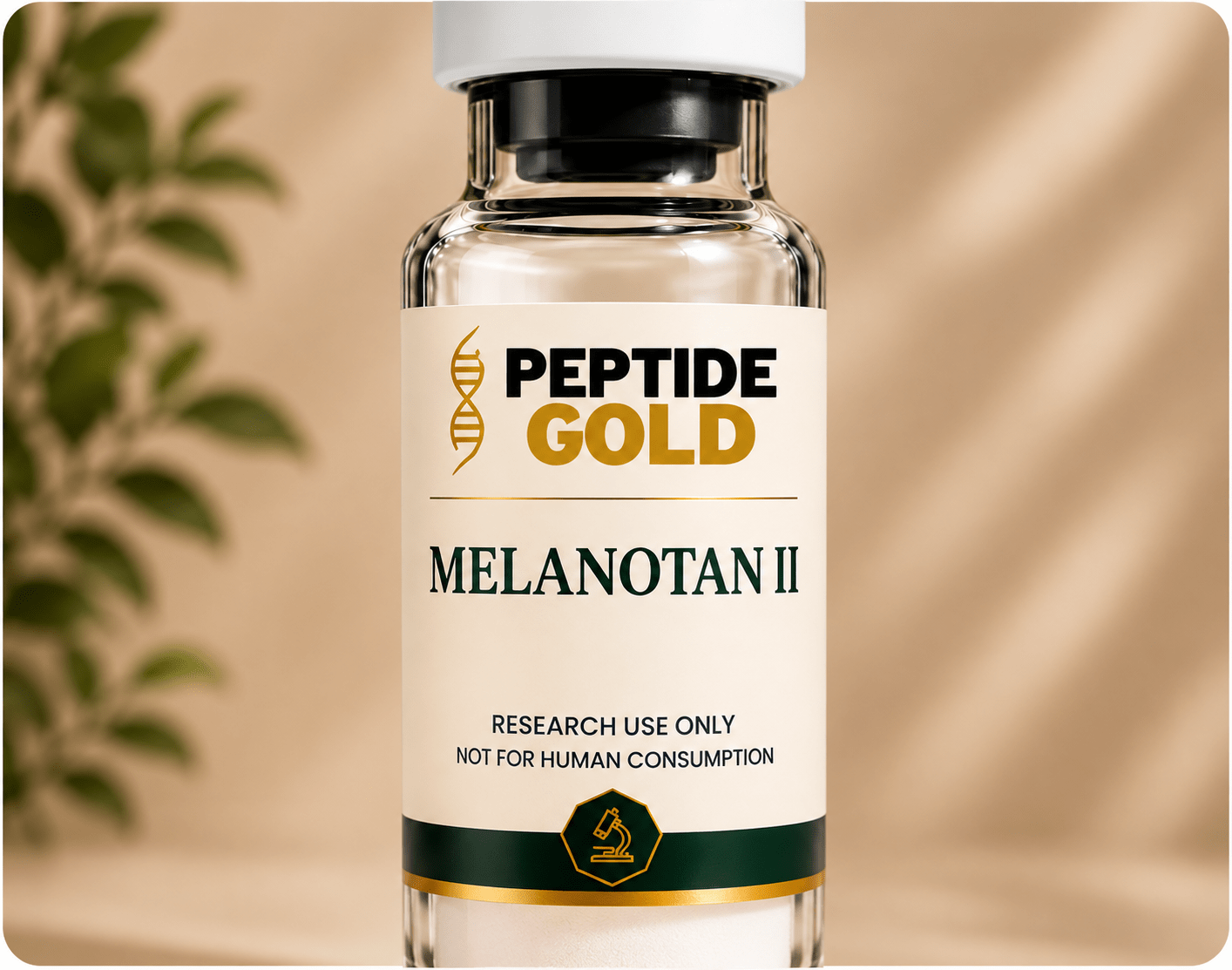
Melanotan II: A Comprehensive Guide to Uses, Research, Dosing, Forms, and Potential Benefits
Melanotan II, often shortened to MT-II, is a synthetic peptide best known for its effects on skin pigmentation, tanning, sexual function, appetite, and melanocortin signaling.
It was originally developed as an analogue of alpha-melanocyte-stimulating hormone, or α-MSH, a naturally occurring peptide involved in pigmentation and several other physiological functions.
Melanotan II is especially unusual because it affects more than one melanocortin receptor.
As a result, researchers have observed effects involving:
increased skin pigmentation
spontaneous erections
sexual desire
reduced appetite
and changes in several centrally regulated physiological functions.
Some of these effects have been demonstrated directly in humans.
However, Melanotan II has never become an approved tanning or sexual-function medication.
Instead, it remains an unapproved experimental peptide, and modern safety reviews continue to raise concerns about uncontrolled use, particularly products obtained through online or research-market channels.
FDA specifically identifies Melanotan II as a substance that may present safety concerns when used in compounded products, including risks related to immunogenicity, peptide aggregation, and peptide-related impurities.
As of 2026, there is no FDA-approved Melanotan II product or standard human dosing regimen.
What Is Melanotan II?
Melanotan II is a synthetic cyclic peptide developed from α-MSH.
Alpha-MSH naturally contains 13 amino acids and plays an important role in pigmentation by activating melanocortin receptors on melanocytes.
Researchers created shorter and more stable analogues to produce stronger and longer-lasting melanocortin activity.
Melanotan II is one of those analogues.
It is a cyclic heptapeptide, meaning it contains seven amino-acid residues arranged in a structure that includes a molecular ring.
The cyclic design increases stability and receptor activity compared with naturally occurring α-MSH.
Melanotan II is sometimes confused with:
Melanotan I
and
bremelanotide, or PT-141.
All three are related to melanocortin biology, but they are not identical compounds and do not have the same regulatory status.
What Are Melanocortin Receptors?
The melanocortin system consists of several receptors designated:
MC1R
MC2R
MC3R
MC4R
and
MC5R.
These receptors influence different biological processes.
MC1R
MC1 receptors are found primarily on melanocytes.
Activation promotes production of melanin, the pigment responsible for much of skin and hair color.
MC3R and MC4R
These receptors are heavily involved in central nervous-system functions including:
appetite
energy balance
sexual behavior
and other neuroendocrine processes.
MC5R
MC5 receptors have roles in several peripheral tissues and exocrine glands.
Melanotan II is considered a nonselective melanocortin receptor agonist, meaning it can activate more than one melanocortin receptor subtype.
This explains why its effects extend beyond tanning.
How Does Melanotan II Produce Tanning?
Tanning occurs primarily through increased melanin production.
When ultraviolet radiation reaches the skin, melanocytes respond by increasing synthesis and transfer of melanin.
Melanin absorbs and disperses ultraviolet radiation and contributes to visible pigmentation.
Melanotan II can activate MC1 receptors directly.
This stimulates melanogenesis even without relying entirely on UV exposure.
Early human research demonstrated that repeated subcutaneous Melanotan II administration increased measurable pigmentation in several body areas.
A small Phase I study involving three healthy men found increased pigmentation of the face, upper body, and buttocks after several doses over two weeks.
This established that MT-II has genuine melanotropic activity in humans.
Does Melanotan II Cause a Tan Without Sunlight?
It can increase pigmentation independent of normal tanning stimuli, but the answer is more complicated than simply saying yes.
Human studies demonstrated increased pigmentation after peptide administration.
However, people using unregulated Melanotan II often combine it with UV exposure because melanocortin stimulation and UV radiation can interact to increase pigmentation.
That practice raises an important safety issue:
a darker tan does not make ultraviolet radiation harmless.
Melanin provides some natural photoprotection, but it does not eliminate the risks of:
sunburn
photoaging
DNA damage
or skin cancer.
Melanotan II should therefore not be interpreted as a sunscreen or a way to make excessive UV exposure safe.
FDA previously took enforcement action against a company marketing Melanotan II as an injectable tanning product and specifically objected to unsupported claims that it could protect against skin cancer.
Why Was Melanotan II Developed?
The original scientific interest involved creating melanocortin analogues that could produce pigmentation without requiring extensive ultraviolet exposure.
One goal was to investigate whether increasing melanin might provide some protection against UV-related skin injury.
That concept ultimately led researchers toward several melanocortin compounds.
Melanotan II proved to be highly potent but also produced several unexpected effects.
One of those effects became particularly important:
spontaneous penile erections.
Researchers realized that the melanocortin system influenced sexual function at the level of the central nervous system.
That observation eventually contributed to development of bremelanotide, a related melanocortin agonist that is now FDA-approved for a specific sexual-desire disorder in premenopausal women.
Melanotan II itself was never approved.
Melanotan II and Erectile Function
This is one of the most interesting areas of human MT-II research.
Unlike drugs such as sildenafil, which act primarily on blood vessels, Melanotan II appears to initiate sexual responses through the brain.
A double-blind, placebo-controlled crossover study involving 10 men with psychogenic erectile dysfunction found that clinically apparent erections developed in 8 of 10 men after Melanotan II.
Mean duration of high penile rigidity was approximately 38 minutes with MT-II versus 3 minutes with placebo.
Researchers also observed:
nausea
stretching
yawning
and decreased appetite.
This established that Melanotan II can produce centrally mediated erectile effects in humans.
Melanotan II and Organic Erectile Dysfunction
The effects were not limited to psychogenic erectile dysfunction.
Another controlled study involved men with organic erectile dysfunction.
Melanotan II produced subjectively reported erections in 12 of 19 administrations, compared with only 1 of 21 placebo administrations.
Participants also reported significantly greater sexual desire.
However, nausea was common, and several administrations produced severe nausea.
These findings helped confirm that melanocortin signaling can influence sexual function independent of the traditional nitric-oxide pathway.
Melanotan II and Sexual Desire
MT-II does not appear to affect only erection mechanics.
Human studies have also demonstrated changes in sexual desire.
In one study of men with erectile dysfunction, increased sexual desire was reported after approximately 68% of Melanotan II administrations, compared with approximately 19% of placebo administrations.
This is particularly interesting because most conventional erectile-dysfunction drugs do not substantially increase libido.
They improve blood flow but generally require existing sexual stimulation.
Melanocortin agonists act more centrally and can influence both:
sexual motivation
and
genital responses.
This concept ultimately helped drive research into more selective melanocortin therapies.
Melanotan II and Women
Melanocortin signaling also appears to influence female sexual function.
Research involving melanocortin analogues reported changes in:
sexual desire
and genital arousal in women.
A review of the early human Melanotan II program described evidence that melanocortin activation can influence sexual function in both males and females.
However, Melanotan II itself was not ultimately developed into an approved female sexual-function medication.
Instead, a related compound—bremelanotide—became the more clinically focused drug.
Melanotan II Versus PT-141
Melanotan II and PT-141, or bremelanotide, are related but should not be confused.
PT-141 was developed specifically to retain melanocortin effects on sexual function while reducing emphasis on pigmentation.
Human trials found that subcutaneous PT-141 produced significant erectile responses in men with erectile dysfunction.
Bremelanotide eventually received FDA approval under the brand name Vyleesi for acquired, generalized hypoactive sexual desire disorder in certain premenopausal women.
Melanotan II itself remains unapproved.
This provides a good example of drug development:
an experimental molecule produces interesting effects, and researchers then develop a more targeted derivative with a better clinical profile.
Melanotan II and Appetite
Melanotan II can influence appetite through central melanocortin pathways.
MC3 and MC4 receptors participate in the regulation of:
hunger
energy balance
and body weight.
Some human studies reported reduced appetite following MT-II administration.
This has led to occasional discussion of Melanotan II as a possible fat-loss or appetite-control peptide.
However, this is not an established medical use.
There are no modern large randomized obesity trials demonstrating clinically meaningful long-term weight loss with Melanotan II.
It should not be compared with approved metabolic medications such as:
or investigational retatrutide.
Melanotan II Dosing in Human Research
There is no FDA-approved Melanotan II dose.
Published doses should therefore be understood only as descriptions of historical research.
One early Phase I study began with:
0.01 mg/kg subcutaneously
and gradually increased doses in some subjects to approximately:
0.025 to 0.03 mg/kg.
The researchers observed increasing pigmentation but also side effects such as:
nausea
fatigue
somnolence
stretching
yawning
and spontaneous erections.
The investigators proposed 0.025 mg/kg as a dose for future controlled research at that time.
Later erectile-function studies also used approximately:
0.025 mg/kg subcutaneously.
These were supervised experimental protocols and should not be interpreted as personal dosing guidance.
Why Online Dosing Is Especially Problematic
Melanotan II has developed a large gray-market presence.
Products may be sold as:
lyophilized powder
pre-mixed liquid
or other unofficial formulations.
There is no standard regulatory requirement ensuring that such products contain:
the labeled amount
the correct peptide
acceptable purity
or sterile material.
A vial labeled “10 mg Melanotan II” cannot automatically be assumed to contain exactly 10 mg of pharmaceutical-quality MT-II.
That makes numerical dosing based on gray-market labeling inherently uncertain.
What Forms Is Melanotan II Offered In?
Although no FDA-approved product exists, Melanotan II is widely encountered through research and unregulated markets.
Lyophilized Powder
The most common research form is freeze-dried or lyophilized powder.
This format can improve stability before reconstitution.
Research Vials
Online suppliers frequently offer MT-II in small vials containing specified milligram quantities.
A research vial should not automatically be assumed to be sterile or suitable for human administration.
Nasal Sprays
“Nasal tanning sprays” claiming to contain Melanotan II are widely advertised online.
These are not FDA-approved products.
Absorption may also vary significantly depending on formulation and nasal delivery.
Pre-Mixed Solutions
Some unregulated sellers advertise ready-to-use liquids.
These raise additional questions involving:
stability
sterility
storage
and actual concentration.
There is no FDA-approved retail Melanotan II formulation.
Common Side Effects Seen in Human Research
Several side effects were repeatedly observed in early clinical studies.
These included:
- Nausea
- Yawning
- Stretching
- Decreased appetite
- Fatigue
- Somnolence
- Flushing
- Spontaneous erections
Nausea appears to be particularly common.
In one study involving men with erectile dysfunction, severe nausea occurred after approximately 12.9% of administrations at 0.025 mg/kg.
This is one reason later drug development focused on more selective compounds.
Priapism
Because Melanotan II can strongly stimulate erection pathways, one potential concern is priapism.
Priapism is a prolonged erection that persists without appropriate sexual stimulation and can become medically dangerous.
Prolonged erections can damage penile tissue if blood becomes trapped for several hours.
Modern reviews of unregulated tanning products have documented serious adverse events associated with melanotan use, including priapism.
A prolonged or painful erection requires urgent medical evaluation.
Skin Changes and Moles
One of the biggest controversies surrounding Melanotan II involves pigmentation of existing freckles and moles.
Because MT-II activates melanocortin signaling, it can darken:
normal skin
freckles
existing nevi or moles
and potentially create new areas of pigmentation.
This can make monitoring suspicious skin lesions more difficult.
There have been case reports describing rapid changes in nevi or melanoma diagnoses temporally associated with Melanotan use.
These reports do not prove that Melanotan II causes melanoma.
However, because the compound directly stimulates melanocyte biology and because users may simultaneously increase UV exposure, dermatologic monitoring is a legitimate concern.
A tan should never be used as evidence that skin is protected from UV damage.
Does Melanotan II Cause Melanoma?
A causal relationship has not been established.
That distinction matters.
Reports of melanoma occurring after Melanotan II use cannot determine whether the peptide caused the cancer, accelerated an existing lesion, made it more noticeable, or was simply coincidental.
However, two facts warrant caution:
Melanotan II stimulates melanocortin pathways in pigment cells.
and
many people using MT-II also expose themselves intentionally to ultraviolet radiation.
UV radiation itself is an established carcinogen and major cause of melanoma and other skin cancers.
Therefore, using MT-II to facilitate more intense tanning could increase overall skin-cancer risk indirectly even if the peptide itself is not proven carcinogenic.
Serious Adverse Events Reported With Unregulated Use
Modern literature has documented several serious events in people using unregulated melanotan products.
A 2026 systematic review of tanning agents noted reports involving:
rhabdomyolysis
renal infarction
and priapism following unregulated Melanotan I or II exposure.
These are uncommon reports and do not establish the incidence of complications.
But they illustrate why Melanotan II should not be regarded as a harmless cosmetic tanning supplement.
The lack of regulated manufacturing makes it especially difficult to distinguish adverse effects caused by:
Melanotan II itself
from those caused by:
impurities
incorrect concentration
contamination
or another substance entirely.
Immunogenicity and Peptide Quality
FDA currently identifies Melanotan II among bulk substances that may present significant safety risks in compounding.
The agency specifically cites possible risks involving:
peptide aggregation
immunogenicity
and peptide-related impurities.
Immunogenicity means that the immune system recognizes a substance as foreign and generates an immune reaction.
Peptide impurities or aggregates can potentially increase that risk.
This is particularly relevant when a peptide is produced outside tightly regulated pharmaceutical manufacturing.
Is Melanotan II FDA Approved?
No.
Melanotan II is not FDA-approved for tanning, sexual enhancement, erectile dysfunction, appetite suppression, weight loss, or any other medical condition.
FDA has considered it an unapproved new drug for many years.
In 2007, the agency issued a warning involving the illegal marketing of Melanotan II as an injectable tanning product and rejected unsupported claims that the product could protect against skin cancer or treat rosacea.
FDA enforcement documents subsequently reiterated that Melanotan II remained an unapproved drug whose distribution violated federal requirements.
That status has not changed into an approved indication.
Melanotan II Versus Melanotan I
These names can be confusing.
Melanotan I
Melanotan I is closely related to afamelanotide.
Afamelanotide is a more selective MC1 receptor agonist and has been developed primarily for pigmentation-related medical uses.
A pharmaceutical version is FDA-approved under the brand name Scenesse for erythropoietic protoporphyria.
Melanotan II
Melanotan II is less selective and activates several melanocortin receptors.
That broader activity explains its stronger effects involving:
sexual function
appetite
yawning
and other central nervous-system responses.
Melanotan I/afamelanotide and Melanotan II should therefore not be treated as equivalent products.
Melanotan II Versus Bremelanotide
Bremelanotide is more closely related to MT-II’s sexual-function effects.
Both act through melanocortin receptors.
However, bremelanotide underwent formal pharmaceutical development and FDA review.
Melanotan II did not.
This illustrates why the existence of a medically approved related molecule does not validate unapproved MT-II products.
What Do People Commonly Seek Melanotan II For?
Outside formal research, Melanotan II is generally sought for three reasons.
Tanning
This is by far the best-known use.
Users seek darker pigmentation with less perceived need for sun exposure.
However, many still combine it with UV tanning, which creates separate skin-cancer risks.
Sexual Function
Some people seek MT-II because of its ability to increase:
erections
and potentially sexual desire.
Human evidence supports these biological effects, but MT-II itself is not an approved erectile-dysfunction treatment.
Appetite Reduction
Some users report reduced hunger.
This is consistent with melanocortin physiology and findings from early studies.
However, it has not been clinically developed as an obesity treatment.
Melanotan II and Competitive Sports
The current 2026 WADA Prohibited List is in force for competitive athletes.
Athletes should not assume that a research-market peptide is permitted simply because it is not a conventional anabolic steroid.
The regulatory treatment of melanocortin analogues can depend on the exact compound, sport rules, and governing body.
Competitive athletes should verify the current list and obtain authoritative anti-doping guidance before exposure to any unapproved peptide.
Current Research in 2026
Melanotan II itself is no longer a major mainstream pharmaceutical-development candidate.
Its most important scientific legacy may be the discovery that melanocortin signaling can regulate:
pigmentation
sexual function
appetite
and behavior.
That work helped lead to more selective and clinically useful compounds.
For example:
afamelanotide uses melanocortin signaling for a legitimate pigmentation-related medical indication.
bremelanotide uses melanocortin signaling to influence sexual desire.
Researchers continue to investigate melanocortin pathways for:
obesity
sexual dysfunction
inflammatory disorders
pigmentation diseases
and neurological conditions.
In that sense, Melanotan II remains scientifically important even though the compound itself has not become an approved therapy.
What Research Is Still Needed?
For MT-II specifically, major unanswered questions include:
long-term cardiovascular safety
effects on melanocytes and nevi
cancer-related risk
immune responses
human pharmacokinetics with repeated exposure
dose-response relationships
and long-term effects on appetite and sexual function.
However, because more selective melanocortin drugs already exist, future pharmaceutical research may focus more heavily on those compounds rather than reviving Melanotan II itself.
The Bottom Line
Melanotan II is a synthetic cyclic melanocortin peptide analogue originally developed from alpha-melanocyte-stimulating hormone.
Its biological effects are real.
Human studies have shown that MT-II can:
increase skin pigmentation,
initiate penile erections,
increase sexual desire,
and reduce appetite in some individuals.
Early tanning research demonstrated visible increases in pigmentation after repeated subcutaneous exposure.
Controlled erectile-function studies found erections in a substantial proportion of treated men, including men with both psychogenic and organic erectile dysfunction.
Those findings helped demonstrate that the melanocortin system influences far more than skin color.
However, Melanotan II never became an approved drug.
There is currently:
no FDA-approved Melanotan II product,
no approved tanning indication,
no approved erectile-dysfunction indication,
no FDA-approved dosage,
and no established long-term safety profile.
Common adverse effects in human research included:
nausea
yawning
stretching
fatigue
decreased appetite
and spontaneous erections.
More serious adverse events have also been reported during unregulated melanotan use, including priapism, rhabdomyolysis, and renal infarction.
The cosmetic use of Melanotan II also creates a particularly important misconception:
a darker tan does not make UV exposure safe.
UV radiation remains an established cause of premature skin aging and skin cancer regardless of whether pigmentation was stimulated naturally or pharmacologically.
FDA has long classified Melanotan II as an unapproved drug and currently identifies additional concerns involving peptide impurities, aggregation, and possible immunogenicity.
Perhaps the most accurate description of Melanotan II in 2026 is:
a potent experimental melanocortin receptor agonist with demonstrated human effects on pigmentation, erectile function, sexual desire, and appetite—but with no approved medical use, substantial uncertainty regarding long-term safety, and additional quality risks arising from the unregulated market through which it is commonly sold.
For researchers, Melanotan II played an important role in revealing how melanocortin receptors regulate pigmentation, appetite, and human sexual behavior.
For consumers, the critical distinction is between:
a peptide that clearly produces biological effects
and
a peptide that has been demonstrated to provide a safe and medically appropriate long-term treatment.
Melanotan II meets the first definition.
It does not currently meet the second.
Educational and research notice: This article is intended for general scientific and educational information. It is not medical advice or a recommendation for human use of Melanotan II. Historical doses mentioned above describe controlled clinical research and should not be interpreted as personal dosing instructions. Melanotan II is not FDA-approved for tanning, erectile dysfunction, sexual enhancement, appetite suppression, weight loss, or any other medical condition.