

Bacteriostatic Water (BAC Water): A Comprehensive Guide to Uses, Storage, Reconstitution, Forms, and Safety
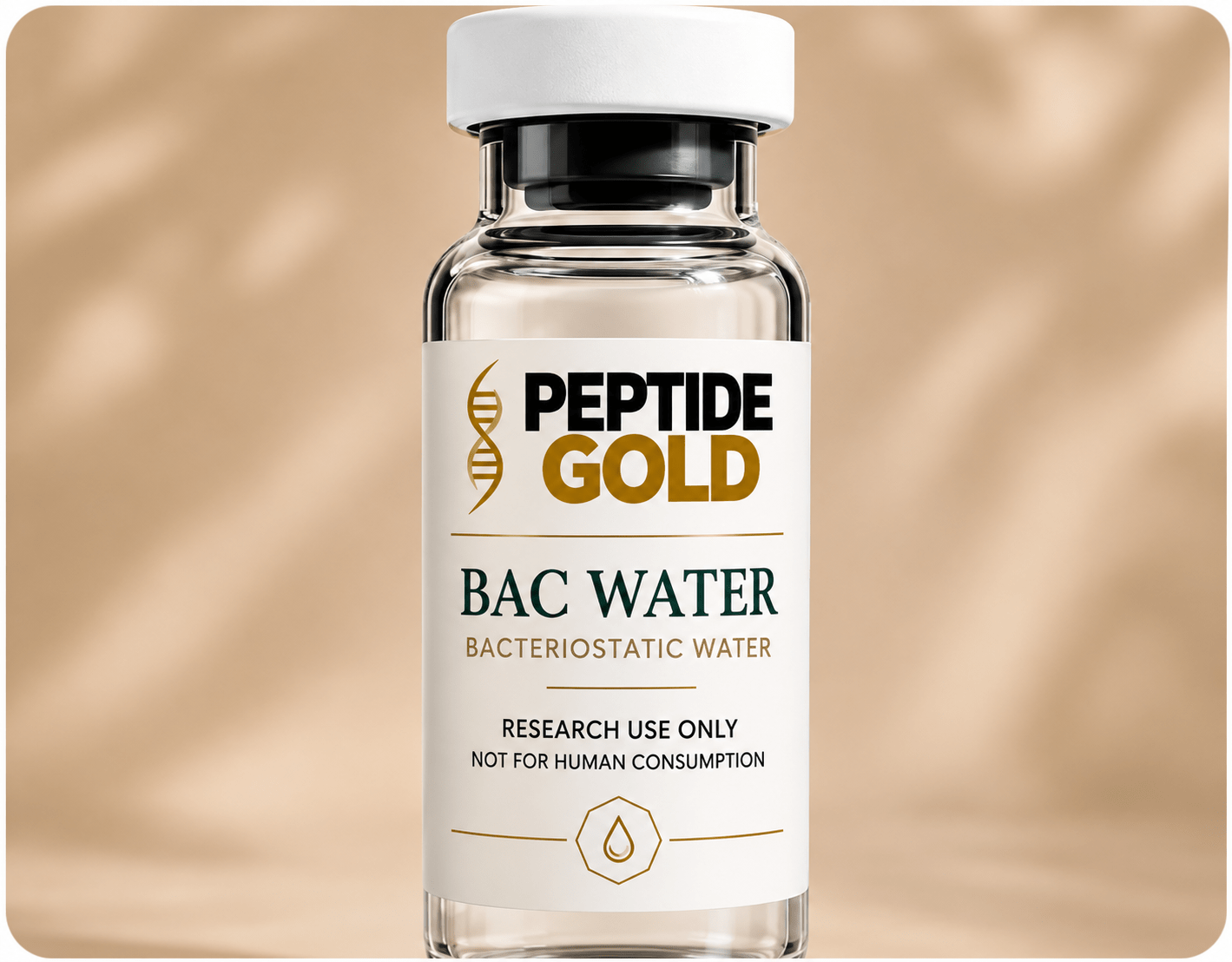
Bacteriostatic Water for Injection, commonly called BAC Water or bacteriostatic water, is a sterile pharmaceutical diluent used to dissolve or dilute certain medications before injection.
Unlike most of the substances covered in this series, BAC Water is not a peptide, hormone, supplement, or therapeutic drug in the usual sense.
Its job is much simpler:
it acts as a sterile liquid vehicle for medications that need to be reconstituted or diluted before administration.
What distinguishes bacteriostatic water from ordinary sterile water is the addition of a preservative—most commonly:
0.9% benzyl alcohol, equivalent to 9 mg/mL.
That preservative suppresses bacterial growth and allows appropriately manufactured bacteriostatic water to be supplied in multi-dose containers from which repeated withdrawals may be made. Current U.S. labeling describes Bacteriostatic Water for Injection as a sterile, nonpyrogenic preparation containing 0.9% or, in some presentations, 1.1% benzyl alcohol.
Bacteriostatic water is commonly encountered in:
- Hospitals and medical practices
- Pharmacies
- Compounding
- Clinical research
- Injectable medication preparation
- Peptide research
- Hormone products requiring reconstitution
However, BAC Water is not universally compatible with every injectable medication.
The instructions for the specific drug being reconstituted always control which diluent should be used. The current label states that bacteriostatic water is indicated only for diluting or dissolving injectable drugs according to the drug manufacturer’s instructions.
What Is Bacteriostatic Water?
Bacteriostatic Water for Injection is essentially:
sterile Water for Injection + a bacteriostatic preservative.
A common formulation contains:
Water for Injection, USP
plus
0.9% benzyl alcohol.
At 0.9%, that equals:
9 mg of benzyl alcohol per milliliter.
The solution is:
sterile
nonpyrogenic
and supplied specifically for parenteral drug preparation.
Current labeling lists a typical pH around:
5.7
with an acceptable range of approximately:
4.5 to 7.0.
The preservative is what gives bacteriostatic water its practical advantage over sterile water in certain multi-dose applications.
What Does “Bacteriostatic” Mean?
The word bacteriostatic means that a substance inhibits or slows the growth of bacteria.
That is slightly different from:
bactericidal, which means killing bacteria.
The benzyl alcohol in BAC Water helps prevent bacterial multiplication if small numbers of organisms are accidentally introduced during repeated entry into a multi-dose vial.
This does not mean bacteriostatic water can make a contaminated medication sterile.
It also does not mean normal sterile technique becomes unnecessary.
The preservative provides an additional safeguard—not permission to use poor handling practices.
What Is Benzyl Alcohol?
Benzyl alcohol is an aromatic alcohol used as a preservative in many pharmaceutical preparations.
In typical bacteriostatic water, it is present at:
0.9%, or 9 mg/mL.
At this concentration it helps inhibit microbial growth while allowing the water to function as a diluent for compatible drugs.
Benzyl alcohol is also used in some:
injectable medications
cosmetics
topical products
and pharmaceutical formulations.
However, its presence creates several important safety restrictions.
Most notably:
Bacteriostatic Water for Injection must not be used in neonates.
Why Is BAC Water Not Used in Newborns?
Current Bacteriostatic Water for Injection labeling carries a prominent warning:
NOT FOR USE IN NEONATES.
The concern is the benzyl alcohol preservative.
Newborn infants—particularly premature or low-birth-weight infants—have limited ability to metabolize benzyl alcohol.
High systemic exposure has historically been associated with a severe and sometimes fatal condition known as:
“gasping syndrome.”
This syndrome can include:
metabolic acidosis
central nervous system depression
gasping respirations
and cardiovascular deterioration. FDA-regulated labeling for other injectable products specifically warns about serious and fatal reactions in neonates exposed to benzyl-alcohol-containing solutions.
For neonatal medication preparation, preservative-free diluents are generally used when appropriate.
BAC Water Versus Sterile Water
These two products are commonly confused.
Bacteriostatic Water for Injection
Usually contains:
0.9% benzyl alcohol
and is generally supplied as a:
multi-dose container.
Its preservative allows repeated withdrawals under appropriate sterile conditions.
Sterile Water for Injection
Contains:
no bacteriostatic preservative.
It is commonly supplied for single-use or medication-specific reconstitution.
Once a preservative-free container is entered or a medication is reconstituted, the drug’s specific labeling determines how long it may be stored.
The two products are not automatically interchangeable.
Some drugs specifically require sterile water.
Others permit bacteriostatic water.
The drug manufacturer’s instructions should always determine which one is used.
BAC Water Versus Bacteriostatic Saline
Another common comparison is between BAC Water and Bacteriostatic Sodium Chloride Injection.
Bacteriostatic saline contains:
0.9% sodium chloride
plus approximately:
0.9% benzyl alcohol.
Because it contains sodium and chloride, bacteriostatic saline is isotonic.
Bacteriostatic water itself does not contain the electrolytes needed to make it isotonic.
This difference can affect medication compatibility.
Again, a medication’s official reconstitution instructions determine whether the appropriate vehicle is:
sterile water
bacteriostatic water
normal saline
bacteriostatic saline
or another solution entirely.
What Is BAC Water Used For?
The official purpose of Bacteriostatic Water for Injection is narrow.
It is indicated for:
diluting or dissolving drugs intended for intravenous, intramuscular, or subcutaneous injection when the drug manufacturer’s instructions permit its use.
In practice, that may include certain:
antibiotics
hormones
biologic medications
research compounds
and other lyophilized injectable products.
The water itself is not supposed to provide the therapeutic effect.
The medication dissolved in it provides the effect.
BAC Water and Lyophilized Products
Many injectable drugs and research compounds are supplied as lyophilized powder.
Lyophilization means freeze-drying.
Removing water can improve product stability during storage and shipping.
Before use, the powder must often be reconstituted with a compatible liquid.
That liquid might be bacteriostatic water.
The basic concept is:
lyophilized drug + appropriate diluent → liquid solution containing the drug
The amount of diluent added determines the resulting concentration.
For example, adding more liquid to the same amount of drug produces a more dilute solution.
Adding less liquid produces a more concentrated solution.
However, the amount used should follow the specific drug’s validated reconstitution instructions whenever they exist.
BAC Water and Research Peptides
BAC Water is particularly well known in the peptide-research market because many peptides are sold as freeze-dried powders.
Examples may include research material labeled as:
CJC-1295
or numerous other compounds.
Researchers may use a sterile compatible diluent to prepare solutions for laboratory experiments.
However, the presence of BAC Water does not turn a research-grade peptide into an approved injectable medication.
If a research vial lacks validated:
sterility
identity
purity
endotoxin testing
or pharmaceutical manufacturing controls,
mixing it with sterile bacteriostatic water does not correct those deficiencies.
This distinction is especially important in gray-market peptide use.
Reconstitution and Concentration
One of the main practical purposes of reconstitution is to establish a known concentration.
The basic calculation is:
amount of substance ÷ volume of diluent = concentration
For example, if a laboratory vial contains:
10 mg of material
and a validated protocol calls for:
2 mL of compatible diluent,
the resulting nominal concentration would be:
5 mg/mL.
This arithmetic is straightforward.
The harder question is whether:
2 mL is chemically compatible
the resulting concentration is stable
the vial is sterile
and the intended route is appropriate.
Those questions must come from product-specific data rather than mathematics alone.
Why Reconstitution Volume Matters
The amount of bacteriostatic water added can affect more than convenience.
Changing the volume can alter:
concentration
pH
solubility
osmolarity
and potentially stability.
Some compounds dissolve readily at one concentration but precipitate at another.
Others require a specific diluent or buffer.
For this reason, a universal instruction such as:
“Add 1 mL of BAC Water to every peptide vial”
would be scientifically inappropriate.
Reconstitution should always be compound specific.
Is Bacteriostatic Water Isotonic?
Not necessarily.
Current labeling specifically states that Bacteriostatic Water for Injection must be made approximately isotonic before use where appropriate.
This is because plain water does not contain the salts found in blood and extracellular fluid.
Injecting large quantities of hypotonic water directly can damage red blood cells and disturb fluid balance.
BAC Water is therefore a drug diluent, not a general-purpose IV fluid.
The label specifically states that benzyl-alcohol-containing parenteral preparations should not be used for fluid replacement.
Can BAC Water Be Injected by Itself?
It is not intended to be administered as an ordinary standalone injection.
Its labeled purpose is to serve as a pharmaceutical aid for dissolving or diluting compatible injectable drugs.
Injecting unnecessary sterile water provides no therapeutic benefit and may create discomfort or problems related to tonicity.
The final drug preparation—not the bacteriostatic water alone—is what is intended for administration.
Can BAC Water Be Used Intrathecally or Epidurally?
No.
Current labeling states that parenteral preparations containing benzyl alcohol should not be used for epidural or spinal anesthesia procedures.
This is another reason it is essential not to assume that “sterile water is sterile water.”
Route-specific compatibility matters.
A solution appropriate for preparing a subcutaneous medication may be completely inappropriate for administration around the spinal cord.
Multi-Dose Vials
One of the defining features of BAC Water is the multi-dose vial.
Current U.S. products include 30 mL multi-dose vials containing 0.9% benzyl alcohol.
The preservative allows the manufacturer to design the vial for repeated access.
This is one reason bacteriostatic water is attractive when multiple medication preparations are expected from the same container.
However, each entry into the vial still creates an opportunity for contamination.
How Long Is an Open BAC Water Vial Good For?
This is frequently misunderstood.
The common general rule for many multi-dose medication vials in clinical settings is to follow the product label and institutional infection-control policy, often using a 28-day beyond-use interval after first puncture unless the manufacturer specifies otherwise.
However, the specific Bacteriostatic Water label should always be followed, and a vial should never be used merely because it falls inside a certain number of days if:
the solution has become cloudy
particles are present
the stopper or seal is damaged
or sterility is otherwise questionable.
The safest rule is:
record the date of first entry and follow the manufacturer’s and facility’s multi-dose-vial policy rather than assuming an indefinite shelf life.
Storage of Unopened BAC Water
Current Hospira labeling states that Bacteriostatic Water for Injection should be stored at controlled room temperature:
20°C to 25°C
or:
68°F to 77°F.
Permitted temperature excursions may fall within the USP controlled-room-temperature range depending on the product.
This means unopened pharmaceutical bacteriostatic water generally does not require routine refrigeration.
The specific manufacturer’s label should always take priority.
Should BAC Water Be Refrigerated?
Not necessarily.
Commercial Bacteriostatic Water for Injection is typically labeled for controlled room-temperature storage.
After the water is used to reconstitute a medication, however, the situation changes.
The proper storage temperature then depends on:
the drug that was reconstituted.
Some reconstituted products require refrigeration.
Others are stable at room temperature.
Some must be used rapidly.
Therefore:
BAC Water storage instructions and reconstituted-drug storage instructions are two different things.
How Should BAC Water Look?
Bacteriostatic Water for Injection should normally appear:
clear
and free of visible particulate matter.
Do not use a vial if:
cloudiness develops
particles appear
the seal has been compromised
or there is other evidence of contamination or damage.
The labeling for commercial products also emphasizes use only when the solution is clear and the container or seal is intact.
Sterile Technique
The benzyl alcohol preservative does not eliminate the need for careful sterile handling.
Repeated contamination can overwhelm the protection provided by a bacteriostatic agent.
In clinical practice, this means maintaining proper aseptic technique when entering a multi-dose vial.
The vial stopper and equipment used during preparation should be handled according to established sterile-medication procedures.
BAC Water should never be considered self-sterilizing.
What Happens After BAC Water Is Mixed With a Drug?
Once bacteriostatic water is added to a drug, the resulting preparation is no longer simply “BAC Water.”
It becomes a reconstituted drug solution.
Its stability may now depend on:
peptide degradation
protein aggregation
pH
temperature
light exposure
oxidation
and microbial considerations.
The preservative does not guarantee that the drug molecule itself remains chemically stable.
For example, a peptide could degrade even while the solution remains microbiologically preserved.
Therefore, the correct beyond-use time comes from the drug’s stability data, not just from the presence of benzyl alcohol.
Does Benzyl Alcohol Protect the Peptide?
No.
Benzyl alcohol’s main purpose is antimicrobial preservation.
It does not necessarily protect a peptide against:
oxidation
hydrolysis
deamidation
aggregation
or other chemical degradation.
In some pharmaceutical formulations, preservatives can even affect protein stability.
This is one reason medication-specific compatibility data matter.
BAC Water and Peptide Storage
Peptides can vary dramatically in stability after reconstitution.
Factors include:
amino-acid sequence
temperature
concentration
pH
buffer
light exposure
and repeated vial handling.
It is therefore inaccurate to say:
“Every peptide reconstituted with BAC Water lasts 28 days.”
The bacteriostatic water vial and the reconstituted peptide solution are separate stability questions.
A particular peptide might remain chemically stable for:
hours
days
or longer,
depending on validated data.
The drug or research protocol should specify the appropriate storage period.
Can BAC Water Freeze?
Freezing is generally unnecessary and may not be recommended for commercial Bacteriostatic Water for Injection.
Current labeled products are designed for controlled room-temperature storage.
Once bacteriostatic water has been mixed with another drug, freezing can also potentially:
damage proteins or peptides
change concentration through partial freezing
or cause precipitation or aggregation.
The storage instructions for the reconstituted medication should therefore be followed.
BAC Water and Single-Dose Vials
The term multi-dose is important.
A vial containing preservative is specifically designed to tolerate repeated entries better than a preservative-free single-dose vial.
A single-dose vial generally should not be saved for repeated future use merely because medication remains inside.
BAC Water exists partly to solve this exact problem when a compatible drug needs a multi-dose diluent.
BAC Water and Injection Comfort
Some people assume bacteriostatic water is chosen primarily because it makes injections painless.
That is not its main purpose.
Its defining characteristic is the preservative.
Injection discomfort depends on the final solution’s:
pH
concentration
tonicity
drug itself
volume
and administration route.
Benzyl alcohol itself can also contribute to local irritation in some contexts.
Potential Side Effects
BAC Water is generally used only in small quantities as a diluent, so adverse effects usually relate more to:
the medication
the administration route
or product contamination.
Potential issues associated with the diluent itself can include:
- Local irritation
- Hypersensitivity to benzyl alcohol
- Problems caused by incompatible reconstitution
- Excess benzyl-alcohol exposure
- Microbial contamination after improper handling
- Problems related to injecting a non-isotonic preparation
The label notes that adverse reactions may occur because of the solution, the drug added, or the technique of administration.
Benzyl Alcohol Toxicity
For most adults receiving small amounts through compatible drug preparations, benzyl alcohol exposure from bacteriostatic water is generally limited.
However, cumulative exposure becomes more important in:
infants
people receiving large volumes,
or people exposed to multiple benzyl-alcohol-containing drugs.
This is why neonatal use is explicitly contraindicated.
Allergic Reactions
Hypersensitivity to benzyl alcohol is uncommon but possible.
A reaction could potentially involve:
redness
itching
swelling
or broader allergic symptoms.
Severe allergic reactions require prompt medical attention.
It can sometimes be difficult to determine whether a reaction comes from:
the diluent
or the medication dissolved in it.
BAC Water and Intravenous Infusion
Bacteriostatic water should not be confused with an IV hydration fluid.
It is not intended as a vehicle for routine large-volume fluid replacement. Current labeling specifically warns against using benzyl-alcohol-containing parenteral preparations for fluid replacement.
Solutions used for IV hydration normally contain appropriate electrolytes and are manufactured for that purpose.
Examples include:
0.9% sodium chloride
or other balanced crystalloid solutions.
Is BAC Water FDA Approved?
Yes, legitimate U.S. Bacteriostatic Water for Injection, USP products exist under an FDA-approved New Drug Application.
Current DailyMed listings show active products associated with:
NDA 018802.
This is an important distinction from many research peptides.
Pharmaceutical Bacteriostatic Water for Injection is an established regulated drug-diluent product.
However, that does not mean every vial sold online with the words:
“BAC Water”
is necessarily the same thing.
Pharmaceutical BAC Water Versus Research-Market BAC Water
An FDA-regulated Bacteriostatic Water for Injection product has controlled standards involving:
sterility
endotoxins
benzyl alcohol concentration
packaging
and manufacturing.
A bottle sold online merely as:
“reconstitution solution”
or
“bacteriostatic water for research use”
should not automatically be assumed equivalent.
This distinction is particularly important because the fluid may ultimately come into contact with a product intended for injection.
Sterility is not something that can be confirmed by visual appearance alone.
BAC Water Vial Sizes
Current U.S. products include 30 mL multi-dose vials, and some labels or repackaged presentations may be available in other sizes.
In research markets, smaller volumes such as:
3 mL
5 mL
or 10 mL
may also be encountered.
The vial size does not determine pharmaceutical quality.
What matters is:
manufacturer
regulatory status
sterility
preservative concentration
and whether the product is appropriate for the intended use.
Common Misconception: BAC Water “Activates” Peptides
BAC Water does not activate a peptide in the way an enzyme or receptor activates a biological pathway.
It simply dissolves or dilutes the material.
The peptide was already the chemical compound before the water was added.
Reconstitution changes the peptide from:
dry powder
into:
solution.
This makes accurate liquid handling possible but does not fundamentally turn an inactive chemical into an active peptide.
Common Misconception: More BAC Water Makes a Stronger Dose
The opposite is generally true.
If the same amount of drug is dissolved in more liquid:
the concentration decreases.
For example:
10 mg in 1 mL = 10 mg/mL
while
10 mg in 2 mL = 5 mg/mL.
The total amount of drug in the vial remains 10 mg.
Only the concentration changes.
This is an important distinction in laboratory calculations.
Common Misconception: BAC Water Makes Any Powder Safe to Inject
It does not.
A sterile diluent cannot compensate for:
nonsterile powder
endotoxin contamination
incorrect chemical identity
heavy metals
residual solvents
or poor peptide purity.
A substance must itself be manufactured appropriately for parenteral use if it is intended for injection.
Sterile water plus contaminated material produces contaminated solution.
Current Role of BAC Water in 2026
Bacteriostatic Water for Injection remains a standard pharmaceutical diluent.
Current U.S. DailyMed labeling updated in May 2026 continues to describe the product as:
sterile
nonpyrogenic
multi-dose
and intended solely for dilution or dissolution of compatible injectable drugs.
Its role has not fundamentally changed.
What has changed is the enormous growth of online peptide and research markets, where BAC Water has become widely discussed by people who may not otherwise have experience with pharmaceutical reconstitution.
That makes understanding the distinction between:
a pharmaceutical diluent
and
a peptide medication
particularly important.
The Bottom Line
Bacteriostatic Water for Injection—commonly called BAC Water—is a sterile pharmaceutical diluent, not a peptide or therapeutic compound.
A typical U.S. formulation contains:
sterile Water for Injection
plus
0.9% benzyl alcohol, or approximately 9 mg/mL, which serves as a bacteriostatic preservative.
The preservative allows the product to be supplied in a multi-dose vial, making repeated withdrawals possible when appropriate sterile technique is used.
Its official purpose is narrowly defined:
to dissolve or dilute compatible medications intended for intravenous, intramuscular, or subcutaneous injection according to the instructions supplied with the medication.
BAC Water differs from ordinary Sterile Water for Injection because sterile water generally contains no preservative.
It also differs from Bacteriostatic Sodium Chloride because bacteriostatic saline contains sodium chloride and is isotonic, while bacteriostatic water itself does not contain those electrolytes.
Several safety rules are especially important.
Bacteriostatic Water for Injection is:
not intended for use in neonates because of benzyl alcohol toxicity,
not intended as a general IV hydration fluid,
and not appropriate for epidural or spinal administration.
Commercial products are typically stored at controlled room temperature around:
20°C to 25°C, or 68°F to 77°F.
After BAC Water is mixed with a drug, however, storage and usable lifetime are determined by the reconstituted drug, not simply by the bacteriostatic water.
This is especially important in peptide research.
There is no universal rule stating that every reconstituted peptide remains stable for the same number of days.
Likewise, there is no universal volume of BAC Water that should be added to every lyophilized vial.
Different substances can require different:
diluents
concentrations
pH conditions
and storage procedures.
Perhaps the best way to describe BAC Water is:
a regulated sterile multi-dose diluent containing a bacteriostatic preservative that provides a convenient vehicle for preparing compatible injectable medications, while contributing no therapeutic peptide activity of its own.
For researchers, the most important principle is that BAC Water can help create a usable solution from a compatible lyophilized compound.
It cannot establish the:
identity
purity
sterility
or safety of the compound being dissolved.
In other words:
pharmaceutical-grade bacteriostatic water is only one part of a properly prepared injectable product.
The quality and suitability of the substance being reconstituted remain equally important.
Educational and safety notice: This article is intended for general pharmaceutical and research education. Bacteriostatic Water for Injection should be used only as a diluent for products whose instructions permit its use. It should not be administered to neonates, used as a general fluid-replacement solution, or assumed compatible with every medication or research compound. Reconstitution volume, concentration, storage, and beyond-use time should be determined from product-specific validated instructions rather than from a universal peptide-mixing rule.