

Lyophilized Peptide Storage: Best Conditions and Shelf Life
One of the primary reasons peptides are commonly supplied in lyophilized, or freeze-dried, form is stability. Removing most of the water from a peptide formulation can dramatically slow many of the chemical reactions that contribute to degradation.
But lyophilization does not make a peptide indestructible.
Temperature, moisture, oxygen, light, packaging, repeated temperature changes, and the characteristics of the individual peptide can all influence stability. This means that proper storage remains important even when a peptide is in a dry, freeze-dried state.
So, what are the best conditions for storing lyophilized research peptides? How long can they remain stable? And what changes once a peptide has been reconstituted?
The answers require understanding what lyophilization accomplishes—and what it does not.
Why Lyophilization Improves Peptide Stability
Peptides are chains of amino acids joined by peptide bonds. Depending on their structures, they can be vulnerable to numerous degradation pathways, including oxidation, hydrolysis, deamidation, aggregation, and other chemical or physical changes.
Water can facilitate many of these reactions.
Lyophilization addresses this problem by freezing a peptide-containing solution and then removing frozen water primarily through sublimation under vacuum.
The FDA describes freeze-drying as a process in which water is removed from a frozen product without passing through the conventional liquid phase. FDA — Lyophilization of Parenteral Products
The resulting material contains substantially less water than the original solution.
Reducing water content generally decreases molecular mobility and can slow degradation reactions. This is why freeze-drying is widely used for biological materials that may not remain sufficiently stable in aqueous solution for long-term storage.
However, the finished material still contains a small amount of residual moisture, and the peptide itself remains susceptible to environmental conditions.
Temperature: One of the Most Important Variables
Temperature has a major influence on chemical reaction rates.
Generally, lower temperatures slow molecular motion and many chemical degradation processes. For this reason, manufacturers and research laboratories commonly use refrigerated or frozen storage for peptide materials when supported by the product’s stability data.
However, there is no single temperature that can be considered ideal for every lyophilized peptide.
Depending upon the compound and formulation, storage specifications might call for controlled room temperature, refrigeration, freezing around -20°C, or substantially colder temperatures for specialized long-term research storage.
The correct condition is therefore the one supported by the manufacturer’s stability data or validated laboratory protocol for that particular peptide.
Refrigerated Storage
Refrigeration typically means approximately 2°C to 8°C (36°F to 46°F) in pharmaceutical and laboratory contexts.
This temperature range is commonly used for many temperature-sensitive biological materials because it provides a significantly cooler environment than room temperature without freezing the product.
For some lyophilized peptide formulations, refrigerated storage may provide adequate stability.
Refrigerators also offer convenience because samples can be accessed without the more substantial temperature transitions associated with deep-frozen materials.
But refrigeration should not automatically be assumed to be appropriate for every peptide. The specific storage requirements should always take precedence.
Frozen Storage
Many research peptides are stored frozen when longer-term stability is desired.
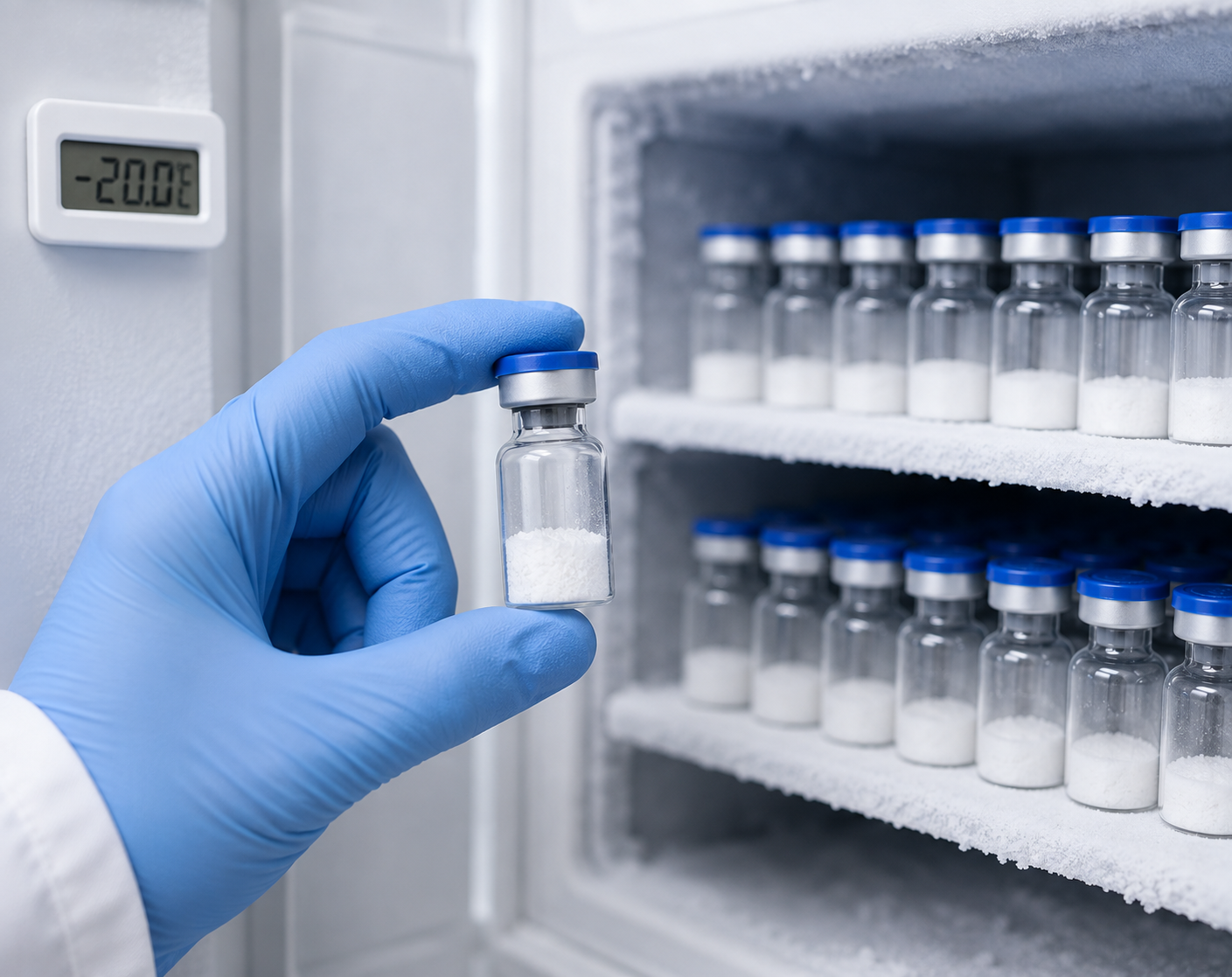
A common laboratory freezer temperature is approximately -20°C (-4°F).
Reducing the temperature can further slow degradation processes and is often used for biological research materials intended for extended storage.
Some specialized research environments may use temperatures of -70°C to -80°C for particular biological materials.
Colder, however, is not automatically better in every situation.
Packaging, formulation characteristics, glass-vial integrity, closure performance, and temperature cycling must all be considered. A peptide should therefore be stored according to validated conditions rather than simply placed at the coldest temperature available.
Room-Temperature Storage
Can a lyophilized peptide be kept at room temperature?
Potentially—but the answer depends entirely upon the peptide and formulation.
One of the advantages of lyophilization is that certain freeze-dried biological products can tolerate temperatures that would produce more rapid degradation in solution. The FDA notes that improved stability of dry products is an important advantage of lyophilization. FDA — Lyophilization of Parenteral Products
That does not mean every lyophilized peptide is indefinitely stable at room temperature.
Temperature exposure is cumulative. A short period at moderate room temperature during normal handling is very different from months of storage in a warm warehouse, vehicle, garage, or other uncontrolled environment.
For long-term storage, the manufacturer’s documented storage conditions should always be followed.
Heat Is Particularly Problematic
If cool temperatures generally slow degradation, high temperatures tend to accelerate it.
This makes locations such as cars, windowsills, garages, attics, or areas near heating equipment poor storage environments for temperature-sensitive research materials.
A room described as “room temperature” can also vary considerably.
A climate-controlled laboratory maintained near 21°C is very different from a shipping container or vehicle interior that may exceed 40°C.
When evaluating storage conditions, researchers should therefore think in terms of actual temperature exposure, not simply whether something was technically “indoors.”
Moisture: The Enemy of a Freeze-Dried Product
Protecting lyophilized peptides from moisture is extremely important.
Freeze-drying deliberately removes water. Allowing the material to subsequently absorb atmospheric moisture undermines one of the primary advantages of the process.
Many freeze-dried materials are hygroscopic to varying degrees, meaning they can absorb water from the surrounding environment.
This is why lyophilized peptides are normally contained within sealed vials.
The rubber stopper, crimp seal, vial, and sometimes an inert-gas environment are all components of the overall packaging system.
A damaged stopper, loose seal, cracked vial, or other compromised closure can allow moisture into the container.
Avoid Opening Lyophilized Vials Unnecessarily
Keeping a lyophilized peptide in its original sealed vial helps maintain the controlled environment established during manufacturing.
Opening the vial exposes the material to atmospheric humidity, oxygen, microorganisms, and other contaminants.
For laboratory inventory, repeatedly opening a bulk container to remove small quantities can therefore create different stability concerns than storing individually sealed aliquots.
Good laboratory practice attempts to minimize unnecessary environmental exposure.
Protect Peptides From Light
Light is another environmental variable capable of contributing to degradation of certain molecules.
Ultraviolet radiation is particularly energetic, but visible light may also be relevant depending upon molecular structure.
Photosensitive pharmaceutical products are frequently packaged in amber glass or protective secondary packaging for precisely this reason.
For research peptides, a sensible general practice is to avoid unnecessary exposure to strong light and direct sunlight unless stability information specifically establishes that light exposure is unimportant.
Keeping vials inside their original protective packaging can provide additional protection.
Oxygen and Oxidation
Some amino-acid residues are susceptible to oxidation.
Methionine, cysteine, tryptophan, histidine, and tyrosine can potentially participate in oxidative degradation pathways depending upon the peptide and environmental conditions.
Reducing unnecessary exposure to air can therefore be important for some peptide formulations.
This is another reason maintaining the original vial closure is valuable.
Some pharmaceutical lyophilization processes may also use inert gases such as nitrogen during vial finishing or backfilling to help control the vial environment.
Avoid Repeated Temperature Cycling
Another frequently overlooked consideration is repeated movement between cold and warm environments.
Imagine a peptide vial stored in a freezer.
It is removed and allowed to warm. It is then returned to the freezer. The following day, the process happens again—and continues repeatedly.
This temperature cycling may introduce additional physical stresses and, depending upon the circumstances, can increase the possibility of condensation.
A more controlled approach is generally preferable.
Research laboratories often divide materials into appropriately sized aliquots when the product and protocol permit it. This can reduce the need to repeatedly expose the entire inventory to temperature changes.
Condensation Can Defeat the Purpose of Lyophilization
Condensation deserves particular attention.
Consider a sealed vial taken directly from a cold freezer into a warm, humid room.
Moisture can condense on cold surfaces. If a vial is opened while still very cold, humid room air entering the vial may similarly encounter cold surfaces and increase the risk of moisture exposure.
For this reason, laboratory protocols frequently allow certain sealed containers to equilibrate appropriately before opening when moisture sensitivity is a concern.
The exact procedure should always follow the requirements for the specific material.
The important principle is simple:
Keep atmospheric moisture away from a product that was deliberately dried to improve stability.
What Is the Shelf Life of a Lyophilized Peptide?
This is one of the most common questions—and one of the easiest to oversimplify.
There is no universal shelf life for “peptides.”
A peptide is a category of molecule, not a single product.
The stability of an individual lyophilized peptide depends on factors including:
- Amino-acid sequence
- Molecular structure
- Purity
- Formulation
- Excipients and stabilizers
- Residual moisture
- Manufacturing process
- Lyophilization cycle
- Vial and stopper system
- Oxygen exposure
- Light exposure
- Storage temperature
- Temperature excursions
- Time
A manufacturer can establish a meaningful expiration or retest period only through appropriate stability testing.
How Shelf Life Is Actually Determined
Shelf life should not simply be guessed based upon the fact that a peptide is freeze-dried.
Manufacturers perform stability studies in which products are stored under defined environmental conditions and periodically analyzed.
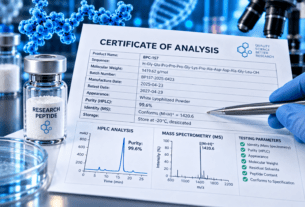
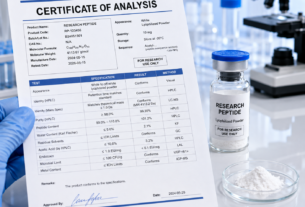
Testing may evaluate characteristics such as appearance, purity, degradation products, peptide content, moisture, pH following reconstitution, and other product-specific attributes.
Regulatory guidance from the International Council for Harmonisation establishes widely used principles for pharmaceutical stability testing, including long-term and accelerated studies. FDA — Q1A(R2) Stability Testing of New Drug Substances and Products
This testing provides evidence supporting storage instructions and expiration periods.
Without product-specific stability data, an exact shelf-life claim should be treated cautiously.
Lyophilized vs. Reconstituted Shelf Life
One of the most important distinctions is between a dry lyophilized peptide and the same peptide after it has been placed into solution.
These are two very different environments.
Before reconstitution, most water has been removed.
After reconstitution, water is once again present.
That can dramatically change stability.
Hydrolysis and other degradation pathways may become more relevant. Molecular mobility increases. Microbiological considerations can also change depending upon the solution, preparation method, container, handling conditions, and intended application.
Consequently, storage instructions and expiration periods established for an unopened lyophilized vial should not automatically be applied to a reconstituted solution.
Reconstitution Changes the Equation
Once a peptide has been reconstituted, stability depends on additional variables:
The solvent matters.
The concentration matters.
The pH matters.
The storage temperature matters.
The formulation matters.
The number of times the container is accessed can matter.
The peptide’s intrinsic stability in aqueous solution matters.
For approved peptide medications, the manufacturer’s labeling provides specific instructions for storage and allowable use periods after preparation or first use. Those instructions should be followed rather than generalized peptide-storage advice.
For laboratory research materials, investigators should follow validated protocols and supplier stability information appropriate to the specific compound.
Can You Tell When a Peptide Has Degraded?
Sometimes physical changes may provide a warning, but appearance alone is not a reliable test of peptide integrity.
Unexpected discoloration, visible contamination, damaged packaging, unusual precipitation after preparation, or major changes in physical appearance may justify rejecting or investigating a sample.
However, peptide degradation can occur without producing any obvious visual change.
A vial can look completely normal while chemical analysis reveals degradation products.
Determining purity and integrity therefore requires appropriate analytical techniques rather than visual inspection alone.
What About Shipping?
Shipping presents a unique storage challenge because the product leaves a controlled laboratory environment.
Packages can encounter trucks, airplanes, warehouses, loading docks, and outdoor temperatures.
The relevant question is not simply:
“Was the peptide refrigerated every second?”
A better question is:
“Has stability testing demonstrated that the product can tolerate the time and temperature conditions encountered during transportation?”
A well-characterized lyophilized product may tolerate temporary temperature excursions considerably better than the same peptide in solution.
That is one of the major logistical advantages of freeze-drying.
But the degree of tolerance is peptide- and formulation-specific.
Practical Storage Principles for Lyophilized Research Peptides
Although specific manufacturer instructions should always take priority, several broad principles apply to many lyophilized materials:
Keep them dry. Moisture protection is fundamental.
Keep them appropriately cool. Follow the validated temperature range for the particular material.
Avoid excessive heat. Do not leave temperature-sensitive materials in uncontrolled hot environments.
Protect them from unnecessary light.
Maintain the original sealed container whenever possible.
Avoid unnecessary temperature cycling.
Track batches and storage dates.
Do not assume the dry-state shelf life applies after reconstitution.
And most importantly:
Follow product-specific storage information whenever it is available.
The Bottom Line
Lyophilization is one of the most effective technologies available for improving the storage stability of many peptides.
By removing the majority of water, freeze-drying can substantially reduce molecular mobility and slow degradation pathways that may occur much more rapidly in solution.
But freeze-drying does not stop chemistry completely.
Temperature, moisture, oxygen, light, formulation, packaging, and time continue to matter.
For many research applications, cool or frozen storage may provide significant advantages, while protection from moisture and excessive heat remains especially important. However, there is no scientifically defensible universal rule stating that every lyophilized peptide should be stored at one particular temperature or that every freeze-dried peptide remains stable for a particular number of months or years.
Shelf life is ultimately peptide-specific and formulation-specific.
The most reliable storage instructions are those supported by actual stability data for the individual product.
And once a lyophilized peptide is reconstituted, the situation changes substantially. A storage period appropriate for the unopened dry material should never automatically be assumed to apply to the resulting solution.
Understanding these distinctions helps researchers preserve sample integrity, reduce avoidable degradation, and obtain more reliable experimental results from peptide materials.
Research-use note: This article discusses general storage principles for peptide research materials. It is not a substitute for the storage instructions supplied with an approved medication or validated laboratory protocol.