


Serious Clinical Peptide Research and Trials Being Conducted Currently
Peptides have become one of the most important areas of modern biomedical research. While much of the public discussion surrounding peptides focuses on weight management, body composition, recovery, or compounds sold specifically for laboratory research, the scientific world surrounding peptides is considerably larger.
Researchers, universities, pharmaceutical companies, cancer centers, and biotechnology companies are investigating peptide-based therapies for conditions ranging from obesity and diabetes to cardiovascular disease, cancer, chronic pain, muscle health, and immune disorders.
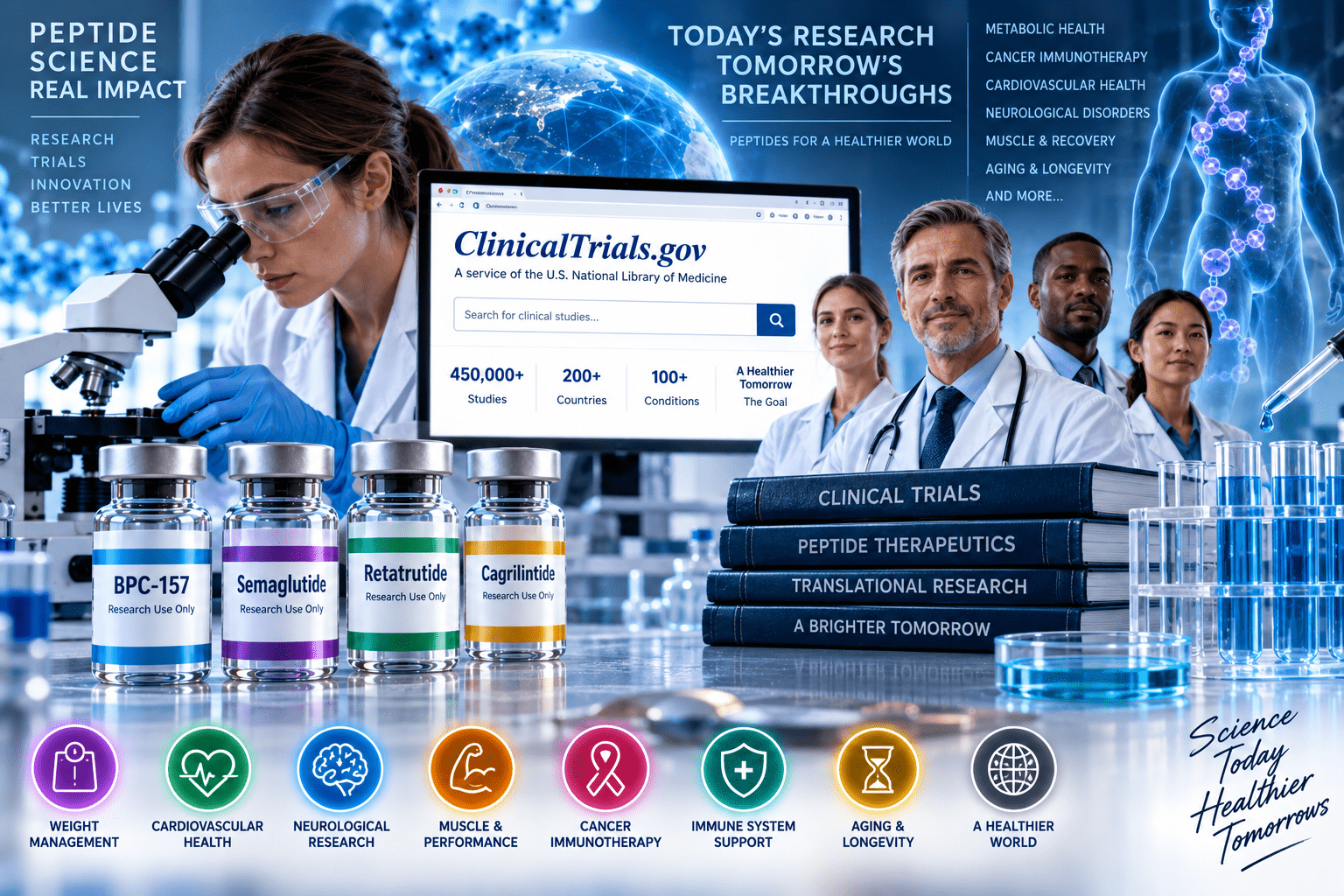
One of the best places to see this work firsthand is ClinicalTrials.gov, the clinical-study database maintained by the U.S. National Library of Medicine. ClinicalTrials.gov includes studies conducted in the United States and around the world.
Looking through these trials reveals something important: peptide science is not a fringe area of medicine. Some peptide-based candidates are being studied in large Phase 3 trials involving hundreds or even thousands of human participants, while other highly experimental peptide technologies are being evaluated in carefully controlled Phase 1 studies.
Here are some of the most interesting examples.
1. Retatrutide: Taking Multi-Receptor Peptide Research Further
Retatrutide, also known as LY3437943, represents one of the most closely watched investigational peptide programs.
The molecule is designed to activate three metabolic hormone receptors: GLP-1, GIP, and glucagon receptors. This “triple agonist” approach is intended to influence several metabolic pathways with one molecule.
Importantly, retatrutide research has progressed far beyond laboratory experiments.
ClinicalTrials.gov lists multiple Phase 3 studies investigating the compound.
For example, TRIUMPH-7 is a Phase 3 randomized, double-blind, placebo-controlled study examining retatrutide in people with overweight or obesity who also have chronic low back pain. The study is designed to investigate whether treatment can improve chronic low back pain while evaluating efficacy and safety over approximately 80 weeks.
This is particularly interesting because researchers are looking beyond a simple question of:
“How much weight can a person lose?”
Instead, investigators increasingly want to know whether substantial metabolic and weight changes can improve other medical conditions associated with excess body weight.
Another Phase 3 retatrutide trial registered on ClinicalTrials.gov began in January 2026 and is expected to enroll approximately 600 participants without type 2 diabetes who have overweight or obesity.
Retatrutide has also been studied in a large Phase 3 program involving people with type 2 diabetes, overweight or obesity, and related conditions including obstructive sleep apnea. One registered study listed an estimated enrollment of approximately 1,000 participants.
Another major Phase 3 study investigated retatrutide in participants with obesity and cardiovascular disease. ClinicalTrials.gov reports actual enrollment of 1,946 participants, demonstrating the scale to which this investigational peptide program has progressed.
Retatrutide therefore provides an excellent example of the progression of peptide science from molecular engineering into large human clinical programs.
2. Survodutide and the Next Generation of Metabolic Peptides
Retatrutide is not the only multi-receptor peptide being seriously investigated.
Survodutide, also known as BI 456906, is another metabolic candidate being studied in large clinical programs. It combines glucagon-receptor and GLP-1-receptor activity.
One Phase 3 study registered on ClinicalTrials.gov evaluated survodutide against placebo in people with overweight or obesity without type 2 diabetes. The study enrolled 726 participants and ran for approximately 76 weeks of treatment.
Even more impressive is the scale of cardiovascular research.
The SYNCHRONIZE-CVOT trial was designed to examine cardiovascular safety in people with overweight or obesity who also had established cardiovascular disease, chronic kidney disease, or important cardiovascular risk factors.
ClinicalTrials.gov reports actual enrollment of 5,531 participants across hundreds of study locations.
That number is worth considering.
When an investigational peptide progresses into a randomized cardiovascular study involving more than 5,000 people, it demonstrates how far peptide therapeutics have advanced from their image as niche laboratory compounds.
3. Cagrilintide and CagriSema: Looking Beyond GLP-1 Alone
Another major research area involves the hormone amylin.
Cagrilintide is a long-acting amylin analogue being investigated both independently and together with semaglutide. The combined treatment is commonly called CagriSema.
A large Phase 3 study known as REIMAGINE 2 compared cagrilintide plus semaglutide with the individual components and placebo in people with type 2 diabetes.
ClinicalTrials.gov lists actual enrollment of 2,734 participants. The study was completed in early 2026, and a peer-reviewed publication associated with the trial was subsequently listed in The Lancet Diabetes & Endocrinology.
But investigators are also asking more detailed questions.
A 2026 recruiting study called RASMUS is examining how CagriSema, cagrilintide, and semaglutide affect muscle health during weight loss.
That question could become increasingly important.
Large reductions in body weight involve changes in both fat mass and lean tissue. Future metabolic therapies may therefore be judged not merely by pounds lost, but by what type of tissue is lost and how physical function changes.
Other current studies are examining appetite and food intake with cagrilintide, pharmacokinetic differences between formulations, and tolerability in individuals who have difficulty tolerating GLP-1 receptor agonist therapies.
ClinicalTrials.gov also lists a Phase 3 study of CagriSema in children and adolescents with type 2 diabetes, illustrating how the clinical-development program continues to expand into additional patient populations.
4. Personalized Peptide Cancer Vaccines
Some of the most scientifically fascinating peptide research has nothing to do with obesity or metabolism.
It involves cancer.
Researchers are developing personalized vaccines containing peptides that correspond to mutations found within an individual patient’s tumor.
The concept is remarkably different from conventional chemotherapy.
Instead of broadly attacking rapidly dividing cells, researchers attempt to identify molecular characteristics unique to a patient’s cancer and teach the immune system to recognize those targets.
One ClinicalTrials.gov study sponsored by MD Anderson Cancer Center investigates personalized peptide vaccines in advanced pancreatic and colorectal cancer.
The Phase 1 program evaluates customized vaccines developed using information from the patient’s tumor and blood, including combinations with immunotherapies such as pembrolizumab.
The central question is whether personalized peptide vaccination can safely stimulate an immune response capable of recognizing tumor-specific targets.
This represents a much broader future for peptide medicine: peptides may function not only as drugs themselves but also as information presented to the immune system.
5. Peptide Vaccines Targeting KRAS-Mutated Cancer
KRAS mutations are among the most important genetic abnormalities in cancer biology.
A particularly interesting peptide-based program is ELI-002 7P.
ClinicalTrials.gov describes ELI-002 7P as including lipid-conjugated peptide-based antigens designed around KRAS and NRAS mutations. The AMPLIFY-7P clinical program has investigated the therapy in people with KRAS/NRAS-mutated solid tumors.
An additional study at Memorial Sloan Kettering Cancer Center is recruiting participants to investigate ELI-002 7P, with or without the checkpoint inhibitor tislelizumab, in pancreatic cancer.
There is even an expanded-access program involving ELI-002 for certain patients with KRAS/NRAS-mutated pancreatic ductal adenocarcinoma who are considered at high risk for relapse.
Separately, Johns Hopkins investigators have registered a Phase 1 study evaluating a pooled mutant-KRAS peptide vaccine combined with chemoimmunotherapy, nivolumab, and ipilimumab in KRAS-mutated non-small-cell lung cancer.
These studies demonstrate how peptide technology can be incorporated into sophisticated modern cancer-immunotherapy strategies.
6. Peptide Vaccination Against Treatment Resistance
Another intriguing concept is using peptide vaccines before cancer develops resistance to treatment.
A Johns Hopkins Phase 1/2 pilot study is investigating a cancer peptide vaccine in patients with advanced ALK-positive non-small-cell lung cancer who are receiving ALK-targeted therapy.
Rather than waiting for drug resistance to occur, investigators are studying whether vaccination might help prevent or delay acquired resistance.
This represents a different way of thinking about cancer treatment.
Future therapies may involve combinations in which targeted drugs suppress cancer while vaccines educate the immune system to recognize molecular features associated with the disease.
7. Personalized Peptides for Sarcoma
Personalized vaccination is also being explored in sarcoma.
The PerVision study at University Hospital Tuebingen is a Phase I/II clinical trial investigating individualized peptide vaccines in patients with metastatic fusion-driven sarcomas.
Researchers use whole-exome sequencing of tumor and normal tissue along with RNA sequencing of the tumor. They then identify patient-specific peptide targets, including peptides associated with tumor fusion breakpoints and mutations.
In other words, the treatment itself may be partly designed around the molecular characteristics of an individual person’s cancer.
That is precision medicine in a very literal sense.
8. Peptide-Based Immune Modulation
Peptides can also be used to influence immune responses rather than simply targeting tumor mutations.
A recruiting Phase 1 study at the University of California, Davis is investigating IO102-IO103, an IDO and PD-L1 peptide-based immune-modulatory therapy, together with pembrolizumab in patients with certain forms of non-muscle-invasive bladder cancer.
Another first-in-human study, START, is investigating PeptiCRAd-1 combined with checkpoint-inhibitor therapy across multiple cancer types. Researchers are examining both safety and the immunological mechanism of action.
These programs show that “peptide therapy” is an extremely broad scientific category.
A peptide can act as a hormone analogue, receptor agonist, signaling molecule, antigen, vaccine component, immune modulator, targeting molecule, or part of a larger therapeutic platform.
9. Tesamorelin and Peripheral Nerve Injury
Peptide research also includes attempts to repurpose or extend the use of existing peptide-based medicines.
Tesamorelin is a growth-hormone-releasing-factor analogue with established medical use in a specific indication. Researchers at Johns Hopkins are conducting a study investigating whether tesamorelin might improve functional outcomes following peripheral nerve injury.
ClinicalTrials.gov lists this study as recruiting as of its latest record update.
This illustrates another important part of peptide research.
Scientists do not necessarily stop investigating a molecule after one medical application has been established. Understanding a biological pathway may lead researchers to explore entirely different diseases or injuries in which that pathway could potentially matter.
10. What Makes These Studies Different From Internet “Peptide Research”?
There is an important distinction between legitimate clinical peptide research and claims frequently encountered online.
A registered human clinical trial typically defines:
- exactly which compound is being investigated;
- who can participate;
- what comparison or control is being used;
- what outcomes researchers will measure;
- how adverse events will be monitored;
- how long participants will be followed;
- who sponsors the study; and
- what phase of clinical development the investigation represents.
ClinicalTrials.gov registration itself does not prove that a treatment works, nor does listing imply endorsement by the U.S. government, FDA, NIH, or National Library of Medicine.
A Phase 1 study may primarily investigate safety and tolerability.
Phase 2 research generally begins asking more substantial questions about biological activity and efficacy while continuing safety evaluation.
Phase 3 trials can involve hundreds or thousands of participants and are generally designed to provide much stronger evidence regarding benefits and risks.
Even a promising Phase 3 investigational drug should not automatically be considered an approved therapy.
Peptide Research Is Becoming More Sophisticated
The most striking lesson from today’s clinical research is that peptide development is moving in several directions simultaneously.
Metabolic researchers are engineering molecules capable of activating multiple receptors.
Cancer researchers are creating peptide vaccines based on individual tumor mutations.
Immunologists are investigating peptide-based methods of directing immune responses.
Researchers are examining how peptide therapies affect not simply weight, but cardiovascular outcomes, chronic pain, muscle health, appetite, metabolic disease and other clinically meaningful endpoints.
And computational biology, genetic sequencing, advanced peptide synthesis, analytical chemistry and precision medicine are increasingly converging.
The future may therefore involve far more than discovering another naturally occurring peptide.
Researchers can increasingly ask:
What biological target do we want to influence, and can we engineer a peptide specifically for that purpose?
That represents a fundamental change in the field.
From Laboratory Curiosity to Serious Medicine
Peptides sometimes receive an unusual amount of attention online because experimental compounds can become popular long before definitive clinical evidence exists.
That can obscure the much more important story.
Behind the social-media discussion is a serious scientific field involving major universities, cancer centers, biotechnology companies, pharmaceutical manufacturers, regulatory authorities and thousands of clinical-trial participants.
Some peptide candidates will undoubtedly fail.
Others may demonstrate biological activity but unacceptable side effects.
Some may work only for narrowly defined groups of patients.
And a small number may ultimately change standards of medical care.
That uncertainty is exactly why controlled clinical trials matter.
The purpose of good peptide research is not to prove that a compound works. It is to find out whether it works, how well it works, for whom it works, and whether its benefits outweigh its risks.
That distinction separates scientific investigation from marketing.
The Future of Clinical Peptide Research
The current ClinicalTrials.gov landscape suggests several areas worth watching closely over the coming years:
Multi-receptor metabolic peptides may continue expanding beyond weight reduction into cardiovascular disease, diabetes complications, sleep apnea, chronic pain and other obesity-related conditions.
Amylin-based approaches could become increasingly important, particularly in combination with GLP-1-based therapies.
Personalized peptide cancer vaccines may become more sophisticated as tumor sequencing becomes faster and less expensive.
Mutation-specific vaccines targeting KRAS, NRAS and other cancer-driving abnormalities could help determine whether the immune system can be trained to control residual disease or delay recurrence.
Peptide immune modulators could increasingly be combined with checkpoint inhibitors and other forms of cancer immunotherapy.
And entirely new engineered peptides may emerge from computational drug design and artificial intelligence.
Conclusion: Peptide Research Is Much Bigger Than Most People Realize
Anyone who thinks peptide research consists only of experimental compounds discussed for weight loss, muscle development, recovery, or healthy aging is seeing only a small portion of the field.
Current clinical research tells a much larger story.
Thousands of participants have entered late-stage studies involving advanced metabolic peptides. Researchers are investigating peptide therapies for cardiovascular risk, chronic pain, diabetes and muscle health. Major cancer centers are designing personalized peptide vaccines around individual tumors. Other investigators are targeting KRAS mutations, immune checkpoints and treatment resistance.
These are serious scientific investigations with important questions still to answer.
That final point matters.
A clinical trial is evidence that scientists believe a hypothesis is important enough to test—not evidence that the hypothesis has already been proven.
For anyone interested in the future of peptides, following registered human studies provides a much clearer picture of where the science is actually heading than relying on marketing claims or online enthusiasm.
And judging from the clinical research underway today, the next generation of peptide medicine may ultimately extend far beyond the applications that made peptides famous in the first place.
Research note: Trial recruitment status, enrollment, completion dates and study designs can change as records are updated. Readers interested in a particular study should check its current ClinicalTrials.gov record directly before drawing conclusions about its present status.