

Peptide Bond Essentials: Biology and Synthesis
Peptide bonds are the chemical links that connect amino acids, allowing cells to build peptides and proteins with specific shapes and functions. If you understand how a peptide bond forms, you can better understand everything from digestion and hormones to laboratory peptide synthesis. This article explains the biology in plain English, with enough structure to make the chemistry easier to remember.
What is a peptide bond?
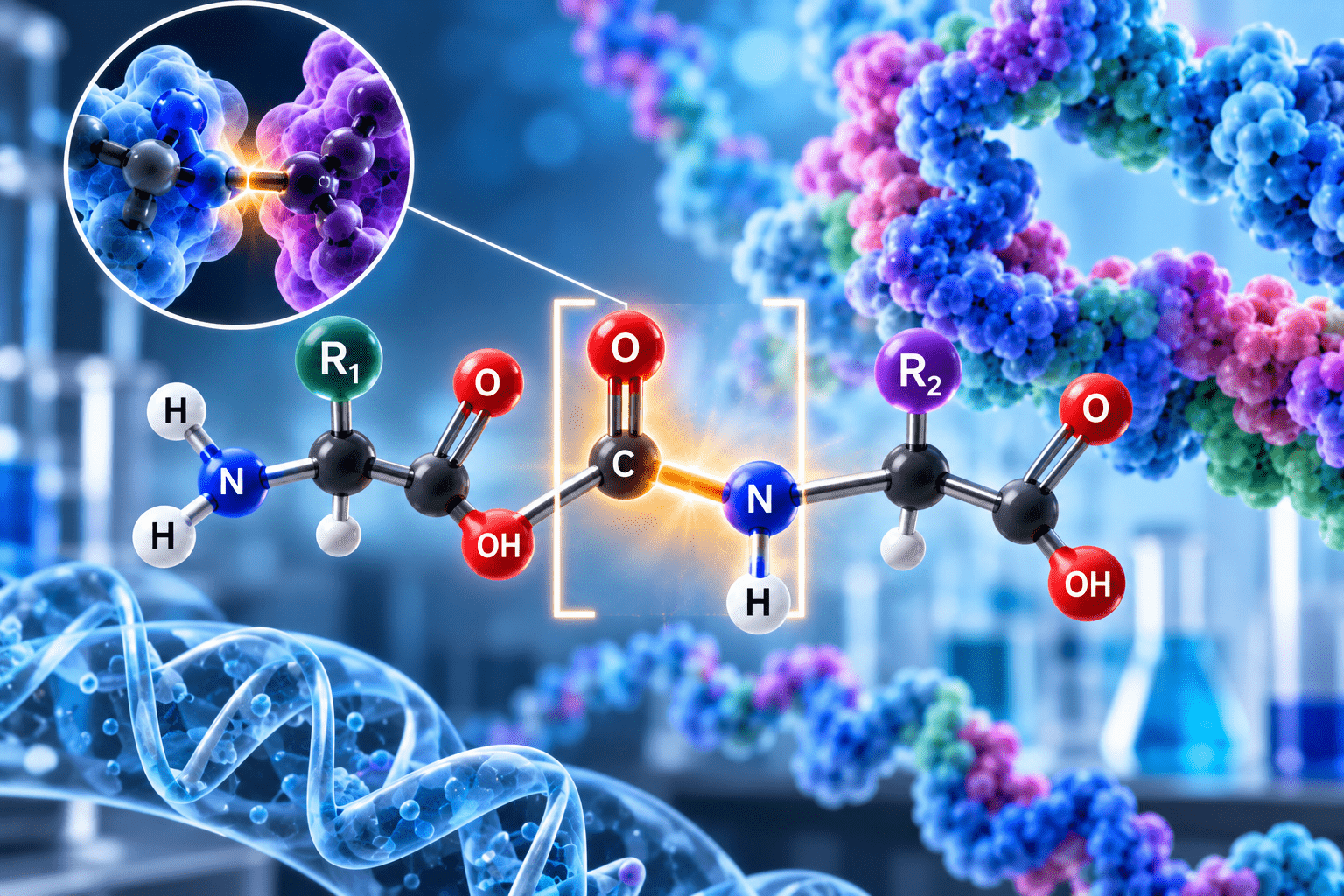
A peptide bond is the covalent bond that joins the carboxyl group of one amino acid to the amino group of another amino acid. In simple terms, it is the connection point that turns separate amino acids into a chain. That chain may be short, forming a peptide, or much longer and more complex, forming a protein.
Amino acids have two important ends: an amino group and a carboxyl group. When two amino acids link, the amino group of one reacts with the carboxyl group of the other.
During the process of forming a peptide bond, a molecule of water is produced as a byproduct. This is the reason why the formation of peptide bonds is frequently referred to as either a dehydration reaction or a condensation reaction. Essentially, when two amino acids come together to create a peptide bond, they do so by eliminating a water molecule, which is the result of combining an –OH group from one amino acid and a hydrogen atom from the other. This elimination of water is a critical aspect of how these bonds are formed, and it highlights the connection between water loss and the creation of more complex molecules in biological systems.
Once formed, the peptide bond has partial double-bond character. That makes it relatively rigid compared with many single bonds in biological molecules. This rigidity matters because the angles around peptide bonds help influence the eventual shape of the peptide or protein.

The peptide definition biology students actually need
A practical peptide definition biology learners can use is this: a peptide is a short chain of amino acids connected by peptide bonds.
The word “short” can mean different things in different books and science. But the main idea is still the same.
Peptides are smaller amino acid chains, while proteins are usually longer chains that fold into complex three-dimensional structures.
This definition helps because it keeps the focus on structure and function. Peptides are not random supplements, mystery chemicals, or miniature proteins by default. They are biological molecules made from amino acid building blocks, and their activity depends on their sequence, shape, and interactions with other molecules.
In the body, peptides can act as signals, structural components, intermediates in protein breakdown, or precursors to other molecules. Some are only a few amino acids long. Others are long enough to have more defined shapes and specialized roles.
What are peptides made of?
Peptides are made of amino acids arranged in a specific order. Each amino acid has a common backbone structure, but its side chain is different. Those side chains give amino acids their individual properties, such as being charged, water-loving, water-repelling, acidic, basic, or sulfur-containing.
The sequence of amino acids is not just a list; it is a set of instructions. Change one amino acid, and the peptide may fold differently, bind less effectively, become more stable, or lose its function entirely. This is one reason peptide chemistry is so important in biology and biotechnology.
A basic way to think about peptide structure is:
- Amino acids are the building blocks. They provide the chemical variety needed for biological function.
- Peptide bonds are the links. They connect amino acids into a continuous chain.
- The amino acid sequence is the message. It determines how the chain behaves.
- The final shape affects activity. A peptide’s function depends on how it fits with receptors, enzymes, membranes, or other targets.
This structure-function relationship is central to both natural peptides and lab-made peptides. Whether a peptide is produced by a cell or created through making peptides in a laboratory, its amino acid order is the foundation of what it can do.
How peptide bonds form in living cells
Inside living cells, peptide bonds are formed during protein synthesis. Ribosomes read genetic instructions carried by messenger RNA, then link amino acids together in the correct order. Transfer RNA molecules bring the needed amino acids to the ribosome, where the growing chain is extended one amino acid at a time.
This process is highly organized. The cell does not simply mix amino acids and hope they connect correctly.
Instead, molecular machinery arranges each amino acid to ensure that the new peptide bond forms correctly and in the proper order.
The direction of growth is also important. Peptide chains are built from the amino end, often called the N-terminus, toward the carboxyl end, known as the C-terminus. This direction helps scientists describe sequences consistently and understand how proteins are assembled.
After a peptide or protein is made, it may be modified. Some chains are cut into smaller active peptides. Others may have chemical groups added, helping control where they go, how long they last, or how they function.
Peptides, proteins, and where the difference matters
Peptides and proteins are related, but they are not always interchangeable terms. Both are made from amino acids connected by peptide bonds. The main difference is usually size, complexity, and folding.
Peptides are generally shorter chains and may have simpler structures. Proteins are usually longer chains that fold into stable, complex shapes and often perform larger biological jobs. Enzymes, antibodies, transport proteins, and many structural molecules are proteins.
The difference matters because size and folding influence behavior. A short peptide may move quickly, signal briefly, or bind to a specific receptor. A large protein may have multiple functional regions, interact with many partners, or require careful folding to work.
In a peptides and proteins lab, scientists often study both because they are connected.
A researcher may study how a piece of a peptide influences a protein interaction, how a protein is divided into active peptides, or how altering a single amino acid can change the behavior of the whole molecule.
Are peptides like steroids?
Peptides are not like steroids in their basic structure. Peptides are made of amino acids linked by peptide bonds, while steroids are lipid-based molecules built around a characteristic ring structure. They can both act as signals in the body, but they belong to different chemical families and often work in different ways.
This question comes up because people hear about peptide hormones and steroid hormones in similar contexts. Both can influence biological processes, but the molecules themselves are very different. A peptide hormone typically binds to a receptor on the outside of a cell because many peptides do not easily pass through cell membranes. A steroid hormone can often cross cell membranes and interact with receptors inside the cell.
That difference affects how signals are delivered. Peptide signals are often fast and receptor-driven at the cell surface. Steroid signals often involve changes in gene expression, which may take longer but can have broad effects.
The practical takeaway is simple: the word “peptide” does not mean “steroid.” They are separate categories, and they should not be treated as the same thing in biology, health discussions, or laboratory contexts.
What are the peptide hormones?
Peptide hormones are signaling molecules made from amino acid chains. They are produced by glands, tissues, or specialized cells and help coordinate processes such as metabolism, growth, appetite, blood sugar regulation, stress responses, and reproduction.
Common examples discussed in biology include insulin, glucagon, growth hormone, oxytocin, vasopressin, and parathyroid hormone. These molecules vary in size and role, but they share the basic feature of being built from amino acids rather than from lipids.
Peptide hormones typically work by binding to receptors on target cells. That binding triggers a signal inside the cell, often through second messengers or enzyme-linked pathways. The hormone does not need to enter the cell to cause an effect; it only needs to activate the right receptor.
This receptor-based signaling is one reason peptide hormones can be highly specific. A peptide may circulate widely, but only cells with the correct receptor will respond strongly. That specificity is a major theme in endocrinology and cell communication.
Making peptides in the laboratory
Making peptides in a lab is different from how cells make them, but the goal is similar: connect amino acids in a controlled order. Laboratory peptide synthesis usually builds the chain step by step, using protected amino acids so that reactions happen at the intended sites.
The most common teaching concept is solid-phase peptide synthesis. In this method, the first amino acid is attached to a solid support. Additional amino acids are added one at a time, with cycles of deprotection and coupling until the desired sequence is complete.
A simplified version of the workflow looks like this:
- Choose the target sequence. The amino acid order is selected based on the intended study or use.
- Attach the starting amino acid. The first residue is anchored to a solid support.
- Remove a protecting group. This exposes the reactive site needed for the next bond.
- Add the next protected amino acid. A coupling reaction forms the new peptide bond.
- Repeat the cycle. Each round extends the chain by one amino acid.
- Release and purify the peptide. The finished chain is separated from the support and cleaned for analysis.
This process shows why peptide chemistry requires precision. If an amino acid is skipped, added twice, or attached incorrectly, the final peptide may not behave as expected. Purification and quality checks are therefore important parts of responsible peptide research.
Why peptide bonds are strong but still digestible
Peptide bonds are stable enough to hold proteins together under normal biological conditions. That stability is essential because cells rely on proteins to maintain structure, catalyze reactions, transport molecules, and send signals. If peptide bonds fell apart too easily, biological systems would be chaotic.
At the same time, peptide bonds can be broken when the body needs to digest food proteins or recycle old cellular proteins. Enzymes called proteases or peptidases catalyze the breakdown of peptide bonds. These enzymes are selective, meaning they often cut at particular amino acid sequences or structural sites.
Digestion is a clear example. Proteins in food are broken into smaller peptides and amino acids, which the body can absorb and reuse. Inside cells, damaged or unneeded proteins can also be broken down so their amino acids can be recycled.
This balance is elegant: peptide bonds are strong enough for life’s machinery, but not so permanent that the body cannot remodel, digest, or regulate its own molecules.
Key takeaways for remembering peptide bonds
Peptide bonds can seem abstract at first, but a few core ideas make them easier to understand. Focus on the building blocks, the connection, and the result.
- A peptide bond links two amino acids. It forms between a carboxyl group and an amino group.
- Water is released during formation. This is why the reaction is called dehydration or condensation.
- Peptides are amino acid chains. Shorter chains are often called peptides, while longer folded chains are usually proteins.
- Sequence controls function. The order of amino acids affects shape, stability, and biological activity.
- Peptides are not steroids. They are chemically different, even when both act as hormones.
- Cells and labs can both make peptides. Cells use ribosomes, while laboratories use controlled chemical synthesis.
A simple way to see the bigger picture
Peptide bonds are small chemical connections with enormous biological importance.
Amino acids are small building blocks that play a crucial role in biological processes. They can combine together to form chains known as peptides, which are then further assembled into larger structures called proteins. These proteins are vital because they perform a wide variety of functions that are essential to the operation of living organisms. In fact, proteins help carry out many important tasks within cells and throughout the body, making them integral to the maintenance of life itself.
Once you understand the peptide bond, many bigger topics become easier: enzymes, hormones, digestion, cell signaling, protein folding, and peptide synthesis. The details can become advanced, but the foundation is straightforward. Amino acids connect through peptide bonds, and those connections create molecules that help life function.