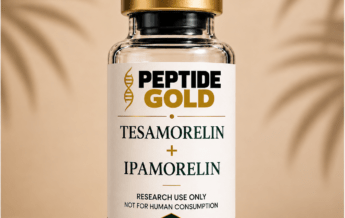


Tesamorelin + Ipamorelin: A Comprehensive Guide to Uses, Research, Dosing Information, Forms, and Potential Benefits
The combination of Tesamorelin + Ipamorelin is a growth-hormone–focused peptide pairing designed around two different signaling pathways that converge on the same general outcome:
increased endogenous growth hormone release.
The combination is most commonly discussed in connection with:
- Visceral fat reduction
- Body composition
- Growth hormone support
- Recovery
- Sleep
- Lean mass preservation
- Metabolic health
- Age-related decline in GH secretion
- Exercise recovery
The biological rationale is straightforward.
Tesamorelin peptide activates the GHRH receptor on pituitary cells.
Ipamorelin peptide activates the ghrelin/GHS-R1a receptor.
Because the two receptors are different, using both theoretically allows the pituitary to receive two separate signals encouraging growth hormone release.
That creates an appealing concept:
Tesamorelin → GHRH pathway
plus
Ipamorelin → ghrelin/GHSR pathway
leading potentially to a stronger or differently patterned GH response.
However, the most important limitation is this:
there are currently no controlled published human trials testing Tesamorelin and Ipamorelin together.
The combination is therefore based on the known biology of the individual compounds and on research involving other GHRH-plus-GHRP combinations rather than direct clinical validation of this exact pairing. Current searches of the published literature show no dedicated clinical trial of Tesamorelin + Ipamorelin.
What Is Tesamorelin?
Tesamorelin peptide is a synthetic analogue of human growth hormone-releasing hormone, or GHRH.
It stimulates the pituitary gland to release the body’s own growth hormone.
Tesamorelin is notable because it is an FDA-approved prescription drug.
The current FDA-approved product is:
EGRIFTA WR®.
Its indication is specifically:
reduction of excess abdominal fat in adults with HIV-associated lipodystrophy.
Tesamorelin is not FDA-approved for:
general obesity,
bodybuilding,
anti-aging,
athletic performance,
or routine cosmetic abdominal-fat reduction.
What Is Ipamorelin?
Ipamorelin peptide is a synthetic growth hormone secretagogue.
Unlike tesamorelin, it does not activate the GHRH receptor.
Instead, it stimulates:
GHS-R1a — the growth hormone secretagogue/ghrelin receptor.
This receptor is naturally activated by ghrelin.
When Ipamorelin activates GHS-R1a, the pituitary releases a pulse of growth hormone.
Human pharmacokinetic research confirms that Ipamorelin can produce a clear GH response.
In healthy male volunteers, GH peaked approximately:
0.67 hours after exposure
or about:
40 minutes.
Ipamorelin itself had a terminal half-life of approximately:
2 hours.
Unlike tesamorelin, Ipamorelin is not FDA-approved for any indication.
Why Combine Tesamorelin and Ipamorelin?
The reason is that the two peptides act through different receptors.
Growth hormone secretion is normally controlled by several interacting signals.
Two particularly important ones are:
GHRH
and
ghrelin.
GHRH activates GHRH receptors on pituitary somatotrophs.
Ghrelin activates GHS-R1a receptors.
Both can promote GH secretion.
When both pathways are activated simultaneously, the GH response can theoretically be greater than when either pathway is stimulated alone.
This general concept has been demonstrated with other GHRH and GHRP compounds.
However, that should not be confused with proof that:
Tesamorelin + Ipamorelin specifically produces a superior clinical outcome.
No dedicated human trial has tested the pair.
How Does the Combination Work?
The simplified pathway looks like this:
Tesamorelin → GHRH receptor
plus
Ipamorelin → GHS-R1a receptor
leading to:
Pituitary GH release
which subsequently affects:
IGF-1 production
fat metabolism
protein turnover
connective tissue
and body composition.
The liver produces much of the circulating IGF-1 after exposure to GH.
That gives the combination a downstream pathway of:
Tesamorelin + Ipamorelin → GH → IGF-1
This is the biological foundation behind most claims involving the combination.
Why the Two Pathways Are Complementary
The endocrine system normally uses multiple signals to regulate growth hormone.
GHRH is one major stimulatory signal.
Ghrelin provides another.
Somatostatin acts in the opposite direction and suppresses GH release.
A GHRH analogue and a ghrelin receptor agonist therefore do not simply duplicate each other.
Tesamorelin acts on one receptor.
Ipamorelin acts on another.
This makes the pairing conceptually different from combining:
tesamorelin + sermorelin
or:
tesamorelin + CJC-1295,
where both components act primarily through the GHRH receptor.
Does Tesamorelin + Ipamorelin Produce More Growth Hormone?
That is biologically plausible, but it has not been directly demonstrated in a controlled Tesamorelin + Ipamorelin human trial.
The closest related human evidence comes from studies combining other GHRH and GHRP compounds.
Those studies show that activating both receptor systems can increase GH release compared with either pathway alone.
But different peptides have different:
potency
half-lives
receptor kinetics
and pharmacodynamics.
Therefore, researchers cannot simply assume that a result involving sermorelin plus GHRP-2 will translate quantitatively to tesamorelin plus ipamorelin.
Current evidence reviews specifically note that no trial has administered these two exact compounds together.
Tesamorelin and Visceral Fat
Tesamorelin’s strongest established benefit is reduction of visceral adipose tissue.
Visceral fat is the fat stored deep within the abdominal cavity surrounding the organs.
It differs from:
subcutaneous fat,
which lies immediately beneath the skin.
In its approved HIV-lipodystrophy population, tesamorelin has demonstrated significant reductions in visceral abdominal fat.
This makes tesamorelin especially interesting from a body-composition standpoint.
However, FDA labeling explicitly states that EGRIFTA WR is:
not indicated for weight-loss management.
That distinction matters.
Tesamorelin can alter fat distribution without producing large overall reductions in body weight.
Does Adding Ipamorelin Improve Tesamorelin’s Fat-Loss Effect?
There is currently no controlled evidence demonstrating that it does.
This is one of the most common assumptions surrounding the combination.
The theory is:
more GH stimulation → stronger lipolysis → potentially greater fat reduction.
But biological systems rarely behave in such a simple linear fashion.
Greater GH exposure could also produce:
higher IGF-1
greater fluid retention
more glucose-related effects
and potentially more adverse events.
There is currently no trial showing that adding Ipamorelin to tesamorelin produces:
more visceral fat loss
more total fat loss
or better waist reduction than tesamorelin alone.
Tesamorelin + Ipamorelin and Weight Loss
The combination is sometimes marketed as a weight-loss stack.
That description is not well supported.
Tesamorelin itself is not a conventional weight-loss drug.
Its approved clinical benefit involves visceral-fat reduction in a very specific population.
Ipamorelin has no established weight-loss indication.
Therefore, Tesamorelin + Ipamorelin should not be compared directly with:
or retatrutide.
Those drugs directly target metabolic and appetite pathways and have extensive weight-loss trial data.
Tesamorelin + Ipamorelin primarily influences the GH–IGF-1 axis.
Tesamorelin + Ipamorelin and Muscle
Growth hormone and IGF-1 participate in:
protein metabolism
muscle maintenance
connective tissue
and body composition.
This creates interest in the combination for:
lean mass
muscle preservation
and recovery.
Tesamorelin monotherapy has demonstrated increases in lean body mass in its approved population.
Ipamorelin can increase growth hormone.
However, there are no controlled studies showing that combining the two produces substantial muscle hypertrophy in healthy adults.
The combination should therefore not be described as a proven muscle-building treatment.
Lean Body Mass Versus Muscle
This distinction is important.
Studies often report:
lean body mass.
Lean body mass includes:
skeletal muscle
water
organs
bone
and other non-fat tissues.
An increase in lean mass does not automatically mean an equivalent increase in functional skeletal muscle.
Growth-hormone–related therapies may also increase water retention.
This can contribute to measured lean mass.
Tesamorelin + Ipamorelin and Recovery
The combination is commonly discussed for recovery because GH and IGF-1 influence:
collagen metabolism
connective tissue
protein turnover
and tissue repair.
This creates a reasonable biological rationale for research involving:
exercise recovery
tendon and ligament maintenance
and soft tissue.
However, no large trials show that Tesamorelin + Ipamorelin:
shortens injury recovery
repairs tendons
or improves post-workout recovery.
Those claims are mostly extrapolations from GH physiology.
Tesamorelin + Ipamorelin and Sleep
Growth hormone secretion is strongly linked to deep sleep.
The largest natural GH pulse often occurs during slow-wave sleep.
Ipamorelin can produce a relatively discrete GH pulse.
Tesamorelin also stimulates endogenous GH release.
For this reason, the combination is frequently associated with nighttime protocols in wellness and peptide markets.
However, there are no controlled trials demonstrating that the combination treats:
insomnia
poor sleep quality
or sleep disorders.
Improved GH secretion and improved sleep are related concepts, but they are not interchangeable.
Tesamorelin + Ipamorelin and IGF-1
One of the most important outcomes of repeated GH stimulation is an increase in IGF-1.
Tesamorelin’s FDA label specifically warns that the drug can elevate IGF-1 and recommends monitoring during treatment.
Adding another GH secretagogue could theoretically increase total GH/IGF-1 exposure further.
However, because the combination has never been adequately studied, researchers do not know:
how much additional IGF-1 would result
whether the increase would be clinically meaningful
or whether it would increase adverse effects.
More is not necessarily better.
Elevated IGF-1 and Safety
IGF-1 is a normal and essential hormone.
It influences:
growth
protein synthesis
bone
tissue repair
and metabolism.
But chronically excessive IGF-1 is not considered desirable.
Potential concerns associated with excessive GH/IGF-1 signaling include:
fluid retention
joint discomfort
carpal tunnel symptoms
glucose intolerance
and excessive tissue-growth signaling.
Tesamorelin’s FDA label notes that the effects of prolonged elevated IGF-1 are unknown and recommends considering discontinuation if elevations persist.
Cancer-Related Considerations
Growth hormone and IGF-1 participate in cellular growth and survival pathways.
This does not establish that Tesamorelin + Ipamorelin causes cancer.
However, tesamorelin itself is contraindicated in people with active malignancy.
FDA recommends caution in people with prior malignancy and states that treatment should be stopped if recurrence occurs.
Adding Ipamorelin has not been studied in this context.
Therefore, the combination has even less evidence regarding long-term cancer-related safety than tesamorelin alone.
Tesamorelin + Ipamorelin and Blood Sugar
Growth hormone can reduce insulin sensitivity.
This is one of the more important metabolic issues surrounding any GH-stimulating combination.
Tesamorelin labeling warns about:
glucose intolerance
and diabetes-related risk.
Adding another GH secretagogue could theoretically increase that effect.
Possible areas of concern include:
fasting glucose
insulin resistance
and HbA1c.
There is no combination trial quantifying these risks.
Ipamorelin and Growth Hormone Release
Human data provide a clear picture of Ipamorelin’s immediate endocrine effect.
In healthy volunteers, Ipamorelin produced a single GH-release episode.
The GH peak occurred at approximately:
0.67 hours,
and the response then declined exponentially.
Ipamorelin itself had an estimated terminal half-life of approximately:
2 hours.
This short-acting nature differs significantly from the longer downstream IGF-1 effects produced by repeated tesamorelin administration.
Is Ipamorelin More Selective Than Older GHRPs?
Ipamorelin was developed partly because it appeared more selective for GH release than older compounds such as:
GHRP-2
GHRP-6
and Hexarelin.
Older secretagogues can influence:
ACTH
cortisol
and sometimes prolactin.
Ipamorelin appears to have a cleaner GH-focused profile in preclinical research.
That selectivity is one reason it is often chosen as the GHS-R1a component in modern peptide combinations.
But selective does not mean clinically proven or risk-free.
Tesamorelin + Ipamorelin Dosing Information
There is no FDA-approved Tesamorelin + Ipamorelin combination dose.
There is also no published clinical protocol defining:
the optimal ratio
timing
frequency
cycle length
or maximum safe exposure.
This needs to be separated from tesamorelin’s approved dosing.
FDA-Approved Tesamorelin Dose
For the current EGRIFTA WR formulation, the FDA-approved dose is:
1.28 mg subcutaneously once daily.
This applies specifically to the:
11.6 mg per vial EGRIFTA WR formulation
for adults with HIV-associated lipodystrophy.
The FDA label warns that EGRIFTA WR and older EGRIFTA formulations are not directly interchangeable because the formulations differ.
Ipamorelin Research Dosing
Published human Ipamorelin research has used intravenous dose-escalation protocols measured in:
nmol/kg.
One pharmacokinetic study evaluated infusion rates from:
4.21 to 140.45 nmol/kg over approximately 15 minutes.
These were research doses used to model GH secretion.
They do not establish a routine subcutaneous wellness or anti-aging dose.
Why Online Combination Doses Are Not Established
Commercial clinics and research suppliers may offer Tesamorelin + Ipamorelin in fixed-ratio blends.
Those ratios are typically based on:
clinical practice
peptide-market conventions
or extrapolation from the individual compounds.
They are not based on randomized clinical trials of the combination.
Current evidence reviews consistently note that no validated combination protocol exists.
What Forms Is Tesamorelin + Ipamorelin Offered In?
The combination is primarily encountered outside the standard FDA-approved pharmaceutical system.
Separate Tesamorelin and Ipamorelin
The compounds can be studied separately.
This allows independent adjustment of each component.
Combination Lyophilized Vials
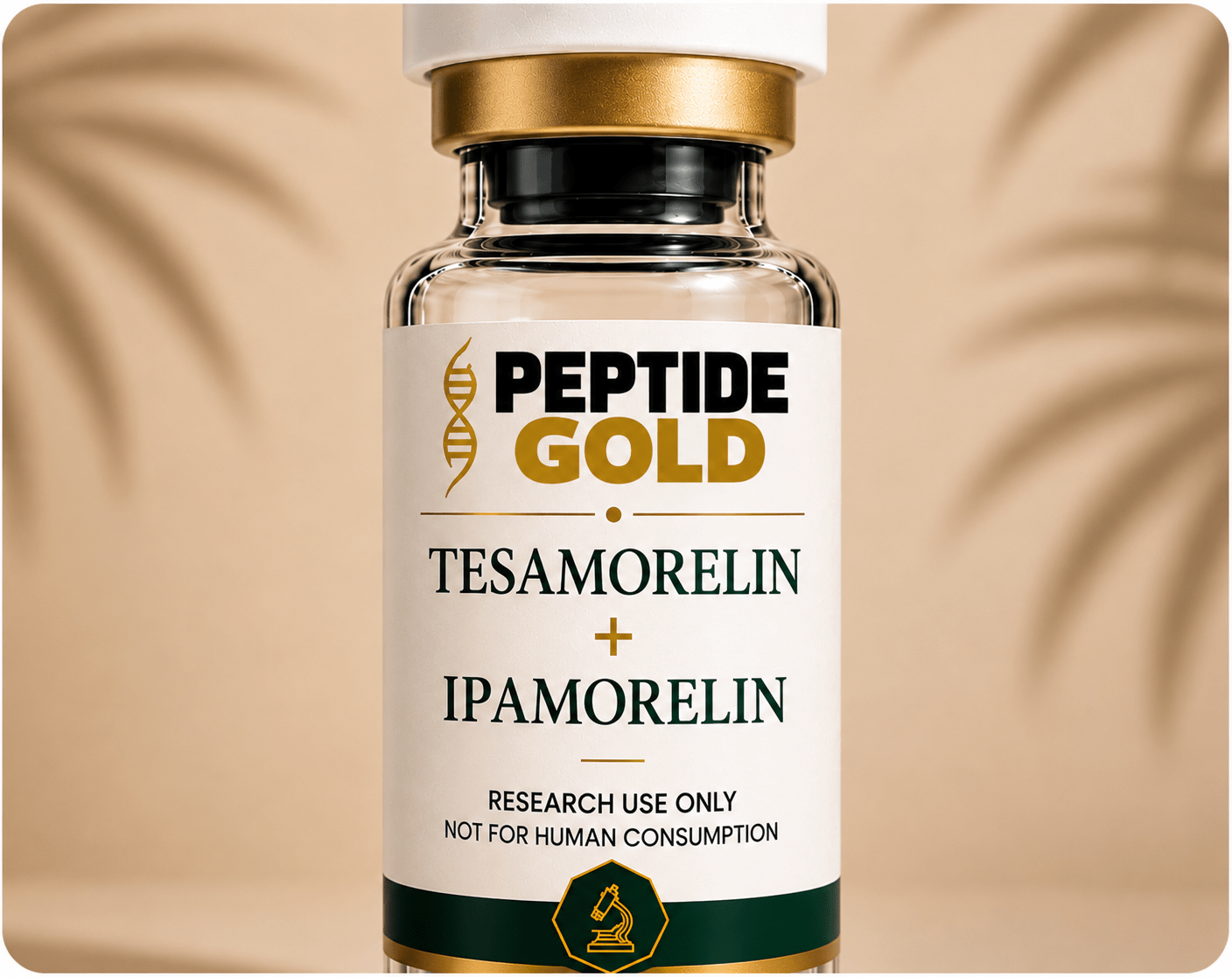
Research suppliers and some compounding settings may offer both peptides in a single freeze-dried vial.
There is no standardized official ratio defining a pharmaceutical “Tesamorelin + Ipamorelin” product.
FDA-Approved Tesamorelin
Tesamorelin itself is available as:
EGRIFTA WR, containing 11.6 mg of tesamorelin as lyophilized powder per vial.
Research-Grade Ipamorelin
Ipamorelin is commonly offered as freeze-dried research material.
There is no FDA-approved Ipamorelin product.
Why a Combination Vial Is Not Equivalent to EGRIFTA
This is important.
EGRIFTA WR is an FDA-approved pharmaceutical product with validated:
identity
potency
sterility
stability
and manufacturing standards.
A vial combining tesamorelin and ipamorelin has not undergone the same FDA review.
Even if it contains tesamorelin, it is not automatically equivalent to EGRIFTA WR.
The approved formulation also has specific reconstitution and storage instructions that apply to that pharmaceutical product alone.
Potential Side Effects
Because no controlled combination safety study exists, there is no validated side-effect frequency for Tesamorelin + Ipamorelin.
Possible concerns can be inferred from the individual compounds and the GH–IGF-1 pathway.
These may include:
- Injection-site reactions
- Headache
- Flushing
- Fluid retention
- Swelling
- Joint discomfort
- Tingling
- Carpal tunnel-like symptoms
- Changes in glucose regulation
- Increased IGF-1
- Fatigue
- Possible changes in appetite
These should not be considered a complete or proven combination safety profile.
Fluid Retention
Tesamorelin’s FDA prescribing information specifically warns that fluid retention can occur.
Possible manifestations include:
edema
joint pain
and carpal tunnel syndrome.
Because Ipamorelin also stimulates GH, it is biologically plausible that adding it could increase GH-related fluid-retention effects.
That has not been quantified in clinical trials.
Hypersensitivity
Tesamorelin can cause hypersensitivity reactions.
Research-market combination products introduce additional concerns involving:
peptide impurities
aggregation
sterility
and inaccurate concentration.
These manufacturing issues may create risks separate from the pharmacology of either peptide.
Is Tesamorelin FDA Approved?
Yes.
Tesamorelin is FDA-approved as EGRIFTA WR for:
reducing excess abdominal fat in adults with HIV-associated lipodystrophy.
FDA specifically states that it is:
not indicated for weight-loss management,
and that its long-term cardiovascular safety has not been established.
Is Ipamorelin FDA Approved?
No.
Ipamorelin is not FDA-approved for:
growth hormone deficiency
body composition
anti-aging
recovery
or any other medical condition.
Human research confirms its ability to release GH, but clinical development did not result in an approved drug.
Is Tesamorelin + Ipamorelin FDA Approved?
No.
The combination has:
no FDA-approved product
no FDA-approved indication
no validated dose ratio
and no approved administration schedule.
The approval of tesamorelin alone does not extend automatically to a combination containing ipamorelin.
Current Research in 2026
The research picture is somewhat unusual.
Tesamorelin has a strong human clinical evidence base as a monotherapy.
Ipamorelin has human pharmacokinetic and endocrine research showing that it stimulates GH.
What is missing is the bridge between them.
As of 2026, evidence reviews and database searches still identify no published controlled study of Tesamorelin + Ipamorelin administered together.
That means most claims about the blend are mechanistic extrapolations.
The broader principle of combining a GHRH receptor agonist with a ghrelin receptor agonist is scientifically reasonable.
But researchers still need to determine whether the specific pairing produces:
more GH
more IGF-1
greater visceral-fat reduction
better lean mass
or simply more side effects.
What Research Is Needed Next?
A straightforward clinical study could answer most of these questions.
Researchers could randomize participants to:
tesamorelin alone
ipamorelin alone
Tesamorelin + Ipamorelin
and placebo.
They could measure:
GH pulse amplitude
IGF-1
visceral adipose tissue
lean body mass
fasting glucose
HbA1c
insulin sensitivity
waist circumference
and adverse events.
That would establish whether the combination provides true additive or synergistic benefit.
At present, that evidence simply does not exist.
The Bottom Line
Tesamorelin + Ipamorelin is an experimental growth-hormone–secretagogue combination built around two different receptor pathways.
Tesamorelin activates the:
GHRH receptor
while
Ipamorelin activates the:
ghrelin/GHS-R1a receptor.
Both ultimately stimulate the pituitary gland to release growth hormone.
That makes the combination biologically appealing because the two compounds are not simply duplicating the same receptor signal.
Tesamorelin has strong clinical evidence on its own.
It is FDA-approved as EGRIFTA WR for reducing excess abdominal fat in adults with HIV-associated lipodystrophy, with a current approved dose of 1.28 mg subcutaneously once daily for that specific formulation and indication.
Ipamorelin also has direct human endocrine evidence.
In healthy volunteers, it produced a distinct GH pulse peaking roughly 40 minutes after administration, with an estimated terminal peptide half-life of approximately two hours.
What does not exist is direct clinical evidence validating the pair.
There are currently:
no controlled human Tesamorelin + Ipamorelin trials,
no established combination dose,
no validated blend ratio,
no evidence that adding Ipamorelin improves tesamorelin’s visceral-fat effect,
and no established long-term safety profile for the combination.
The pairing may theoretically produce stronger GH signaling because it activates two complementary receptors.
But stronger endocrine stimulation could also mean:
higher IGF-1
more fluid retention
greater glucose intolerance
and other GH-related effects.
Tesamorelin’s FDA label already warns about elevated IGF-1, fluid retention, glucose intolerance, and malignancy-related considerations when it is used alone.
Perhaps the most accurate way to describe Tesamorelin + Ipamorelin in 2026 is:
a mechanistically plausible dual-pathway growth-hormone secretagogue combination that pairs an FDA-approved GHRH analogue with an experimental ghrelin-receptor agonist, but whose combined effects on GH, IGF-1, visceral fat, body composition, and long-term safety have never been validated in a controlled clinical trial.
For researchers, the combination is scientifically interesting because it tests whether two distinct physiological signals controlling growth hormone can be manipulated together.
For consumers, however, the critical distinction is between:
evidence that tesamorelin and ipamorelin each stimulate the GH axis
and
evidence that combining them is safer or more effective than using either compound alone.
The first is established.
The second remains unproven.
Educational and research notice: This article is intended for general scientific and educational information only. It is not individualized medical advice or a recommendation for human use of Tesamorelin + Ipamorelin. The 1.28 mg once-daily dose described above applies specifically to FDA-approved EGRIFTA WR for its labeled indication and should not be interpreted as a dosing recommendation for combination or research-market products. Ipamorelin is not FDA-approved, and no FDA-approved Tesamorelin + Ipamorelin combination regimen exists.