

Pinealon: A Comprehensive Guide to Uses, Research, Dosing, Forms, and Potential Benefits
Pinealon is a short experimental peptide most commonly discussed in connection with brain health, cognitive function, neuroprotection, cellular stress resistance, aging, and peptide bioregulation.
It belongs to a group sometimes called short peptide bioregulators or cytomedines, compounds originally developed largely through Russian gerontology and peptide-regulation research.
Pinealon is exceptionally small.
It contains only three amino acids:
Glu – Asp – Arg
or:
Glutamic acid – Aspartic acid – Arginine.
This makes Pinealon a tripeptide.
Researchers have investigated it for potential effects involving:
- Brain aging
- Memory and cognition
- Neuronal stress resistance
- Oxidative stress
- Hypoxia
- Serotonin-related signaling
- Gene regulation
- Circadian and neuroendocrine biology
- Age-related functional decline
The scientific picture, however, requires caution.
Most Pinealon research comes from a relatively concentrated research network in Russia and Eastern Europe, and much of the evidence consists of cell studies, animal models, small human studies, and mechanistic experiments rather than large modern randomized clinical trials.
There is currently no FDA-approved Pinealon medication, no standardized U.S. medical indication, and no FDA-approved human dosing regimen.
For that reason, Pinealon is best understood as an experimental neuroregulatory peptide with intriguing but still limited clinical evidence.
What Is Pinealon?
Pinealon is the synthetic tripeptide:
Glu-Asp-Arg
also abbreviated:
EDR.
Its tiny size makes it very different from longer peptide hormones such as growth hormone, insulin, or kisspeptin.
Researchers associated with the St. Petersburg Institute of Bioregulation and Gerontology have investigated Pinealon as part of a broader program examining how very short peptides may influence gene expression and age-related cellular function.
One particularly interesting laboratory study showed that fluorescently labeled Pinealon could enter both the cytoplasm and nucleus of cultured human cells.
The researchers also found that Pinealon interacted differently with specific DNA sequences, suggesting that short peptides might influence gene activity through direct or indirect interactions with nucleic acids.
This proposed regulatory mechanism is one of the defining concepts behind Pinealon research.
What Are Peptide Bioregulators?
Peptide bioregulators are short amino-acid sequences proposed to influence specific tissues or physiological systems.
The general theory is that extremely short peptides may act as biological signals capable of helping regulate:
gene expression
protein synthesis
cellular differentiation
and tissue-specific function.
Pinealon has generally been associated with the central nervous system and brain.
Other short peptides developed through similar research programs have been associated with different tissues.
For example, Epithalon is most closely associated with pineal and aging research, while other peptide sequences have been studied in vascular, thymic, bronchial, or reproductive systems.
This entire area remains controversial because some proposed mechanisms are unconventional and have not been independently validated to the extent expected for established pharmaceutical therapies.
How Does Pinealon Work?
There is no single universally accepted mechanism of action.
Researchers have proposed several overlapping mechanisms involving:
gene regulation
DNA interactions
serotonin synthesis
oxidative-stress resistance
neuronal survival
and cellular responses to hypoxia.
Unlike a conventional receptor agonist, Pinealon is not best understood as simply binding one receptor and producing one downstream effect.
Instead, much of the research proposes that Pinealon influences cellular regulatory pathways.
Pinealon and DNA Interaction
One of the most unusual aspects of Pinealon research involves its reported ability to interact with DNA.
A 2011 laboratory study found that Pinealon could enter the nucleus of cultured HeLa cells and interact selectively with certain nucleotide sequences.
The investigators reported preferential interactions with some CAG-containing sequences and suggested that very short peptides might influence gene activity through sequence-dependent interactions with DNA.
Later biophysical research also examined how the Glu-Asp-Arg peptide interacts with DNA in the presence of different ions, reinforcing interest in the possibility that Pinealon may participate in direct peptide-DNA interactions.
This is scientifically interesting, but it remains primarily mechanistic research.
It has not yet translated into an established human medical therapy.
Pinealon and Brain Aging
Pinealon is most commonly marketed and studied as a brain or neuroregulatory peptide.
The central idea is that aging neurons may become more vulnerable to:
oxidative stress
metabolic stress
hypoxia
inflammation
and changes in gene expression.
Researchers have investigated whether Pinealon can improve cellular resilience under these conditions.
Animal and cell studies have reported effects involving:
neuronal survival
cognitive performance
and resistance to oxidative or hypoxic injury.
These findings have contributed to Pinealon’s reputation as a potential “neuroprotective” peptide.
However, the term neuroprotective should be understood as a research description, not an FDA-approved indication.
Pinealon and Hypoxia
Hypoxia means insufficient oxygen availability.
Brain cells are particularly sensitive to reduced oxygen because neurons require large amounts of energy.
An older animal study compared several short regulatory peptides under hypobaric hypoxia.
Among the peptides examined, Pinealon showed particularly strong antihypoxic activity.
Researchers proposed that the effect might involve stimulation of endogenous antioxidant systems and limitation of excitotoxic injury related to NMDA signaling.
This suggests that Pinealon may help cells adapt to stressful metabolic conditions in experimental settings.
There is currently no evidence that Pinealon should be used as a treatment for stroke, oxygen deprivation, or other acute neurological emergencies.
Pinealon and Oxidative Stress
Oxidative stress occurs when production of reactive oxygen species exceeds the capacity of antioxidant systems.
Neurons are especially vulnerable because the brain:
consumes large amounts of oxygen
contains abundant lipids
and has relatively high metabolic activity.
Experimental research suggests Pinealon may influence internal antioxidant defense rather than simply acting as a direct antioxidant molecule.
This distinction is important.
Instead of directly neutralizing free radicals like vitamin C, Pinealon may influence the cellular machinery that responds to oxidative stress.
That hypothesis remains under investigation.
Pinealon and Serotonin
One of the more interesting mechanistic studies examined the effect of Pinealon on serotonin-related biology in aging brain-cell cultures.
Researchers reported that Glu-Asp-Arg stimulated serotonin expression in cultured cerebral cortex cells.
They also proposed that the peptide influenced expression of the gene encoding tryptophan hydroxylase, an enzyme involved in serotonin synthesis.
Serotonin participates in:
mood
sleep
appetite
cognition
and many other neurological functions.
However, this laboratory finding does not mean Pinealon is an antidepressant or serotonin-replacement therapy.
There are no large clinical trials establishing Pinealon as a treatment for depression, anxiety, insomnia, or other psychiatric disorders.
Pinealon and Memory
Animal research has produced interest in Pinealon for memory and cognitive function.
One study examined the offspring of rats exposed to experimental hyperhomocysteinemia during pregnancy.
Pinealon treatment was associated with improved cognitive performance in the offspring and increased resistance of cerebellar neurons to oxidative stress.
These results support a potential neuroprotective mechanism.
But prenatal animal models are very different from ordinary age-related memory decline in humans.
It would therefore be inappropriate to conclude that Pinealon is proven to improve memory in healthy adults.
Pinealon and Cognitive Aging
Because Pinealon research often centers on aging, it is frequently discussed in connection with:
memory preservation
mental clarity
attention
reaction time
and age-related cognitive decline.
One small human study examined Pinealon together with another peptide, Vesugen, in people aged 41 to 83 with multiple chronic conditions and organic brain syndrome in remission.
Researchers reported improvements in certain biological-age and central nervous system indicators.
However, the study included only 32 participants and involved more than one peptide intervention, making it difficult to determine the independent clinical effect of Pinealon.
The study also reported some unexpected laboratory findings, including pro-oxidant activity and decreased CD34+ hematopoietic cell markers, which reinforces the need for better-controlled safety research.
Pinealon and Healthy Aging
Pinealon is often marketed as a geroprotective or anti-aging peptide.
That terminology comes from studies evaluating biological-age markers and adaptive capacity.
For example, one study involving railway workers reported that Pinealon was administered for two weeks at:
100 micrograms per capsule, twice daily.
Researchers reported improvements in some measurements of biological age and adaptive function.
This is one of the few published human protocols involving Pinealon.
However, several limitations are important.
The study did not establish that Pinealon:
extends lifespan
prevents dementia
reverses aging
or reduces mortality.
“Biological age” measurements can also vary substantially depending on the methodology used.
Therefore, these findings are best considered preliminary.
Does Pinealon Slow Aging?
There is no evidence that Pinealon has been proven to slow human aging.
The concept is based primarily on:
cellular research
animal models
and small human studies measuring indirect biomarkers.
To demonstrate true anti-aging effects, researchers would need much stronger evidence involving outcomes such as:
physical function
cognitive decline
frailty
disease incidence
and eventually mortality.
Those studies do not currently exist.
Pinealon should therefore not be described as a proven longevity therapy.
Pinealon and Neuroprotection
The term neuroprotection refers to protecting nerve cells from damage or degeneration.
Pinealon has been investigated in models involving:
oxidative stress
hypoxia
prenatal metabolic stress
and age-related neuronal changes.
The cumulative preclinical literature suggests that Pinealon may influence neuronal stress-resistance pathways.
However, there are no large human studies demonstrating that it prevents:
Alzheimer’s disease
Parkinson’s disease
stroke
vascular dementia
or other neurodegenerative disorders.
It remains a research compound.
Pinealon and Alzheimer’s Disease
Because Pinealon is associated with cognition and aging, it is sometimes discussed online in relation to Alzheimer’s disease.
This should be treated cautiously.
There is no high-quality clinical evidence demonstrating that Pinealon:
slows Alzheimer’s progression
improves established dementia
or prevents Alzheimer’s disease.
Cellular and animal neuroprotection studies can generate useful hypotheses, but they do not establish therapeutic effectiveness in neurodegenerative disease.
Pinealon and Mood
The serotonin-related findings have also generated interest in mood.
Because serotonin contributes to emotional regulation, some have proposed that Pinealon could influence:
mood
stress tolerance
emotional stability
or sleep.
This remains speculative.
The serotonin research was primarily cellular and mechanistic.
There is no established clinical evidence supporting Pinealon as a treatment for depression, anxiety, PTSD, or other psychiatric conditions.
Pinealon and Sleep
Pinealon is sometimes confused with peptides that have more direct connections to sleep, such as:
or pineal-related compounds such as Epithalon.
Pinealon is different.
Its research emphasis is primarily neuronal regulation and cognitive aging, rather than direct induction of sleep or melatonin production.
There is insufficient evidence to describe Pinealon as a sleep peptide.
Pinealon Versus Epithalon
These peptides come from a similar broader research tradition but have different sequences and research focuses.
Pinealon
Sequence:
Glu-Asp-Arg
Main experimental interests:
brain function
neuronal protection
cognition
serotonin
hypoxia
and age-related nervous-system regulation.
Epithalon
Sequence:
Ala-Glu-Asp-Gly
Main experimental interests:
telomeres
telomerase
pineal function
melatonin
circadian rhythms
and aging biology.
The compounds should not be treated as interchangeable.
Pinealon Dosing Information
There is no FDA-approved human dosage for Pinealon.
Published human research provides only limited dosing information.
One study involving railway workers used:
100 micrograms orally twice daily
for:
14 days.
This is a description of a specific published study—not a general recommendation.
Other research and commercial materials may describe different amounts or routes.
However, there is no standardized clinical protocol defining:
starting dose
maintenance dose
maximum dose
cycle length
or long-term dosing frequency.
Online Pinealon regimens should therefore not be treated as medically validated.
Why Pinealon Dosing Is Difficult to Standardize
Pinealon has not undergone the type of modern dose-ranging pharmaceutical program normally used to establish medication dosing.
Researchers lack robust information regarding:
oral bioavailability
subcutaneous bioavailability
plasma half-life
tissue distribution
blood-brain barrier penetration in humans
metabolism
and dose-response relationships.
Without this information, it is difficult to determine what amount produces meaningful human exposure.
What Forms Is Pinealon Offered In?
Pinealon is encountered primarily through research and peptide markets.
Capsules
Some of the published human research used oral capsules.
The railway-worker study used capsules containing:
100 micrograms Pinealon.
Lyophilized Powder
Research suppliers may offer Pinealon as:
freeze-dried or lyophilized powder.
Lyophilization can improve stability during storage.
Research Vials
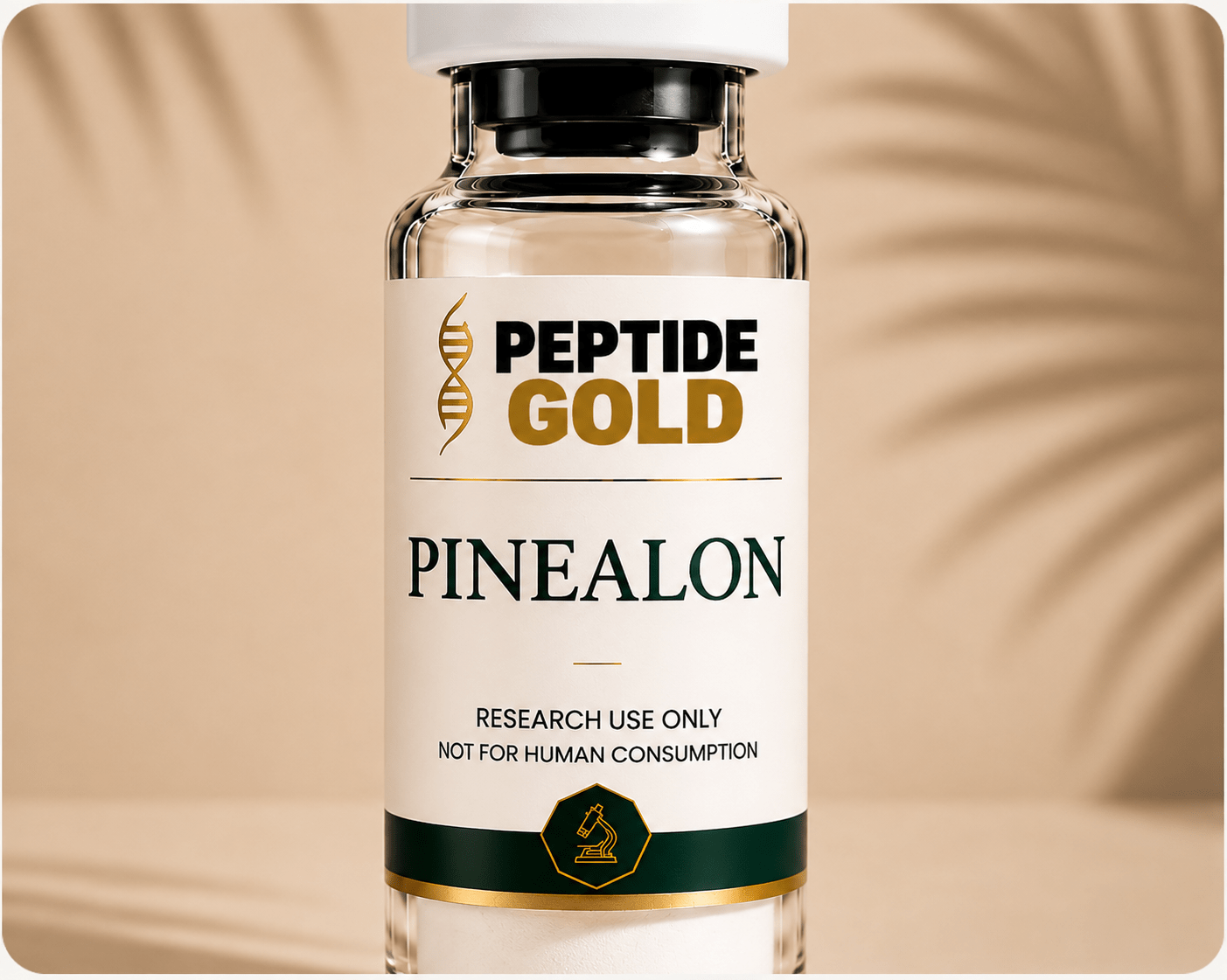
Pinealon may also be supplied in research vials containing measured amounts of peptide.
A research vial should not automatically be assumed to be:
sterile
pharmaceutical grade
or appropriate for human administration.
Oral and Sublingual Research Products
Some peptide markets offer tablets, capsules, or sublingual preparations.
There is insufficient comparative human research to establish which route provides the most reliable biological exposure.
Pinealon and the Blood-Brain Barrier
Because Pinealon is intended primarily for nervous-system research, an important question is whether it reaches the brain.
Its extremely small size is one reason researchers have considered this plausible.
Laboratory work shows that Pinealon can penetrate cellular membranes and enter cell nuclei.
However, cellular penetration in culture does not prove efficient penetration of the human blood-brain barrier after oral or systemic administration.
Human pharmacokinetic data are inadequate to establish how much intact Pinealon reaches the brain.
Potential Side Effects
Pinealon does not have a well-defined modern human adverse-event profile.
Small studies have generally not reported dramatic acute toxicity, but that does not establish long-term safety.
One human study reported biochemical changes including:
pro-oxidant activity
and reductions in circulating CD34+ hematopoietic progenitor markers while evaluating Pinealon and Vesugen.
The clinical significance of these findings is uncertain.
Potential concerns with unapproved peptide products also include:
incorrect identity
impurities
contamination
incorrect concentration
and immune reactions.
These product-quality concerns become especially important with injectable research material.
Is Pinealon FDA Approved?
No.
Pinealon is not an FDA-approved medication in the United States.
There is no FDA-approved indication for:
memory enhancement
cognitive decline
anti-aging
neuroprotection
dementia
brain injury
sleep
or any other medical condition.
There is also no FDA-approved Pinealon:
capsule
injection
or dosing regimen.
The absence of an FDA-approved product does not prove that the peptide has no biological activity.
It means its safety and effectiveness have not undergone the regulatory testing required for an approved medication.
How Strong Is the Current Evidence?
The evidence can roughly be divided into three levels.
Laboratory Evidence
This is probably Pinealon’s strongest area.
Research has demonstrated:
cellular penetration
nuclear localization
DNA interactions
and changes in serotonin-related gene expression.
Animal Evidence
Animal studies suggest effects involving:
hypoxia resistance
oxidative stress
and cognitive function.
Human Evidence
Human evidence exists but is limited.
The studies tend to be:
small
older
and concentrated within a relatively limited research community.
Some have reported improvements in biological-age or adaptive-function measurements.
What is missing are large, independently replicated, randomized, placebo-controlled trials.
Current Research in 2026
Pinealon remains much less clinically developed than peptides such as tirzepatide, kisspeptin, or even some investigational metabolic compounds.
The existing published literature continues to focus heavily on:
gene regulation
DNA interactions
neuronal stress resistance
serotonin-related biology
and aging.
There is not currently a large modern Phase 2 or Phase 3 clinical-development program establishing Pinealon for neurological disease.
That means the peptide remains closer to experimental bioregulation research than mainstream neurological therapeutics.
What Research Is Still Needed?
The next generation of Pinealon research would benefit enormously from modern clinical pharmacology.
Researchers first need to establish:
human pharmacokinetics
oral bioavailability
blood-brain barrier penetration
half-life
dose-response relationships
and short- and long-term safety.
Only then would larger efficacy trials become meaningful.
Potential controlled studies could examine:
memory
processing speed
attention
executive function
mild cognitive impairment
age-related cognitive decline
and measurable biomarkers of neuronal stress.
Studies should also be conducted by independent research groups to determine whether the early findings are reproducible.
The Bottom Line
Pinealon is a very small experimental three-amino-acid peptide consisting of Glu-Asp-Arg, or EDR.
It emerged from research into short peptide bioregulators and is associated primarily with:
brain aging
neuroprotection
cognition
oxidative stress
hypoxia
and gene regulation.
Laboratory research demonstrates that Pinealon can enter cultured cells and their nuclei and interact selectively with certain DNA sequences.
Other experiments suggest that Pinealon may influence serotonin synthesis by affecting expression of serotonin-related genes in aging brain-cell cultures.
Animal research has reported improved neuronal resistance to hypoxic and oxidative stress, and one prenatal rat model found improvements in cognitive function after Pinealon exposure.
Some small human studies have also been conducted.
One study involving railway workers used 100 micrograms twice daily for two weeks and reported improvements in selected biological-age and adaptive-capacity measurements.
Another small study involving adults with chronic illness reported changes in central nervous system and biological-age indicators, although it also identified biochemical findings that warrant further investigation.
These findings make Pinealon scientifically interesting.
But they do not establish it as a proven cognitive enhancer or anti-aging treatment.
There is currently:
no FDA-approved Pinealon medication,
no FDA-approved human dosage,
no large modern clinical evidence base,
no proven treatment for dementia or Alzheimer’s disease,
and no evidence that Pinealon extends human lifespan.
Perhaps the most accurate description of Pinealon in 2026 is:
an experimental short neuroregulatory tripeptide with intriguing cellular and animal evidence involving gene regulation, serotonin biology, neuronal stress resistance, and cognitive aging, supported by a small amount of human research but lacking the large independent clinical trials needed to establish effectiveness, optimal dosing, and long-term safety.
For researchers studying peptide regulation of the nervous system, Pinealon is especially interesting because its tiny structure raises fundamental questions about whether short amino-acid sequences can influence gene expression and neuronal adaptation.
For consumers, however, the distinction between:
demonstrating molecular effects in cells and animals
and
proving meaningful cognitive or anti-aging benefits in people
remains essential.
At present, the first has considerably more evidence than the second.
Educational and research notice: This article is intended for general scientific and educational information only. It is not medical advice or a recommendation for human use of Pinealon. Published doses described above are historical research protocols and should not be interpreted as personal dosing instructions. Pinealon is not FDA-approved for cognitive enhancement, dementia, neuroprotection, anti-aging, sleep, or any other medical condition.