

Kisspeptin: A Comprehensive Guide to Uses, Research, Dosing, Forms, and Potential Benefits
Kisspeptin is a naturally occurring neuropeptide that plays a central role in human reproduction.
Unlike many peptides commonly discussed for muscle growth, metabolism, recovery, or cosmetic effects, kisspeptin acts near the very top of the hypothalamic-pituitary-gonadal axis, or HPG axis.
Its primary biological role is to stimulate neurons that release:
GnRH — gonadotropin-releasing hormone.
GnRH then signals the pituitary gland to release:
LH — luteinizing hormone
and
FSH — follicle-stimulating hormone.
Those hormones subsequently regulate the ovaries and testes, influencing:
testosterone
estrogen
ovulation
sperm production
fertility
and puberty.
For that reason, kisspeptin has become one of the most important experimental peptides in reproductive endocrinology.
Human research has examined kisspeptin for:
- Infertility
- IVF
- Ovulation
- Hypothalamic amenorrhea
- Puberty disorders
- Male reproductive function
- Testosterone signaling
- Sexual desire
- Reproductive hormone testing
- Polycystic ovary syndrome
- Broader reproductive hormone regulation
Unlike many research peptides, kisspeptin has a meaningful human clinical literature. A 2025 systematic review identified 29 interventional clinical trials involving kisspeptin and described it as a promising therapeutic approach across several reproductive conditions.
However, kisspeptin remains primarily investigational. There is currently no standard FDA-approved kisspeptin medication or general-purpose dosing protocol for fertility, testosterone enhancement, libido, or hormone optimization.
What Is Kisspeptin?
Kisspeptin is actually a family of peptides derived from a larger precursor protein encoded by the KISS1 gene.
The original protein is processed into several biologically active fragments.
These include:
Kisspeptin-54
Kisspeptin-14
Kisspeptin-13
and
Kisspeptin-10.
All of these peptides share a common C-terminal sequence that allows them to activate the kisspeptin receptor.
The receptor is known as:
KISS1R
and was historically called:
GPR54.
The kisspeptin/KISS1R system is now recognized as one of the central regulators of mammalian reproduction. Recent reviews describe kisspeptin as an upstream regulator of GnRH secretion, which in turn controls LH, FSH, and reproductive steroid production.
Why Is It Called Kisspeptin?
The name has an unusual history.
The KISS1 gene was originally discovered during cancer research rather than reproductive research.
Researchers studying melanoma cells found that expression of KISS1 could suppress metastasis.
The peptide product was originally called metastin because of its potential role in limiting metastatic spread.
Only later did scientists discover that mutations affecting the kisspeptin receptor could cause profound reproductive problems.
That observation transformed the field.
Researchers eventually realized that kisspeptin was one of the major biological switches controlling puberty and fertility.
How Does Kisspeptin Work?
The simplified pathway looks like this:
Kisspeptin → KISS1R → GnRH → LH/FSH → Ovaries or Testes → Sex Hormones and Reproduction
Kisspeptin neurons are located within the hypothalamus.
When kisspeptin binds KISS1R receptors on GnRH neurons, GnRH secretion increases.
GnRH then travels through the pituitary portal circulation and stimulates the anterior pituitary gland.
The pituitary subsequently releases LH and FSH.
In males:
LH stimulates Leydig cells in the testes to produce testosterone.
FSH works with testosterone to support sperm production.
In females:
FSH supports follicle development.
LH contributes to ovulation and ovarian hormone production.
Because kisspeptin acts upstream of all these processes, relatively small changes in kisspeptin signaling can have substantial reproductive consequences.
Kisspeptin and Puberty
One of the most important discoveries in kisspeptin research involved puberty.
Researchers found that people with genetic mutations impairing KISS1R signaling could fail to undergo normal puberty.
This condition is a form of hypogonadotropic hypogonadism.
Conversely, excessive activation of the kisspeptin pathway can be associated with abnormally early puberty.
These findings helped establish kisspeptin as one of the body’s primary gatekeepers of reproductive maturation.
Modern research continues to investigate kisspeptin as both a treatment target and a diagnostic tool in disorders involving puberty and hypothalamic reproductive function. A 2026 review highlighted kisspeptin testing as a potentially useful method for identifying hypothalamic dysfunction in pubertal and reproductive disorders.
Kisspeptin and Fertility
Fertility is probably the most advanced therapeutic area for kisspeptin.
Because kisspeptin stimulates GnRH and subsequently LH and FSH, it can activate reproductive function through a relatively physiological pathway.
This has attracted substantial interest for infertility treatment.
Researchers have studied kisspeptin in women with:
subfertility
hypothalamic amenorrhea
polycystic ovary syndrome
and those undergoing in vitro fertilization.
A 2025 review described exogenous kisspeptin as a promising fertility treatment and highlighted ongoing research into ovarian stimulation and infertility management.
Kisspeptin and IVF
One of the most impressive areas of human kisspeptin research involves in vitro fertilization, or IVF.
Traditional IVF requires medication to trigger final maturation of eggs before retrieval.
One complication of fertility treatment is ovarian hyperstimulation syndrome, or OHSS.
OHSS can range from mild symptoms to severe fluid shifts, blood clots, kidney problems, and other complications.
Researchers investigated whether kisspeptin could stimulate a more physiological LH surge and trigger egg maturation while potentially reducing excessive ovarian stimulation.
In one important study involving 53 women undergoing IVF, participants received a single subcutaneous injection of kisspeptin-54 at doses ranging from:
1.6 nmol/kg
to
12.8 nmol/kg.
Egg maturation occurred at every studied dose.
Fertilization and embryo transfer occurred in approximately 92% of participants, and successful pregnancies occurred following kisspeptin-triggered egg maturation.
Kisspeptin and Ovarian Hyperstimulation Syndrome
Researchers subsequently studied women at particularly high risk of OHSS.
A randomized Phase 2 study included 60 women undergoing IVF who received a single dose of kisspeptin-54 ranging from:
3.2 to 12.8 nmol/kg.
The peptide successfully triggered oocyte maturation in these high-risk patients.
This is one of the strongest examples of a genuine clinical application emerging from kisspeptin biology.
Kisspeptin-based egg maturation triggers remain an area of active fertility research.
Kisspeptin and Ovulation
Ovulation normally requires a dramatic surge of luteinizing hormone.
Kisspeptin neurons play an important role in generating this LH surge.
This makes kisspeptin particularly interesting as a way of initiating ovulation using the body’s own reproductive signaling network.
Rather than directly administering LH-like activity, kisspeptin stimulates the natural sequence:
Kisspeptin → GnRH → LH surge → Ovulation
This more physiological mechanism may eventually provide useful alternatives within fertility treatment.
Kisspeptin and Hypothalamic Amenorrhea
Hypothalamic amenorrhea occurs when the hypothalamus reduces reproductive signaling enough that menstrual cycles stop.
Potential causes include:
very low calorie intake
excessive exercise
psychological stress
low body weight
and other forms of metabolic or physiological stress.
The underlying issue often involves reduced GnRH activity.
Because kisspeptin sits immediately upstream of GnRH, researchers have investigated whether administering kisspeptin can restart reproductive hormone signaling.
Human studies have demonstrated that kisspeptin can stimulate gonadotropin release in women with hypothalamic amenorrhea.
However, repeated exposure can sometimes produce diminished responses, suggesting that receptor or pathway desensitization may become important.
Kisspeptin therefore remains an interesting therapeutic candidate but not an established routine treatment.
Kisspeptin in Men
Kisspeptin also has substantial effects on male reproductive hormones.
When kisspeptin stimulates GnRH, pituitary LH secretion increases.
LH then stimulates the testes to produce testosterone.
This has created interest in kisspeptin as a possible way to activate endogenous reproductive hormone production.
Studies in healthy men demonstrate that kisspeptin administration can significantly increase LH and FSH.
In one direct comparison, healthy men received intravenous kisspeptin-10, kisspeptin-54, or GnRH.
Both forms of kisspeptin increased gonadotropin secretion, although GnRH produced a larger overall LH and FSH response.
This demonstrates that kisspeptin can activate the male reproductive axis in humans.
Does Kisspeptin Increase Testosterone?
Potentially, yes—but the situation requires context.
Kisspeptin can increase:
GnRH
which increases:
LH
which can increase:
testosterone production.
This has led to interest in kisspeptin as a possible alternative strategy for stimulating endogenous testosterone production.
However, kisspeptin is not currently an FDA-approved testosterone treatment.
Its effect also depends on whether the rest of the HPG axis is functional.
If the testes cannot adequately respond to LH, increasing kisspeptin may not produce meaningful testosterone increases.
Likewise, if GnRH neurons or pituitary function are severely impaired, the response may differ.
For that reason, kisspeptin may ultimately prove most useful in carefully selected reproductive disorders rather than as a general-purpose testosterone booster.
Kisspeptin Versus Testosterone Replacement
Kisspeptin and testosterone therapy work very differently.
Testosterone replacement therapy supplies testosterone directly.
That can suppress the body’s own GnRH and LH production.
As a result, TRT can reduce sperm production and fertility in some men.
Kisspeptin instead attempts to stimulate the body’s natural reproductive signaling pathway.
In theory:
Kisspeptin → GnRH → LH/FSH → endogenous testosterone and sperm production.
That makes kisspeptin scientifically interesting in situations where preserving fertility matters.
However, it has not been established as a routine alternative to testosterone replacement.
Kisspeptin and Sexual Desire
One of the more surprising areas of kisspeptin research involves the brain.
The kisspeptin system does more than regulate reproductive hormones.
Kisspeptin receptors and signaling networks also interact with brain regions involved in:
sexual attraction
emotional processing
reward
and sexual motivation.
Human neuroimaging studies have shown that kisspeptin can alter brain responses to sexual and emotional stimuli.
This has led researchers to investigate kisspeptin for sexual desire disorders.
A 2025 review concluded that human studies link kisspeptin administration with increased activity in brain regions involved in sexual and emotional processing, making it a potential future treatment for disorders of sexual desire.
This remains an emerging research field.
Kisspeptin and Anxiety
Because kisspeptin affects emotional brain circuits, researchers have also questioned whether it changes anxiety.
A recent randomized crossover study involving 95 participants examined this directly.
Participants received a 75-minute intravenous infusion of kisspeptin-54 at:
1 nmol/kg/hour
or placebo.
Kisspeptin stimulated reproductive hormones but did not produce significant changes in anxiety measures.
This provides useful reassurance regarding at least short-term exposure in controlled research.
However, it does not establish the long-term psychiatric safety of repeated kisspeptin administration.
Kisspeptin and PCOS
Polycystic ovary syndrome, or PCOS, involves complex abnormalities in reproductive hormones, ovulation, metabolism, and ovarian function.
Kisspeptin signaling may be altered in some women with PCOS.
Researchers have therefore investigated whether kisspeptin agonists or antagonists could help regulate abnormal GnRH and LH signaling.
Modern reviews identify PCOS as one of the important future therapeutic areas for the kisspeptin-GnRH pathway.
However, kisspeptin is not currently an established PCOS treatment.
Kisspeptin and Metabolism
Reproduction and metabolism are closely connected.
The body generally reduces reproductive function when energy availability becomes severely limited.
Kisspeptin neurons appear to integrate signals involving:
nutrition
body weight
leptin
insulin
and other metabolic factors.
This helps explain why excessive dieting, low body fat, or intense exercise can suppress fertility.
Researchers are now investigating how disturbances in kisspeptin signaling might link obesity, diabetes, and reproductive dysfunction.
A 2024 review noted growing interest in kisspeptin as a possible therapeutic link between metabolic and reproductive disorders.
Kisspeptin-10 Versus Kisspeptin-54
The two most commonly studied forms are:
Kisspeptin-10
and
Kisspeptin-54.
Both can activate KISS1R.
Kisspeptin-10 is the shortest sequence that retains full receptor activity.
Kisspeptin-54 is substantially larger and is one of the major naturally occurring circulating forms.
One practical difference is duration of action.
Kisspeptin-10 tends to be cleared relatively quickly.
Kisspeptin-54 has a longer biological duration.
In direct human comparison studies, both stimulated LH and FSH, with kisspeptin-54 generally producing a somewhat greater gonadotropin response under similar experimental conditions.
Kisspeptin Dosing in Human Research
There is no universal FDA-approved kisspeptin dosing regimen.
Different protocols have been studied for different purposes.
IVF Research
Kisspeptin-54 has been administered as a single subcutaneous dose.
Human IVF studies have evaluated:
1.6 nmol/kg
3.2 nmol/kg
6.4 nmol/kg
9.6 nmol/kg
and
12.8 nmol/kg.
These doses were used specifically to trigger oocyte maturation under highly controlled fertility-treatment protocols.
Hormone Research
Studies in men have used intravenous kisspeptin-10 or kisspeptin-54 infusions such as:
0.1 nmol/kg/hour
0.3 nmol/kg/hour
and
1.0 nmol/kg/hour.
Neurobehavioral Research
The recent anxiety study used kisspeptin-54 at:
1 nmol/kg/hour intravenously for 75 minutes.
These are clinical research protocols—not general dosing recommendations.
Why Kisspeptin Dosing Is Complicated
Kisspeptin acts on a hormone axis that is naturally pulsatile and tightly regulated.
More stimulation does not necessarily produce better results.
Repeated or continuous kisspeptin exposure can sometimes produce desensitization, particularly in certain reproductive disorders.
This means prolonged receptor stimulation may eventually reduce the hormonal response.
The appropriate dose therefore depends on:
which kisspeptin form is used
route of administration
sex
menstrual-cycle phase
underlying reproductive condition
and treatment objective.
This is one reason a universal “kisspeptin protocol” would be scientifically inappropriate.
What Forms Is Kisspeptin Offered In?
In legitimate clinical research, kisspeptin is generally encountered as carefully manufactured peptide material.
Kisspeptin-54
This is one of the most extensively studied forms in human reproductive research.
It has been administered:
subcutaneously
and intravenously.
Kisspeptin-10
The shorter active fragment is also widely used experimentally.
It is particularly useful for studying receptor signaling because it contains the minimum sequence required for strong KISS1R activation.
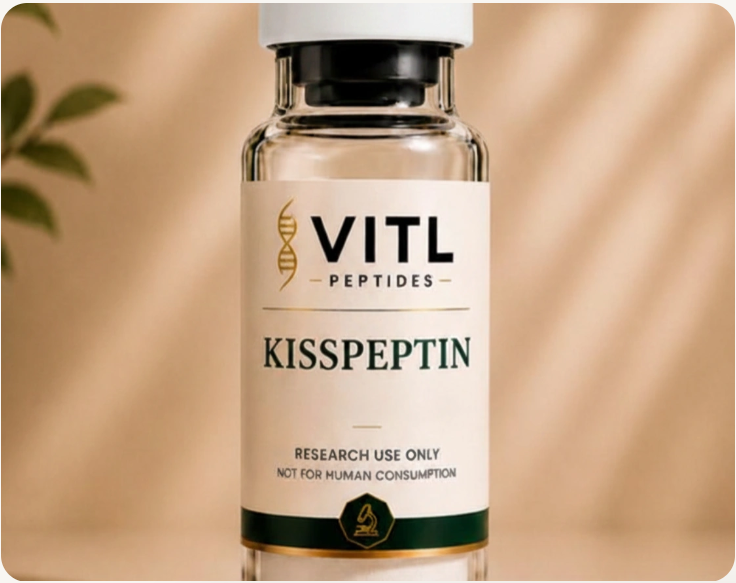
Lyophilized Research Powder
Research suppliers may offer kisspeptin as:
freeze-dried, or lyophilized, powder.
This form may be used in laboratory experiments after appropriate reconstitution.
A research vial should not automatically be assumed to be:
sterile
pharmaceutical grade
or appropriate for human administration.
Kisspeptin Receptor Agonists
Researchers are also developing longer-acting synthetic KISS1R agonists.
These may ultimately prove more practical therapeutically than native kisspeptin because natural peptides can have relatively short durations of action.
Potential Side Effects
Human kisspeptin studies have generally reported reasonable short-term tolerability.
Possible short-term effects may include:
- Flushing
- Headache
- Injection-site reactions
- Changes in reproductive hormones
- Temporary changes in heart rate or blood pressure
- Hormonal symptoms related to LH, FSH, estrogen, or testosterone changes
However, the true adverse-event profile depends heavily on:
dose
route
duration
and the reproductive condition being treated.
Long-term exposure has not been studied nearly as extensively as established fertility medications.
Hormonal Overstimulation
Because kisspeptin sits near the top of the reproductive axis, excessive or poorly timed stimulation could theoretically disrupt normal hormone patterns.
Potential consequences could involve:
abnormal LH secretion
ovarian stimulation
testosterone changes
menstrual-cycle changes
or receptor desensitization.
The fact that kisspeptin activates a natural pathway does not mean uncontrolled exposure is automatically safe.
Pregnancy and Kisspeptin
Kisspeptin biology becomes particularly interesting during pregnancy.
Circulating kisspeptin concentrations rise dramatically during pregnancy, with the placenta becoming a major source.
Researchers believe kisspeptin may contribute to:
placental development
trophoblast invasion
and regulation of pregnancy physiology.
Abnormally low or altered kisspeptin levels have been investigated as possible biomarkers for complications such as miscarriage or placental dysfunction.
However, using kisspeptin therapeutically during pregnancy is a separate question and remains experimental.
Kisspeptin and Cancer
Kisspeptin was originally discovered because of its effects on metastasis.
The KISS1 system appears capable of suppressing migration and metastasis in some cancer models.
However, its role varies depending on:
tumor type
receptor expression
and surrounding cellular biology.
This means kisspeptin should not be described as a cancer treatment.
No FDA-approved oncology therapy uses kisspeptin for this purpose.
Its original metastasis research remains scientifically interesting but is separate from its more established reproductive role.
Is Kisspeptin FDA Approved?
Kisspeptin remains primarily an investigational reproductive peptide.
There is currently no standard FDA-approved kisspeptin drug marketed for:
fertility treatment
testosterone enhancement
hypogonadism
sexual dysfunction
PCOS
amenorrhea
or general hormone optimization.
This is despite a meaningful clinical research program.
A 2025 systematic review identified nearly 30 interventional kisspeptin trials, illustrating that the compound has progressed much farther clinically than many peptides circulating in research markets.
However, research activity is not the same as regulatory approval.
Current Research in 2026
Kisspeptin research remains active and increasingly sophisticated.
Recent work focuses not only on using kisspeptin as a treatment but also as a diagnostic probe.
Because the peptide directly tests the ability of the hypothalamic reproductive system to respond, researchers are investigating whether kisspeptin challenges can help determine where reproductive dysfunction originates.
A 2026 review specifically highlighted kisspeptin as a potential diagnostic test for disorders involving puberty, GnRH function, and reproductive dysfunction.
Other active research areas include:
IVF
hypothalamic amenorrhea
PCOS
male hypogonadism
sexual desire disorders
puberty disorders
and metabolic-reproductive interactions.
What Research Is Still Needed?
Several important questions remain.
Researchers need larger randomized trials evaluating:
pregnancy and live-birth outcomes
optimal IVF dosing
long-term fertility effects
male reproductive outcomes
testosterone responses
sexual-function outcomes
PCOS
and hypothalamic amenorrhea.
Long-term safety studies are also important.
Researchers need to understand whether repeated exposure leads to:
desensitization
reproductive hormone disruption
or other endocrine effects.
The Bottom Line
Kisspeptin is one of the most important regulatory peptides in human reproduction.
It acts as a biological link between the brain and reproductive organs by stimulating:
GnRH
which then stimulates:
LH and FSH
which regulate:
testosterone, estrogen, ovulation, sperm production, and fertility.
This places kisspeptin near the top of the reproductive endocrine hierarchy.
Unlike many experimental peptides, kisspeptin has a substantial body of direct human research.
Human studies demonstrate that kisspeptin can:
increase LH and FSH,
activate reproductive hormone signaling,
and trigger egg maturation during IVF.
Research has also demonstrated successful egg maturation and pregnancy following kisspeptin-54 administration during assisted reproduction.
Among women at high risk for ovarian hyperstimulation syndrome, Phase 2 research has shown that kisspeptin-54 can successfully trigger oocyte maturation.
These are far more substantial human findings than exist for many research peptides.
Kisspeptin also shows promise in:
hypothalamic amenorrhea
puberty disorders
PCOS
male reproductive hormone regulation
sexual desire
and as a diagnostic tool for reproductive endocrine dysfunction. Recent reviews continue to describe these as important future clinical applications.
However, there is currently:
no universal FDA-approved kisspeptin medication,
no general-purpose human dosing regimen,
no approved protocol for testosterone optimization,
and no established use as a general libido or fertility-enhancement peptide outside controlled reproductive medicine.
Clinical studies have used very different protocols.
Kisspeptin-54 doses ranging from approximately 1.6 to 12.8 nmol/kg have been studied as single subcutaneous IVF triggers, while controlled endocrine studies have used intravenous infusions in the range of approximately 0.1 to 1 nmol/kg/hour.
These numbers describe research—not personal dosing instructions.
Perhaps the most accurate way to describe kisspeptin in 2026 is:
a naturally occurring reproductive neuropeptide with a well-established biological role as the upstream activator of the GnRH-LH/FSH axis, meaningful human evidence in fertility and reproductive endocrinology, and considerable therapeutic potential—but one that remains investigational for most proposed clinical applications.
For researchers, kisspeptin is particularly exciting because it offers something many hormone therapies cannot:
the possibility of stimulating reproductive hormones by activating the body’s own upstream physiological control system.
For consumers, however, the distinction between activating reproductive hormones under carefully controlled clinical conditions and using kisspeptin as a general hormone-enhancement product remains essential.
Educational and research notice: This article is intended for general scientific and educational information. It is not medical advice or a recommendation for human use of kisspeptin. Doses discussed above describe clinical research protocols and should not be interpreted as personal dosing instructions. Kisspeptin is not currently a standard FDA-approved therapy for testosterone enhancement, libido, infertility, PCOS, amenorrhea, or general reproductive hormone optimization.