


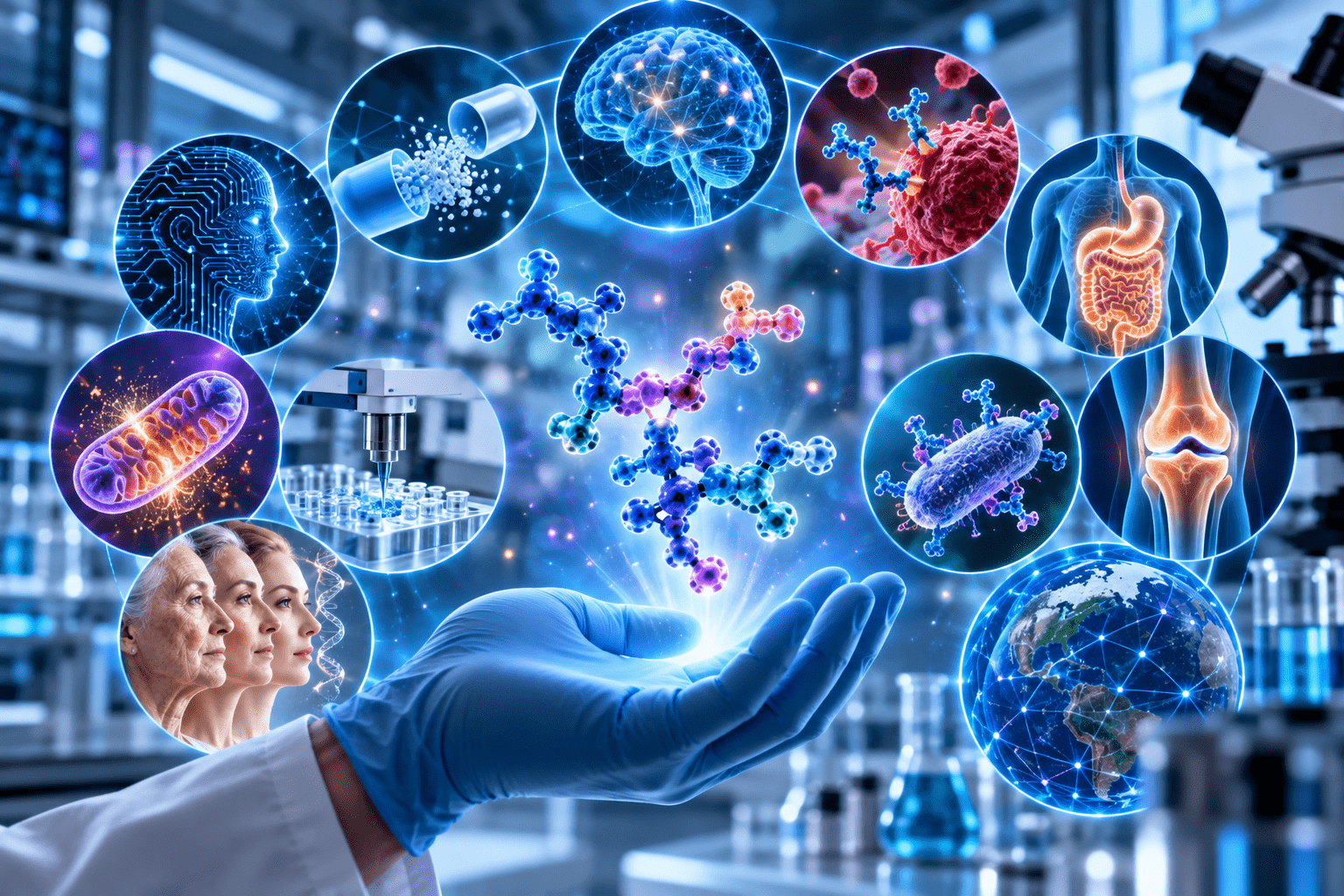
The Future of Peptide Research: 10 Areas Scientists Are Exploring
Peptide research is entering a remarkable period.
Researchers are no longer simply identifying naturally occurring peptides and studying what they do. Increasingly, scientists can design new sequences, modify their structures, predict their behavior computationally and create delivery systems capable of overcoming limitations that once made many peptides impractical.
More than 40 peptide medicines entered clinical use during the decade covered by a major 2025 review, yet today’s research pipeline extends far beyond currently approved therapeutics.
Here are ten areas that could help define the future of peptide research.
1. Multi-Receptor Metabolic Peptides
One of the clearest trends is the transition from single-receptor to multi-receptor molecules.
GLP-1 receptor agonists demonstrated the potential of incretin biology.
GIP/GLP-1 dual agonism expanded the concept.
Triple GIP/GLP-1/glucagon agonism has taken it further.
Future researchers will investigate additional combinations and different balances of receptor activity.
The goal is not simply to activate as many receptors as possible.
The challenge is determining the optimal biological combination.
2. Artificial Intelligence–Designed Peptides
The number of theoretically possible peptide sequences is enormous.
Traditional experimental screening can evaluate only a tiny fraction.
Artificial intelligence and machine learning could dramatically change that process.
Computational systems can potentially help predict:
- molecular structure
- receptor binding
- stability
- solubility
- toxicity
- membrane penetration
- biological activity
Researchers can then prioritize the most promising sequences for laboratory testing.
AI is already being incorporated into peptide-discovery research, including work involving potential geroprotective peptides.
The result could be a dramatic acceleration in discovery.
3. Oral Peptide Delivery
One of the oldest problems in peptide therapeutics is oral delivery.
The digestive system is designed to break peptides apart.
Even if a peptide survives digestion, crossing the intestinal wall can be difficult.
Researchers are investigating:
- protective formulations
- absorption enhancers
- chemical modifications
- nanoparticles
- permeation technologies
- specialized delivery devices
Successfully solving oral delivery could dramatically expand the practicality of peptide therapeutics.
4. Nose-to-Brain Delivery
The blood-brain barrier protects the brain from harmful substances.
Unfortunately, it also makes neurological drug development extremely difficult.
Researchers are investigating whether intranasal delivery can provide alternative routes for certain peptide therapeutics.
A major 2025 review highlighted nose-to-brain peptide delivery as a particularly interesting frontier while noting that the mechanisms and reliability of direct transport require further investigation.
If these challenges can be solved, neurological peptide research could expand substantially.
5. Cancer-Targeting Peptides
Imagine a peptide engineered to recognize a molecular feature disproportionately expressed by cancer cells.
Now imagine attaching something to it:
- a drug
- a radioactive molecule
- an imaging agent
- another therapeutic payload
The peptide becomes a molecular address label.
This is the idea behind many peptide-targeting strategies.
Researchers hope targeted delivery could concentrate therapeutic activity where it is needed while reducing exposure elsewhere.
6. Antimicrobial Peptides
Antibiotic resistance is one of the major challenges facing medicine.
Some naturally occurring peptides form part of the innate immune defenses of organisms.
Scientists are investigating whether antimicrobial peptides can be engineered into new ways of attacking bacteria, fungi and other pathogens.
Challenges remain, including toxicity, stability, manufacturing and resistance.
But the biological diversity of antimicrobial peptides provides researchers with a vast library of potential starting points.
7. Mitochondrial-Derived Peptides
Mitochondria contain their own DNA.
Scientists have discovered that mitochondrial genetic material can encode small biologically active peptides.
These mitochondrial-derived peptides may participate in cellular communication involving:
- metabolism
- stress responses
- insulin sensitivity
- inflammation
- aging
MOTS-c is one widely discussed example.
As researchers uncover more mitochondrial peptides, an entirely new signaling network may emerge.
8. Peptides and Healthy Aging
Aging biology has become another major research frontier.
Scientists are investigating peptides associated with:
- cellular senescence
- mitochondrial function
- tissue repair
- metabolism
- neuroprotection
- extracellular matrix
- inflammatory signaling
The key challenge will be separating meaningful human outcomes from changes in experimental biomarkers.
Current research is promising, but many purported “anti-aging peptides” remain far ahead of their human clinical evidence.
9. Precision Peptide Therapeutics
Two people with what appears to be the same disease can have very different molecular biology.
Genomics, proteomics and metabolomics are revealing those differences.
The future may involve selecting peptide therapies according to molecular characteristics rather than broad diagnostic labels.
Researchers could potentially match:
patient biology → receptor profile → peptide therapy
This is part of the broader movement toward precision medicine.
10. Smarter Peptide Engineering
Perhaps the biggest frontier encompasses everything else.
Scientists are becoming increasingly capable of modifying peptides.
Researchers can investigate:
- amino-acid substitutions
- cyclization
- lipidation
- backbone modification
- conjugation
- sustained-release systems
- receptor-bias engineering
Natural peptides become starting templates.
Scientists can then attempt to improve stability, duration, selectivity or delivery.
This means the most important peptides of the next decade may be molecules that do not exist in nature.
From Discovery to Design
Historically, peptide research often began:
Nature makes a peptide → scientists discover it → scientists study it.
Increasingly, the process can become:
Scientists identify a biological target → computationally design candidates → synthesize them → test them → optimize them.
That represents an enormous philosophical change.
Peptide researchers are moving from discovering biological signals toward engineering them.
The Future Is Bigger Than Today’s Popular Peptides
Online discussions often revolve around a relatively small group of compounds.
But the actual scientific field is much larger.
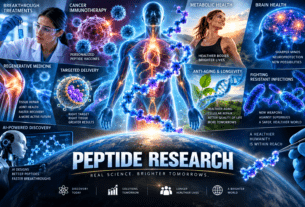
Peptide research extends into:
- metabolic disease
- oncology
- infectious disease
- neurology
- cardiovascular disease
- immunology
- tissue repair
- drug delivery
- aging biology
- diagnostics
Today’s most talked-about peptide may therefore have very little relationship to the most scientifically important peptide ten years from now.
The Next Decade
Three technologies may be particularly transformative:
Artificial intelligence can help discover candidate sequences.
Advanced synthesis can build increasingly complicated molecules.
High-resolution analytical technology can characterize what was actually produced.
Add improved delivery systems and a deeper understanding of receptor biology, and peptide researchers gain an extraordinarily powerful toolkit.
The future of peptide research therefore isn’t simply about finding more peptides.
It’s about gaining greater control over what peptides can do.
And that may ultimately turn peptide science into one of the most versatile platforms in modern biotechnology.