


KLOW Peptide Blend: A Comprehensive Guide to Components, Uses, Research, Dosing Information, Forms, and Potential Benefits
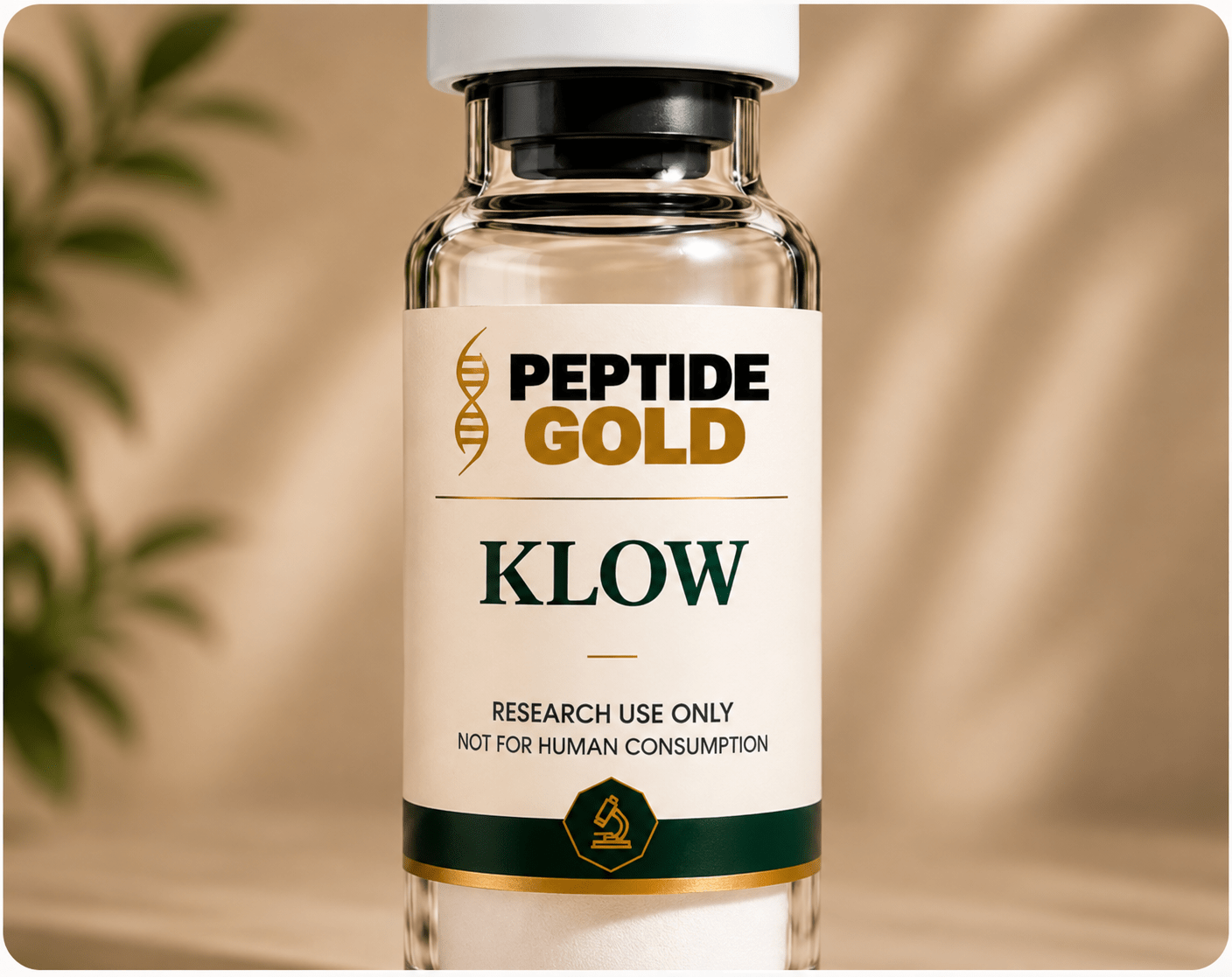
KLOW peptide is a multi-peptide research blend that has attracted increasing attention because it combines four compounds associated with inflammation, tissue repair, collagen remodeling, wound healing, gastrointestinal biology, skin health, and connective-tissue recovery.
KLOW peptide is not a single peptide.
Instead, the name generally refers to a combination of:
and
The most commonly marketed research formulation contains approximately:
50 mg GHK-Cu
10 mg BPC-157
10 mg TB-500
10 mg KPV
for a total of 80 mg of research material.
In simple terms, KLOW blend peptide can be thought of as an expanded version of the popular GLOW blend peptide, which typically contains GHK-Cu, BPC-157, and TB-500. KLOW adds KPV, a small anti-inflammatory tripeptide derived from alpha-melanocyte-stimulating hormone.
The rationale is to combine several different biological pathways into one research formulation:
GHK-Cu → collagen and extracellular-matrix remodeling
BPC-157 → tissue-repair and vascular signaling
TB-500 → cell migration and actin-associated repair pathways
KPV → inflammatory and epithelial-barrier signaling
This creates an interesting research concept.
However, there is one critical limitation:
The four-component KLOW blend itself has not been tested in controlled human clinical trials.
The scientific rationale for the blend is derived almost entirely from research involving the individual ingredients. Current research summaries specifically emphasize that no controlled clinical study has evaluated KLOW as a combined formulation.
What Is KLOW?
KLOW is best described as a co-formulated research peptide blend.
The individual molecules remain separate compounds even though they are packaged together in the same vial.
They do not combine chemically into one new peptide.
The most common KLOW formulation contains:
GHK-Cu — 50 mg
BPC-157 — 10 mg
TB-500 — 10 mg
KPV — 10 mg
This results in an 80 mg total research vial.
Different suppliers could theoretically use different ratios because KLOW is not an FDA-defined or pharmacopeial pharmaceutical product.
Therefore, the actual label and certificate of analysis are important when discussing any specific research formulation.
Why Combine Four Different Peptides?
The basic idea behind KLOW blend peptide is to address multiple parts of tissue injury and inflammation simultaneously.
Tissue repair is not a single biological event.
Successful healing may involve:
controlling excessive inflammation
recruiting cells to the injury
forming new blood vessels
activating fibroblasts
depositing collagen
rebuilding extracellular matrix
and eventually remodeling tissue.
Each KLOW component has been investigated in connection with different parts of that process.
The theory is that combining them could potentially produce complementary research effects.
That theory is biologically plausible.
But it is important not to confuse plausible synergy with proven synergy.
There is currently no controlled evidence demonstrating that the four peptides work better together than they do individually.
Component #1: KPV
KPV is a very small peptide made of only three amino acids:
Lysine – Proline – Valine
It represents the C-terminal portion of alpha-melanocyte-stimulating hormone, or α-MSH.
Alpha-MSH has multiple biological functions involving:
inflammation
pigmentation
immune signaling
and neuroendocrine regulation.
Researchers discovered that the KPV fragment appears to retain some of α-MSH’s anti-inflammatory properties without reproducing many of its pigmentation effects.
This has made KPV particularly interesting in research involving:
intestinal inflammation
inflammatory bowel disease
skin inflammation
epithelial barriers
and wound healing.
KPV and Inflammation
KPV appears to influence several important inflammatory signaling pathways.
One frequently studied pathway is:
NF-κB.
NF-κB is a major transcription factor involved in immune activation and production of inflammatory cytokines.
Experimental research suggests KPV can reduce activation of NF-κB and decrease inflammatory mediators such as:
TNF-α
IL-1β
and IL-6.
KPV can also be transported into certain cells through the peptide transporter PepT1, making it particularly interesting in intestinal inflammation research.
This anti-inflammatory activity is the primary reason KPV is added to the KLOW formulation.
KPV and Gut Research
One of KPV’s most promising research applications involves the gastrointestinal system.
Animal studies have investigated KPV in experimental models of:
colitis
intestinal inflammation
epithelial injury
and inflammatory bowel disease.
Researchers have also developed nanoparticles, hydrogels, and targeted delivery systems designed to transport KPV into inflamed intestinal tissue.
This makes KPV the component of KLOW most strongly associated with:
gut inflammation
epithelial-barrier function
and immune regulation.
However, it has not been clinically established as a treatment for Crohn’s disease, ulcerative colitis, or other gastrointestinal disorders.
Component #2: GHK-Cu
GHK-Cu is probably the KLOW component most strongly associated with skin, collagen, and cosmetic research.
GHK is a naturally occurring three-amino-acid peptide:
Glycine – Histidine – Lysine.
When GHK binds copper, it forms the biologically active complex:
GHK-Cu.
Researchers have studied GHK-Cu extensively for its potential effects on:
collagen production
fibroblast activity
skin remodeling
extracellular matrix
wound healing
angiogenesis
and gene expression.
Because GHK-Cu is associated with tissue remodeling and skin biology, it makes up the largest portion by mass of the typical KLOW formulation.
GHK-Cu and Collagen
Collagen provides structural support to:
skin
tendons
ligaments
blood vessels
and many other tissues.
Fibroblasts are responsible for producing much of the collagen found within connective tissue.
Laboratory research suggests GHK-Cu can influence fibroblast activity and stimulate production of several extracellular-matrix components.
These include:
collagen
elastin
and glycosaminoglycans.
GHK-Cu can also influence enzymes responsible for breaking down damaged matrix.
This suggests the compound may participate in both sides of tissue repair:
removing damaged extracellular material
and
building new matrix.
Current research descriptions of KLOW identify GHK-Cu as its primary matrix-remodeling component.
GHK-Cu and Skin
GHK-Cu has a considerably longer history in skin-care research than most peptides.
Topical copper-peptide products have been marketed for:
fine lines
skin elasticity
collagen support
skin texture
and wound-related research.
Human evidence for topical copper peptides exists, although the results are not uniformly dramatic.
The strongest conclusion is that GHK-Cu has genuine biological activity involving skin and extracellular-matrix signaling.
That does not establish that systemic KLOW produces comparable cosmetic effects.
Component #3: BPC-157
BPC-157 is a synthetic 15-amino-acid peptide commonly studied for tissue protection and repair.
It has become particularly popular because of animal research involving:
tendons
ligaments
muscle
gastrointestinal tissue
blood vessels
and wound repair.
BPC-157 has been associated experimentally with pathways involving:
VEGFR2
Akt
eNOS
nitric oxide
angiogenesis
and fibroblast activity.
In animal tendon experiments, BPC-157 has produced improvements in tissue organization and functional recovery.
These findings are one reason it became known informally as a “healing peptide.”
However, the vast majority of the evidence remains preclinical.
BPC-157 and Tendon Research
Tendons can be difficult to heal because they have relatively limited blood supply.
Animal experiments involving Achilles tendon injury have demonstrated improvements after BPC-157 administration.
Researchers observed changes involving:
blood-vessel growth
collagen organization
fibroblast activity
and tissue strength.
This research forms much of the rationale for the BPC-157 portion of KLOW.
KLOW research summaries commonly identify BPC-157 as the blend’s connective-tissue or angiogenic-repair arm.
Human clinical research, however, remains extremely limited.
Component #4: TB-500
TB-500 is commonly described as a synthetic peptide fragment related to thymosin beta-4.
Thymosin beta-4 is a naturally occurring protein involved in:
actin regulation
cell migration
wound healing
and tissue remodeling.
Actin is one of the major structural proteins inside cells.
Cells must reorganize actin whenever they:
move
change shape
or migrate into damaged tissue.
TB-500 is associated with the actin-binding region of thymosin beta-4.
This makes it particularly interesting for research involving cellular migration during tissue repair.
TB-500 and Cell Migration
When tissue is injured, cells must move into the damaged area.
Fibroblasts, endothelial cells, immune cells, and other cell types migrate toward the injury.
Actin remodeling is central to this process.
TB-500-related research therefore focuses heavily on:
cell migration
wound closure
vascular signaling
and tissue repair.
This makes TB-500 conceptually complementary to BPC-157.
BPC-157 is commonly associated with vascular and tissue-repair signaling, while TB-500 is more strongly associated with cellular movement and cytoskeletal biology.
Current descriptions of KLOW characterize TB-500 as the blend’s cytoskeletal or cell-migration component.
TB-500 Versus Thymosin Beta-4
This distinction is important.
A substantial scientific literature exists on full-length thymosin beta-4.
TB-500 is not necessarily identical to full-length thymosin beta-4.
Some human wound-healing studies commonly referenced in peptide marketing actually involved thymosin beta-4 rather than TB-500 itself.
Human evidence involving the specific TB-500 fragment is considerably weaker.
Therefore, clinical findings involving full-length thymosin beta-4 should not automatically be attributed to TB-500.
What Is KLOW Commonly Researched For?
The KLOW peptide benefits is most often discussed in several overlapping areas.
Tissue Repair
This is probably the broadest area of interest.
KLOW combines several compounds associated experimentally with:
cell migration
collagen remodeling
vascular signaling
inflammation
and connective-tissue repair.
This has generated interest in research involving:
tendons
ligaments
muscles
and soft tissue.
Inflammation
KPV is primarily responsible for this aspect of the formulation.
BPC-157 and GHK-Cu may also influence inflammatory signaling through different mechanisms.
The goal of tissue repair is not necessarily to eliminate inflammation.
Some inflammation is required for healing.
The research question is whether the combination can create a more favorable inflammatory environment.
Skin and Collagen
GHK-Cu gives KLOW a strong connection to:
collagen
skin remodeling
fibroblasts
and cosmetic research.
This is one of the biggest differences between KLOW and combinations designed only for musculoskeletal recovery.
Gastrointestinal Research
KPV and BPC-157 both have substantial preclinical connections to gastrointestinal research.
KPV is primarily studied for inflammatory pathways.
BPC-157 has been investigated for broader cytoprotective and gastrointestinal repair effects.
This makes KLOW particularly interesting as a theoretical multi-pathway blend for gut-related research.
Wound Healing
All four components have some connection with wound-healing biology.
They potentially affect different stages:
KPV → inflammatory control
TB-500 → cell migration
BPC-157 → vascular and tissue-repair signaling
GHK-Cu → collagen and matrix remodeling.
This staged model is probably the clearest explanation for why researchers might combine them.
KLOW Versus GLOW
The difference is straightforward.
A common GLOW formulation contains:
GHK-Cu + BPC-157 + TB-500.
KLOW adds:
KPV.
The addition of KPV gives the formulation a stronger theoretical emphasis on:
inflammation
gut biology
and epithelial barriers.
A typical GLOW vial contains about 70 mg total, while a common KLOW formulation contains about 80 mg total because of the additional 10 mg KPV component.
The exact composition still depends on the supplier.
Is KLOW Proven to Work Better Than GLOW?
No.
There are no controlled comparative studies demonstrating that:
KLOW is better than GLOW
or that either blend is superior to the individual components.
The assumption that adding KPV improves the blend is based on biological reasoning.
That is a reasonable research hypothesis.
It is not clinical proof.
KLOW Dosing Information
There is no FDA-approved human dosage for KLOW.
There is also no published peer-reviewed human trial establishing:
how much KLOW should be administered
how frequently it should be administered
how long it should be studied
or what ratio is optimal.
The common 80 mg number refers to the total amount contained in a research vial.
It does not represent a medically established dose.
Current KLOW research references explicitly state that the 50/10/10/10 mg formulation is a vial composition rather than a validated human dosing protocol.
Why Dosing a Blend Is More Complicated
Combination formulations create a problem that does not exist with individual compounds.
Every time the amount of one ingredient is changed, the researcher automatically changes the amount of the other three.
Suppose the formulation contains:
50 mg GHK-Cu
10 mg BPC-157
10 mg TB-500
10 mg KPV.
Increasing exposure to BPC-157 automatically increases:
GHK-Cu
TB-500
and KPV.
There is no ability to independently adjust one component.
This could eventually become important if the compounds have very different:
pharmacokinetics
optimal concentrations
half-lives
or dose-response relationships.
Current KLOW research summaries specifically highlight this limitation.
What Forms Is KLOW Offered In?
KLOW is primarily encountered as a lyophilized research blend.
Lyophilized Powder
Lyophilization means freeze-drying.
Water is removed from the formulation to improve peptide stability during storage and transportation.
80 mg Research Vial
The most common formulation is an 80 mg total vial containing approximately:
50 mg GHK-Cu
10 mg BPC-157
10 mg TB-500
10 mg KPV.
Individual Components
All four compounds may also be obtained individually for laboratory research.
Individual compounds provide researchers greater control because each one can be studied independently.
Does KLOW Have Human Clinical Research?
No meaningful controlled clinical research has tested the standard four-component KLOW blend.
This is one of the most important points in understanding the product.
There is research involving:
GHK-Cu
BPC-157
KPV
and thymosin beta-4-related compounds.
But combining four substances can potentially change:
stability
pharmacokinetics
bioavailability
immunogenicity
and biological interactions.
Therefore, evidence involving one component cannot prove the safety or effectiveness of the entire blend.
Multiple independent research summaries note that the KLOW formulation itself has never undergone a controlled clinical trial.
Potential Side Effects and Safety Concerns
Because KLOW itself has not undergone human clinical testing, it has no established adverse-event profile.
Potential concerns include:
immune reactions
peptide impurities
incorrect concentrations
contamination
injection-site reactions
unexpected interactions between the peptides
and unknown consequences of long-term exposure.
Each individual component also introduces separate theoretical concerns.
GHK-Cu and Copper Exposure
GHK-Cu delivers copper as part of the peptide complex.
Copper is an essential nutrient, but excessive systemic copper exposure can be harmful.
Topical copper-peptide use has a much longer history than systemic administration.
The safety of a topical cosmetic product therefore cannot simply be extrapolated to repeated systemic exposure.
This makes total GHK-Cu exposure an important research consideration in a blend where it represents approximately 62.5% of the vial by mass.
Angiogenesis and Long-Term Safety
BPC-157, GHK-Cu, and thymosin beta-4-related compounds have all been associated in various experimental settings with angiogenesis, or new blood-vessel formation.
Angiogenesis is important for wound healing.
Damaged tissue needs new circulation.
However, abnormal angiogenesis can also participate in disease processes.
This does not mean KLOW causes cancer.
There is currently no evidence demonstrating that.
It does mean that chronically manipulating vascular-growth pathways deserves proper long-term safety research.
Immune Modulation
KPV’s anti-inflammatory effects are another area requiring careful interpretation.
Reducing excessive inflammation could theoretically support tissue recovery.
But inflammatory pathways also help defend against infection.
Researchers therefore need to understand whether prolonged or high-level exposure affects:
immune defense
infection susceptibility
or normal wound responses.
Those questions have not been answered for KLOW.
Is KLOW FDA Approved?
No.
There is no FDA-approved medication called KLOW.
There is no approved:
KLOW injection
KLOW dosage
KLOW treatment protocol
or KLOW medical indication.
The blend is a research-market formulation rather than a standardized pharmaceutical drug.
Current research descriptions consistently identify KLOW as a research-only combination rather than an approved medication.
Current Research in 2026
The most meaningful scientific research continues to occur at the individual-component level.
Researchers are investigating KPV in:
intestinal inflammation
targeted drug delivery
epithelial biology
and immune signaling.
GHK-Cu remains active in:
skin regeneration
collagen research
wound dressings
hydrogels
and regenerative biomaterials.
BPC-157 continues to be investigated primarily through animal models involving:
tendon
ligament
muscle
vascular
and gastrointestinal repair.
Thymosin beta-4-related research continues in:
wound healing
cell migration
regeneration
and actin biology.
What is currently missing is a rigorous study combining all four.
What Research Is Needed Next?
Before meaningful claims about KLOW itself can be made, researchers need basic combination studies.
These should investigate:
chemical stability
whether the compounds interact in solution
whether co-lyophilization affects peptide integrity
pharmacokinetics of all four components
immune responses
dose-response relationships
and toxicity.
Only then would controlled human trials become meaningful.
Potential clinical research could evaluate measurable endpoints involving:
wound closure
tendon healing
collagen density
skin elasticity
inflammatory biomarkers
intestinal inflammation
and functional recovery.
Researchers would also need to compare KLOW against:
placebo
individual peptides
and potentially GLOW.
Only this type of design could determine whether the fourth component actually adds meaningful value.
The Bottom Line
KLOW is an experimental four-peptide research blend combining:
GHK-Cu
BPC-157
TB-500
and
KPV.
The most common formulation contains approximately:
50 mg GHK-Cu + 10 mg BPC-157 + 10 mg TB-500 + 10 mg KPV, for a total of 80 mg.
The rationale behind the combination is scientifically interesting because each component targets a different aspect of tissue biology.
KPV is primarily associated with anti-inflammatory signaling, particularly NF-κB, cytokines, gut inflammation, and epithelial barriers.
GHK-Cu is associated with collagen production, fibroblast activity, extracellular-matrix remodeling, skin biology, and wound healing.
BPC-157 is associated primarily with preclinical research involving angiogenesis, connective-tissue recovery, tendons, ligaments, muscles, and gastrointestinal repair.
TB-500 is associated with actin dynamics, cellular migration, wound closure, and thymosin beta-4-related repair pathways.
In theory, that means KLOW could influence several stages of healing simultaneously:
inflammation control → cellular migration → vascular support → collagen deposition → tissue remodeling.
But this remains a research hypothesis.
There are currently no controlled human clinical trials demonstrating that the KLOW blend improves injuries, reduces inflammation, repairs intestinal tissue, improves skin, accelerates wound healing, or produces better results than the individual peptides.
There is also:
no FDA-approved KLOW medication,
no validated human dosage,
no established dosing frequency,
no proven optimal ingredient ratio,
and no long-term human safety profile.
The commonly referenced 80 mg formulation describes the contents of a research vial—not a medically established dose.
Perhaps the most accurate way to describe KLOW in 2026 is:
an experimental four-component research blend designed to combine anti-inflammatory, extracellular-matrix, vascular, cell-migration, and tissue-repair pathways in one formulation, with interesting individual-component science but essentially no direct clinical evidence validating the blend itself.
For researchers interested in regenerative biology, inflammation, connective tissue, skin, and gastrointestinal repair, that makes KLOW a particularly interesting combination to investigate.
For consumers, however, the most important distinction is between:
evidence that four individual compounds influence biological pathways related to tissue repair
and
evidence that mixing all four together safely produces superior results in humans.
At present, only the first of those has meaningful scientific support.
Educational and research notice: This article is intended for general scientific and educational information only. It is not medical advice or a recommendation for human use of KLOW, KPV, GHK-Cu, BPC-157, or TB-500. There is no FDA-approved human KLOW dosage, treatment protocol, or indication. Commercial KLOW research formulations should not be assumed to be sterile, pharmaceutical grade, or appropriate for human or veterinary use.