

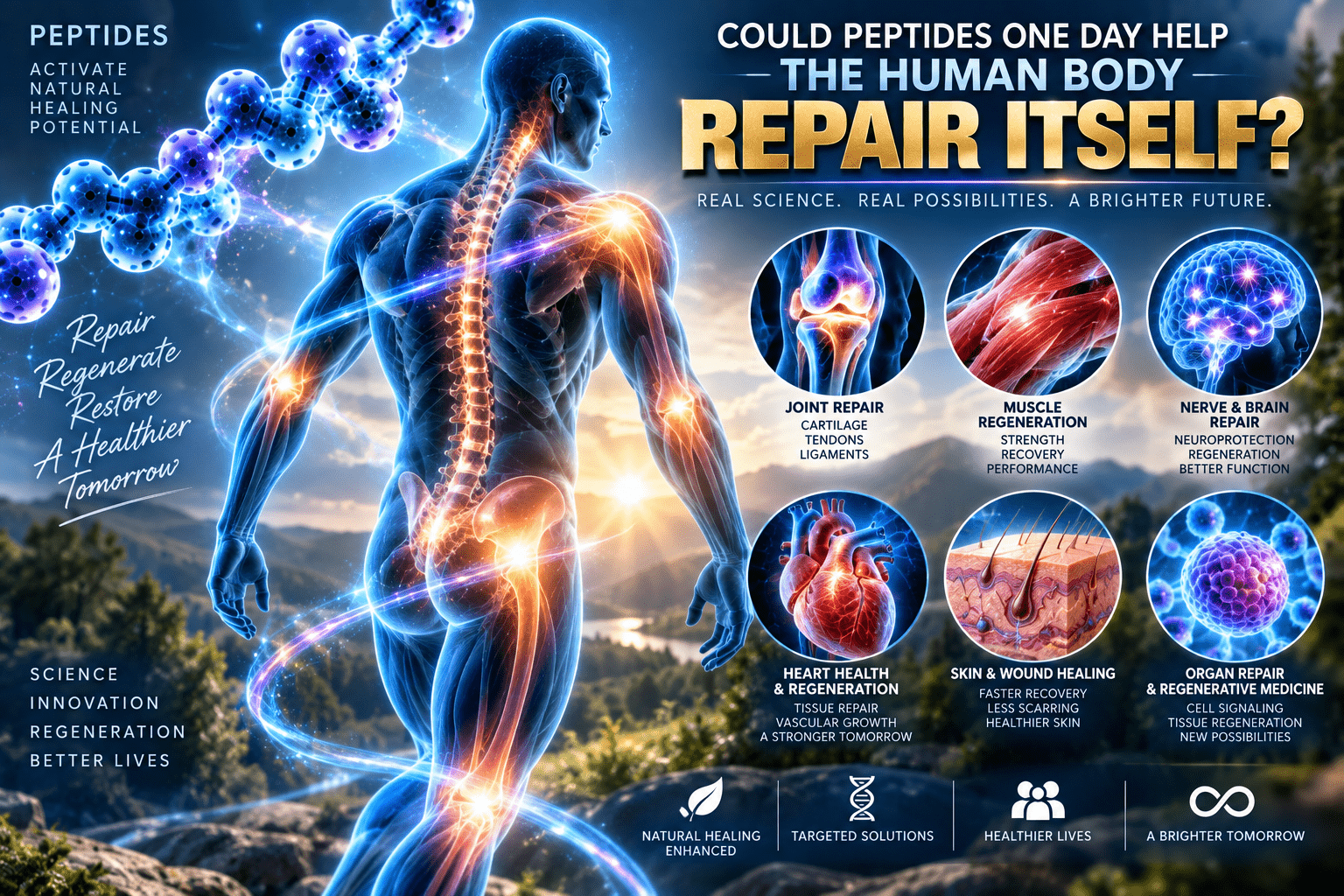
Could Peptides One Day Help the Human Body Repair Itself?
Imagine suffering a serious knee injury and receiving a treatment designed not simply to reduce the pain, but to help damaged tissue rebuild itself.
Imagine a damaged peripheral nerve being given molecular instructions that encourage nerve fibers to reconnect.
Imagine a severe wound healing with less scar tissue because researchers learned how to precisely control the signals governing inflammation, blood-vessel formation and tissue remodeling.
Or imagine physicians treating an aging organ not by replacing it, but by activating carefully selected biological repair mechanisms already hidden within the human body.
This sounds futuristic.
But there is a fascinating reason scientists are interested in possibilities like these:
The human body already knows how to repair itself.
Every cut that closes, broken bone that reconnects, muscle that adapts after exercise and blood vessel that forms around damaged tissue demonstrates that our bodies contain extraordinarily sophisticated repair programs.
The problem is that these programs have limitations.
Cartilage repairs poorly. Severed nerves may never completely reconnect. Tendons can heal slowly. Heart muscle damaged during a heart attack is largely replaced by scar tissue. Aging tissues gradually lose some of their regenerative capacity.
What if researchers could understand the molecular instructions controlling these processes?
And what if peptides could eventually become one of the tools used to deliver those instructions?
That is where regenerative peptide research becomes extraordinarily interesting.
Peptides Are Part of the Body’s Biological Language
Peptides are short chains of amino acids, the same basic building blocks used to construct proteins.
But describing peptides simply as small proteins misses something important.
Many peptides function as biological signals.
Cells throughout the body constantly communicate using hormones, peptides, proteins, neurotransmitters and other molecules.
These signals can tell cells to:
grow,
divide,
migrate,
produce proteins,
release other signaling molecules,
change metabolic activity,
initiate inflammation,
suppress inflammation,
build blood vessels,
remodel tissue,
or activate immune responses.
In other words, healing is not simply a mechanical process.
It is an enormous biological conversation.
Peptides participate in that conversation.
If scientists can understand the language well enough, they may eventually be able to influence what the body says to damaged tissue.
The Body Already Contains an Incredible Repair System
Consider what happens when you cut your skin.
Within seconds, blood clotting begins.
Immune cells arrive.
Inflammatory signals are released.
Cells begin removing damaged material.
Fibroblasts help construct extracellular matrix.
New blood vessels form.
Skin cells migrate across the damaged area.
Collagen is produced.
The tissue gradually remodels.
Eventually, the wound closes.
No engineer coordinates this process.
No surgeon individually instructs each cell.
The repair program is built into biology.
That raises an extraordinary possibility.
Perhaps the future of regenerative medicine will not always require scientists to physically rebuild damaged tissue.
Sometimes the better strategy may be to convince the body to rebuild it itself.
Peptides could potentially become one part of that instruction system.
Could We Learn to Control the Stages of Healing?
Healing is complicated because more repair is not automatically better.
Inflammation provides a good example.
Inflammation is essential during early healing. It helps recruit immune cells and initiate the repair process.
But excessive or prolonged inflammation can damage tissue.
The same is true of collagen.
Collagen is essential for repairing injuries.
Too much disorganized collagen, however, can contribute to fibrosis and scar formation.
Blood-vessel growth is another example.
Damaged tissues often require new blood vessels to supply oxygen and nutrients.
But uncontrolled blood-vessel growth can be harmful in other biological situations.
Future regenerative therapies may therefore need extraordinary precision.
Researchers might eventually need to control not simply whether a biological pathway is activated, but:
how strongly it is activated,
where it is activated,
when it begins,
and when it stops.
This is one reason peptides are so intriguing.
Engineered peptide molecules could potentially provide increasingly specific biological signals.
Could Damaged Cartilage Be Encouraged to Regenerate?
Cartilage is one of regenerative medicine’s biggest challenges.
Unlike many tissues, articular cartilage has very limited natural healing capacity.
That is particularly important in osteoarthritis.
Once cartilage deteriorates substantially, the body generally cannot simply restore the joint to its original condition.
Current treatment can include exercise, physical therapy, medications, injections and eventually joint replacement.
But imagine a completely different objective.
Instead of merely asking:
How do we reduce knee pain?
researchers could ask:
Can we change what is happening inside the damaged joint?
Peptide researchers are investigating approaches involving cartilage targeting, inflammatory pathways, extracellular matrix biology and local therapeutic delivery.
The possibilities could eventually include peptide-based systems designed to penetrate cartilage or deliver therapeutic compounds specifically into joint tissues.
The ultimate objective would be remarkable:
not merely making a damaged joint feel better, but changing the biology responsible for its deterioration.
That goal has not yet been achieved clinically.
But it represents exactly the kind of challenge peptide engineering may help scientists investigate.
Could Tendons and Ligaments Heal Better?
Tendon and ligament injuries are another frustrating medical problem.
These tissues can heal, but recovery may be slow and the repaired tissue may not perfectly reproduce the structure or mechanical properties of the original.
Athletes know this problem particularly well.
A torn tendon can require months of rehabilitation.
Even after healing, the tissue may remain vulnerable.
Future peptide research could potentially investigate several stages of this process:
controlling inflammation,
supporting appropriate cell migration,
influencing collagen organization,
promoting vascular support,
and encouraging extracellular matrix remodeling.
The key word is organization.
A pile of collagen is not the same thing as a properly structured tendon.
True regenerative medicine would need to restore not merely tissue volume, but tissue architecture and function.
That is a much more difficult challenge—and a much more exciting one.
What About Muscle?
Skeletal muscle has a surprisingly impressive ability to repair itself.
Specialized muscle stem cells known as satellite cells help respond to injury.
But that capacity can decline with severe injury, chronic disease and aging.
This raises several fascinating research questions.
Could molecular signals improve satellite-cell activity?
Could muscle regeneration be encouraged without creating abnormal growth?
Could muscle wasting associated with aging or illness someday be treated by influencing the signaling pathways controlling muscle maintenance?
Could future metabolic treatments reduce body fat while deliberately protecting muscle?
Researchers are increasingly interested in the distinction between simply changing body weight and improving body composition and physical function.
The future may therefore involve therapies designed not just to make people lighter, but to preserve the tissue required for strength, mobility and independence.
Could Peptides Help Damaged Nerves Reconnect?
Nerve regeneration may be one of the most extraordinary possibilities.
Peripheral nerves can sometimes regenerate after injury, but the process is slow and often incomplete.
The central nervous system presents an even greater challenge.
Damage to the brain or spinal cord can permanently disrupt neural connections.
Imagine a therapy that could help guide regenerating nerve fibers toward the correct destination.
That would require much more than simply stimulating growth.
Neurons would need to:
survive,
extend new projections,
navigate through damaged tissue,
find appropriate targets,
form functional connections,
and integrate into existing neural circuits.
It is an astonishingly complex problem.
But peptides and proteins already participate in many of the signaling pathways involved in neuronal survival, growth and guidance.
Future research may uncover ways of manipulating those signals much more precisely.
The long-term possibility is breathtaking:
Could medicine eventually help the nervous system rebuild connections once considered permanently lost?
We do not yet know.
But answering that question could transform rehabilitation medicine.
Could the Heart Ever Repair Itself?
The heart provides another dramatic example of limited regeneration.
After a major heart attack, cardiac muscle cells can die because their blood supply has been interrupted.
Unlike skin, the adult human heart has very limited capacity to replace large amounts of lost muscle.
Scar tissue forms instead.
The scar helps maintain structural integrity—but it does not contract like healthy heart muscle.
That can contribute to heart failure.
Regenerative researchers therefore face an enormous challenge.
Could scientists someday create molecular conditions that encourage meaningful cardiac regeneration?
Could peptides help influence blood-vessel formation?
Could they support survival of stressed heart cells?
Could engineered signals help coordinate regeneration while preventing dangerous uncontrolled growth?
The stakes are enormous.
Cardiovascular disease remains one of humanity’s largest health burdens.
Even partial improvements in the heart’s ability to recover after injury could have profound consequences.
Could We Heal Without So Much Scarring?
Scar formation is another fascinating target.
Scars are not simply mistakes made by the body.
They are part of an emergency repair strategy.
When severe tissue damage occurs, rapid closure can be more important biologically than perfect reconstruction.
The body effectively chooses:
Repair quickly now; worry about perfection later.
But what if medicine could improve that tradeoff?
Researchers studying wound healing are investigating the signals controlling fibroblasts, collagen production, inflammation and tissue remodeling.
Future peptide-based approaches might someday help influence these pathways so healing produces tissue that more closely resembles the original structure.
That could potentially matter for:
skin wounds,
burns,
surgical scars,
tendon injuries,
internal fibrosis,
and possibly damaged organs.
The ultimate objective would not necessarily be scar-free healing.
It would be better-quality repair.
What If Peptides Could Be Delivered Only Where They’re Needed?
One major problem with regenerative signaling is that many growth-related pathways can be dangerous if activated throughout the body.
A signal that encourages cell growth in an injured tendon might be undesirable elsewhere.
That makes targeted delivery extremely important.
Future peptide technologies could potentially solve both sides of the problem.
One peptide could provide a biological signal.
Another peptide could act as a targeting molecule.
Researchers could potentially attach therapeutic cargo to molecules that preferentially recognize particular tissues or receptors.
Imagine a molecular delivery system essentially carrying an address:
Damaged cartilage—deliver here.
Or:
Tumor cell—deliver here.
Or:
Inflamed tissue—deliver here.
This concept of tissue-specific targeting could dramatically expand what regenerative therapies are able to accomplish safely.
Smart Peptides Could Potentially Activate Only After Reaching an Injury
The idea can become even more sophisticated.
What if a therapeutic peptide remained relatively inactive while circulating through the body?
Then, after encountering an enzyme or chemical environment associated with damaged tissue, it became active.
The injury itself would essentially provide the activation signal.
Future molecular engineering might therefore produce treatments that are:
inactive during transport,
activated near damaged tissue,
functional for a controlled period,
and then naturally degraded.
That begins to resemble programmable medicine.
Instead of merely placing a drug into the bloodstream and hoping enough reaches the correct tissue, researchers could potentially design molecules with increasingly sophisticated instructions.
Could Peptides Work With Stem Cells?
Stem-cell medicine and peptide science may also converge.
One of the challenges with stem cells is controlling what they do after delivery.
Cells need signals telling them how to behave.
Should they divide?
Should they differentiate?
What type of cell should they become?
Where should they migrate?
Should they remain active or stop dividing?
Peptides and proteins naturally participate in these signaling processes.
Future regenerative medicine could therefore involve combinations in which cells provide the raw biological machinery while engineered peptide signals help provide instructions.
Think of it this way:
Stem cells might provide the workers.
Peptide signals could potentially help provide the construction plans.
That combination could become much more powerful than either technology alone.
Peptides and 3D-Printed Tissue
Now take the concept one step further.
Scientists are already investigating tissue engineering, biological scaffolds and 3D bioprinting.
A scaffold can provide physical structure.
Cells can populate that structure.
But those cells still require biological instructions.
Future biomaterials might therefore contain peptide signals embedded directly into them.
Imagine a 3D scaffold implanted into damaged tissue.
Different areas of the scaffold could potentially contain different molecular instructions.
One region might encourage blood-vessel formation.
Another might encourage connective-tissue development.
Another might help regulate inflammation.
Another might influence cell differentiation.
The scaffold would no longer simply be a physical structure.
It could become a biologically active construction site.
Could an Entire Organ Eventually Be Regenerated?
This is where the imagination really begins to stretch.
Repairing skin is one thing.
Repairing cartilage is harder.
Regenerating a complex organ is vastly more difficult.
An organ contains multiple cell types arranged in incredibly precise three-dimensional structures.
It needs blood vessels.
Nerves.
Extracellular matrix.
Mechanical properties.
Communication between cells.
Connections to the rest of the body.
A liver, kidney or heart cannot simply be replaced by growing a pile of cells.
The cells must organize correctly.
That means whole-organ regeneration would require scientists to understand not just individual cells but the instructions governing biological architecture.
Peptides could potentially become one part of those instructions.
We should not expect a peptide injection to magically regrow a human heart or kidney anytime soon.
But the broader concept is scientifically fascinating.
If researchers gradually decode the signaling language that tells cells where to go, what to become and how to organize, regenerative medicine could eventually accomplish things that seem impossible today.
Aging May Be a Regeneration Problem Too
Young bodies generally recover from injuries more effectively than older bodies.
That suggests an intriguing connection between regeneration and aging.
Aging tissues can experience changes involving:
stem-cell activity,
mitochondrial function,
chronic inflammation,
cellular senescence,
blood-vessel function,
extracellular matrix,
immune responses,
and intercellular signaling.
Perhaps some aspects of biological aging involve not simply accumulating damage but gradually losing the ability to repair that damage effectively.
If so, healthy-aging research and regenerative medicine may eventually overlap.
Instead of trying to make humans “young forever,” a more realistic scientific objective might be:
Can we preserve the body’s ability to maintain and repair itself for longer?
That could profoundly affect healthspan.
A 90-year-old whose muscles, joints, cardiovascular system and nervous system maintain better repair capacity would experience aging very differently from someone whose repair mechanisms declined decades earlier.
AI Could Accelerate the Search for Regenerative Peptides
Artificial intelligence adds another extraordinary dimension.
The number of possible peptide sequences is enormous.
Even relatively short peptides can have staggering numbers of possible amino-acid combinations.
Humans cannot manually investigate all of them.
AI systems may increasingly help researchers predict which sequences could:
bind particular receptors,
interact with specific tissues,
remain stable,
avoid unwanted targets,
penetrate biological barriers,
or generate desired cellular responses.
Imagine asking a computational system:
Design a peptide that binds this receptor found in injured cartilage but has minimal activity elsewhere.
Thousands or millions of candidate sequences could be generated computationally.
The best candidates could be synthesized.
Laboratories could test them.
Experimental results could then train the next generation of models.
The process becomes:
Design → Build → Test → Learn → Redesign.
That feedback loop could dramatically accelerate peptide discovery.
The Ultimate Goal: Tell the Body What to Repair
Put all of these technologies together.
Advanced imaging identifies damaged tissue.
Blood tests detect molecular signals associated with injury.
Genomic analysis reveals individual biological differences.
AI identifies an appropriate peptide sequence.
Targeting technology directs it toward the injury.
Smart delivery activates the molecule only after it reaches the correct biological environment.
The peptide influences selected cellular pathways.
Then it degrades when its job is complete.
That scenario remains futuristic.
But every individual piece represents a field of serious scientific investigation.
And that is what makes regenerative peptide research so exciting.
The ultimate goal would not necessarily be creating artificial replacements for everything that fails.
It might be something far more elegant:
Help the human body remember how to repair itself.
Reality Still Matters
The excitement surrounding regenerative peptides requires an important scientific warning.
Many compounds popularly described online as “healing peptides” have nowhere near the human clinical evidence necessary to justify the extraordinary claims sometimes made about them.
Results from cells or animals do not establish that a peptide regenerates human tissue.
Improved biomarkers do not necessarily mean an injury has healed.
Pain reduction does not prove regeneration.
And demonstrating one biological mechanism does not establish clinical effectiveness.
True regeneration must eventually be demonstrated through rigorous human research showing meaningful restoration of structure and function.
That is a very high scientific standard.
It should be.
The Most Exciting Possibility May Be Understanding Healing Itself
Perhaps the greatest contribution of peptide research will not be discovering one miraculous regeneration compound.
It may be helping scientists understand the molecular language of repair.
Why does one tissue regenerate while another scars?
Why does a child’s body often heal more effectively than an older adult’s?
Why can certain animals regenerate structures humans cannot?
What tells cells when to begin rebuilding?
What tells them where to go?
How do they know when to stop?
Why does inflammation sometimes resolve normally but become chronic in other situations?
What causes organized tissue repair to become fibrosis?
These are enormous questions.
Peptide signaling is only one component of the answers, but it could prove to be an extremely important one.
Could Peptides One Day Help the Human Body Repair Itself?
The answer today is not a simple yes or no.
The human body already uses peptides and proteins as part of the complex signaling networks involved in repair, inflammation, tissue remodeling and cellular communication.
Scientists are learning more about those networks every year.
The extraordinary future possibility is that researchers may eventually learn how to influence them with precision.
Damaged cartilage could potentially receive signals encouraging better repair.
Injured nerves might someday be given molecular guidance that improves reconnection.
Wounds could potentially heal with better tissue organization.
Regenerative treatments might protect muscle and physical function during aging.
Peptide-targeted delivery systems could bring therapies directly to injured tissues.
Stem cells, biomaterials, AI-designed peptides and tissue engineering could eventually operate together rather than as separate technologies.
And perhaps someday, medicine will look at a damaged tissue and ask something very different from what it asks today.
Not:
“How can we manage the symptoms caused by this damage?”
But:
“What instructions does the body need to rebuild it?”
If researchers learn to answer that question, regenerative medicine could become one of the most remarkable chapters in the future of peptide science.
Because the ultimate medical technology may not be replacing the human body.
It may be learning how to help the human body rebuild itself.