

Sermorelin: A Comprehensive Guide to Uses, Research, Dosing, Forms, and Potential Benefits
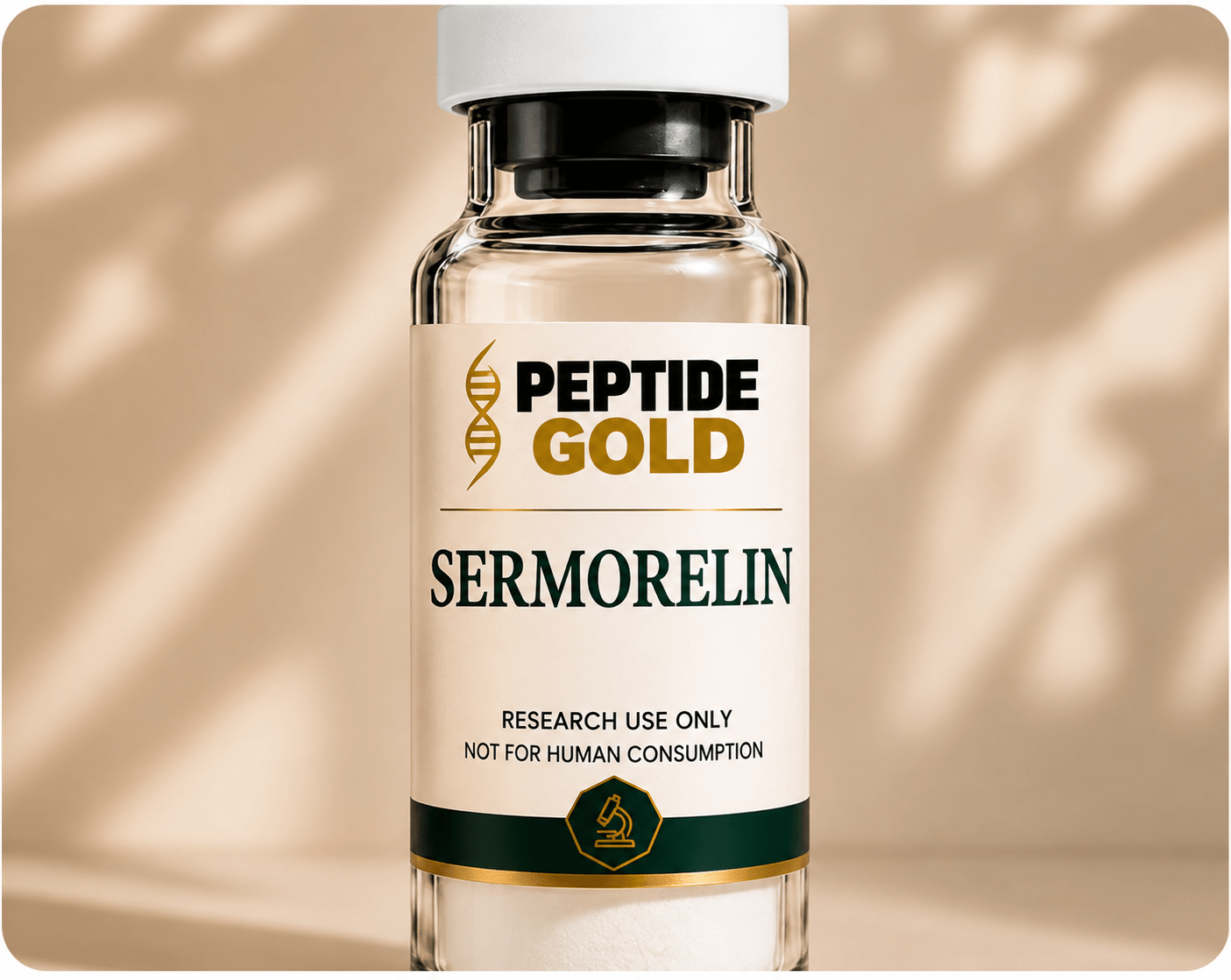
Sermorelin is a synthetic peptide that stimulates the body’s own release of growth hormone, or GH, by mimicking a portion of naturally occurring growth hormone-releasing hormone, or GHRH.
It is most commonly discussed in connection with:
growth hormone deficiency
growth in children
growth hormone testing
body composition
recovery
sleep
and broader research involving the GH–IGF-1 axis.
Sermorelin occupies an interesting position in peptide medicine because it is not simply an experimental molecule with no clinical history.
A prescription product containing sermorelin acetate, marketed as Geref, was FDA-approved in 1997 for pediatric growth hormone deficiency. The product was later discontinued for commercial reasons, and the approvals for Geref-containing products were withdrawn in 2009 after the manufacturer stopped production.
That means sermorelin has a genuine history of FDA-approved medical use, but there is no currently marketed FDA-approved sermorelin product in the United States.
Today, sermorelin is more commonly encountered through research markets and compounding practices.
What Is Sermorelin?
Sermorelin is a synthetic analogue of the biologically active N-terminal portion of human GHRH.
Natural human GHRH contains 44 amino acids.
Sermorelin corresponds to the first:
29 amino acids
of GHRH and is often written as:
GHRH(1-29)-NH₂.
This 29-amino-acid sequence contains the portion of GHRH necessary to activate the GHRH receptor on pituitary cells.
Researchers discovered that the first 29 amino acids retain strong growth hormone-releasing activity despite being considerably shorter than full-length GHRH.
Human studies have demonstrated that GHRH(1-29) can stimulate GH release with potency similar on a molar basis to longer GHRH molecules.
How Does Sermorelin Work?
Sermorelin binds to GHRH receptors located on somatotroph cells in the anterior pituitary gland.
These cells produce growth hormone.
The pathway can be simplified as:
Sermorelin → GHRH receptor → Pituitary → Growth hormone release → IGF-1 production
Growth hormone then travels throughout the body.
One of its major downstream effects is stimulation of insulin-like growth factor 1, or IGF-1, particularly in the liver.
GH and IGF-1 influence:
- Childhood growth
- Protein metabolism
- Bone
- Connective tissue
- Fat metabolism
- Muscle maintenance
- Glucose regulation
- Cellular growth and repair
This makes sermorelin very different from directly administering recombinant human growth hormone.
Sermorelin Versus Growth Hormone
The distinction is important.
Recombinant Growth Hormone
Recombinant GH supplies growth hormone directly.
This bypasses the pituitary gland.
Sermorelin
Sermorelin stimulates the pituitary to release endogenous GH.
That means the body’s own somatotroph cells remain part of the process.
This can preserve more of the normal physiological regulation of growth hormone secretion.
However, sermorelin still activates the GH–IGF-1 axis and can therefore influence many of the same downstream systems.
It should not be assumed to be free of endocrine or metabolic risk simply because it works upstream.
Natural Growth Hormone Secretion
Growth hormone is not normally released at a constant rate.
Instead, secretion occurs in pulses.
The largest GH pulses often occur:
during deep sleep
after exercise
during fasting
and at particular times of day.
GHRH stimulates these pulses.
Another hypothalamic hormone, somatostatin, suppresses GH secretion.
A third pathway involving the hormone ghrelin can also stimulate GH release through the GHSR receptor.
Sermorelin acts specifically on the GHRH side of this regulatory system.
What Was Sermorelin Originally Used For?
Sermorelin was developed primarily for pediatric endocrinology.
FDA’s orphan-drug database shows that sermorelin acetate, marketed as Geref, received marketing approval on September 26, 1997 for treatment of idiopathic or organic growth hormone deficiency in children with growth failure.
It was also used historically as part of growth hormone stimulation testing.
The goal was to determine whether the pituitary gland was capable of releasing GH when stimulated by GHRH.
This could help differentiate between different causes of growth hormone deficiency.
Sermorelin as a Diagnostic Test
Growth hormone deficiency can arise from several locations within the endocrine system.
For example:
Hypothalamic dysfunction may reduce natural GHRH production.
Pituitary dysfunction may impair the ability to produce GH.
If sermorelin produces a substantial GH response, that suggests the pituitary still has reserve capacity.
Older human studies found that some children and young adults considered GH-deficient by conventional testing still produced relatively normal GH responses to GHRH(1-29), indicating that hypothalamic dysfunction may have played an important role.
This made sermorelin useful both therapeutically and diagnostically.
Pediatric Growth Research
Sermorelin has direct human evidence showing that it can increase growth velocity in some children with growth hormone deficiency.
One multicenter study treated 110 previously untreated prepubertal children with:
30 micrograms per kilogram once daily
given subcutaneously at bedtime for up to one year.
Among the children included in the efficacy analysis, average growth velocity increased from approximately:
4.1 cm per year before treatment
to:
8.0 cm per year after six months
and
7.2 cm per year after twelve months.
About 74% of children were considered good responders at six months.
This is meaningful human evidence demonstrating that sermorelin can have genuine biological and clinical effects in appropriately selected pediatric patients.
Why Doesn’t Sermorelin Work for Everyone?
Sermorelin requires a functioning pituitary gland.
If the pituitary is severely damaged or cannot produce GH, stimulating it with GHRH may have little effect.
Older research found poor responses in some patients with longstanding pituitary dysfunction or prior treatment.
By contrast, people whose problem lies primarily in inadequate hypothalamic GHRH signaling may respond more strongly.
This is one reason sermorelin therapy cannot simply be applied universally to anyone with a low IGF-1 level.
Sermorelin and Adults
Modern interest in sermorelin has shifted heavily toward adults.
It is frequently discussed in connection with:
age-related GH decline
body composition
sleep
recovery
muscle maintenance
and fat metabolism.
These uses are much less firmly established than pediatric GH deficiency.
Growth hormone secretion naturally declines with age.
This phenomenon is sometimes called the somatopause.
As GH and IGF-1 decline, aging is also associated with:
lower muscle mass
higher body fat
reduced bone density
and changes in recovery and sleep.
Because sermorelin can stimulate endogenous GH, anti-aging and wellness clinics sometimes use it in an attempt to raise GH and IGF-1.
However, there is no current FDA-approved sermorelin indication for anti-aging.
Does Sermorelin Increase Growth Hormone in Adults?
Yes.
Human studies clearly demonstrate that GHRH(1-29) can stimulate GH release in adults.
In normal men, GHRH(1-29)-NH₂ produced a dose-related increase in circulating growth hormone while having little effect on several other hormones, including prolactin, TSH, LH, FSH, ACTH, cortisol, insulin, glucagon, or thyroid hormones in that experiment.
This selectivity is one of sermorelin’s advantages compared with some older growth hormone secretagogues.
The important distinction is that:
increasing GH is established
while
proving broad anti-aging or performance benefits is not.
Sermorelin and IGF-1
Repeated sermorelin stimulation can increase downstream IGF-1.
IGF-1 mediates many of growth hormone’s effects on:
protein synthesis
bone
connective tissue
and cellular growth.
For this reason, IGF-1 is often monitored in clinical research involving the GH axis.
However, higher IGF-1 is not automatically better.
Chronically elevated GH and IGF-1 can create concerns involving:
fluid retention
joint symptoms
glucose intolerance
and excessive growth signaling.
Sermorelin and Muscle
Sermorelin is often marketed as a muscle-building peptide.
The biological reasoning is straightforward:
Sermorelin → GH → IGF-1 → anabolic signaling
Growth hormone and IGF-1 participate in protein metabolism and muscle maintenance.
However, there is not strong modern clinical evidence showing that sermorelin produces large increases in skeletal muscle mass in healthy adults.
A 2026 review of performance-enhancing peptides specifically notes the gap between established hormonal effects of GHRH analogues and the much weaker evidence supporting physique and performance claims in self-administration settings.
Therefore, sermorelin is better described as a GH-releasing peptide with possible body-composition effects, rather than a clinically proven anabolic drug.
Sermorelin and Fat Loss
Growth hormone stimulates lipolysis, meaning the breakdown of stored fat.
This creates a plausible relationship between sermorelin and body-fat metabolism.
However, there are no large modern obesity trials showing dramatic weight loss from sermorelin.
It should not be compared with medications such as:
or investigational retatrutide.
Those medications have direct Phase 3 evidence showing substantial reductions in body weight.
Sermorelin does not.
Sermorelin and Sleep
Growth hormone secretion is closely linked to deep sleep.
The largest natural GH pulse often occurs during slow-wave sleep.
Because of this relationship, sermorelin is frequently discussed as a nighttime peptide.
Historical pediatric research often administered GHRH(1-29) at bedtime, including the one-year study using once-daily subcutaneous therapy.
However, that does not prove sermorelin itself treats insomnia.
There is insufficient evidence to describe it as a sleep medication.
Sermorelin and Recovery
Growth hormone participates in:
protein turnover
connective-tissue metabolism
collagen synthesis
and recovery from physical stress.
This has generated interest in sermorelin for:
exercise recovery
joint recovery
muscle recovery
and general tissue maintenance.
These uses remain largely extrapolated from GH physiology rather than proven through large sermorelin-specific recovery trials.
Sermorelin and Skin
Growth hormone and IGF-1 influence skin thickness, connective tissue, and collagen metabolism.
This has led to anti-aging claims involving:
skin quality
elasticity
and appearance.
There is currently insufficient clinical evidence showing that sermorelin produces meaningful cosmetic skin rejuvenation.
It should not be grouped with topical skin peptides such as GHK-Cu or SNAP-8, which have entirely different mechanisms.
Sermorelin Versus Tesamorelin
These compounds are closely related but not identical.
Sermorelin
29 amino acids
Corresponds to GHRH(1-29)
Historically approved for pediatric GH deficiency
Currently no marketed FDA-approved U.S. product
Tesamorelin
Based on the full 44-amino-acid GHRH sequence
Modified for greater stability
Currently FDA-approved as EGRIFTA WR for reducing excess visceral abdominal fat in adults with HIV-associated lipodystrophy
Tesamorelin therefore has a current pharmaceutical indication and a much larger modern metabolic clinical database.
Sermorelin Versus CJC-1295 Without DAC
Both act through the GHRH receptor.
CJC-1295 without DAC, often associated with modified GRF(1-29), contains structural modifications designed to increase resistance to enzymatic degradation.
Sermorelin is more closely related to the native GHRH(1-29) sequence.
The intended difference is generally:
Sermorelin → shorter-lived, more physiologic GHRH-type stimulation
Modified GRF/CJC without DAC → modified for greater stability and activity
Neither should be assumed to have identical pharmacokinetics or dosing.
Sermorelin Versus CJC-1295 With DAC
CJC-1295 with DAC is very different.
The Drug Affinity Complex allows CJC-1295 to bind albumin and remain active for much longer.
That can elevate GH and IGF-1 over a period of days.
Sermorelin is short acting.
This makes sermorelin more closely aligned with producing discrete GH stimulation, whereas CJC-1295 with DAC can produce prolonged endocrine exposure.
Sermorelin Versus Ipamorelin
These two peptides stimulate growth hormone through different receptors.
Sermorelin → GHRH receptor
Ipamorelin → ghrelin/GHSR-1a receptor
Because these pathways complement each other physiologically, sermorelin is sometimes discussed in combination with ipamorelin.
The theory is:
GHRH receptor activation + ghrelin receptor activation → stronger GH pulse
This concept is biologically plausible.
However, there is no FDA-approved sermorelin + ipamorelin combination protocol for anti-aging, bodybuilding, recovery, or fat loss.
Sermorelin Dosing Information
There is no current FDA-approved sermorelin dosage because no currently marketed FDA-approved product exists.
However, historical clinical research provides legitimate human dosing information.
In pediatric growth hormone deficiency, a major multicenter study used:
30 micrograms per kilogram once daily
subcutaneously at bedtime.
Earlier human studies also used single GHRH(1-29) doses to evaluate pituitary GH reserve.
These historical medical protocols should not be automatically converted into anti-aging or bodybuilding regimens.
Modern compounded protocols often use fixed microgram amounts rather than weight-based pediatric dosing, but those practices are not supported by a current FDA-approved prescribing label.
Why Modern Online Dosing Is Different
Many peptide clinics and research sites describe sermorelin protocols in small subcutaneous doses given at night.
These schedules are usually based on:
historical GH physiology
compounding practice
clinical experience
and extrapolation from older GHRH studies.
They are not equivalent to a modern FDA-reviewed treatment regimen.
A 2026 review of GH-axis peptides specifically highlights uncertainty around product composition, dosing, stacking, and safety in unregulated self-administration settings.
What Forms Is Sermorelin Offered In?
Today, sermorelin is primarily encountered in compounded or research forms.
Sermorelin Acetate
The most common form is sermorelin acetate.
The acetate salt improves handling and formulation.
Lyophilized Powder
Sermorelin is frequently supplied as:
freeze-dried, or lyophilized, powder.
Lyophilization improves stability during storage.
Compounded Injectable Vials
U.S. compounding pharmacies may prepare sermorelin-containing injectable products under applicable pharmacy laws.
These are not FDA-approved products.
Combination Vials
Sermorelin may be combined with peptides such as:
ipamorelin
GHRP-2
or GHRP-6.
Combination formulations create additional uncertainty because each peptide has different pharmacology.
FDA recall records have documented compounded sermorelin-containing blends in the past, including sermorelin/GHRP combinations.
Research Vials Versus Compounded Prescription Products
A research vial and a properly compounded prescription product are not equivalent.
A research product may not necessarily have validated:
sterility
potency
identity
purity
or stability.
This distinction becomes especially important with injectable peptides.
FDA has previously documented recalls involving compounded sermorelin products because of quality-control problems. In 2022, compounded sermorelin acetate vials were included in a nationwide recall for products found to be out of specification.
This illustrates why product quality matters independently of the peptide’s pharmacology.
Potential Side Effects
Historical human research generally found sermorelin reasonably well tolerated.
Potential effects may include:
- Injection-site reactions
- Flushing
- Headache
- Dizziness
- Nausea
- Sleep-related changes
- Water retention
- Joint discomfort
- Tingling
- Changes in glucose regulation
In one early human study, transient flushing was the only noted side effect at the highest tested dose.
Longer-term adult anti-aging use has not been characterized as rigorously as the earlier pediatric clinical program.
Fluid Retention
Any therapy that increases GH and IGF-1 could theoretically contribute to:
edema
joint discomfort
or carpal-tunnel-like symptoms.
These effects are well recognized with stronger GH exposure.
The incidence and severity with sermorelin depend on how much the GH–IGF-1 axis is stimulated.
Blood Sugar and Insulin Sensitivity
Growth hormone can reduce insulin sensitivity.
This means chronic GH stimulation may influence:
fasting glucose
insulin
and glucose tolerance.
The pediatric one-year study using 30 mcg/kg/day did not identify adverse fasting-glucose changes and reported no excessive IGF-1 generation.
However, those children and treatment conditions are very different from older adults using compounded sermorelin for wellness or body composition.
Modern adult glucose risks therefore cannot simply be inferred from the pediatric trial.
Cancer and Growth Signaling
GH and IGF-1 influence cellular growth and survival pathways.
This does not mean sermorelin has been shown to cause cancer.
However, prolonged stimulation of the GH–IGF-1 axis raises theoretical concern in people with:
active malignancy
history of certain cancers
or unusually high IGF-1.
The long-term cancer risk of modern nonapproved adult sermorelin use has not been adequately defined.
Does Sermorelin Shut Down Natural GH Production?
Sermorelin works by stimulating endogenous secretion rather than replacing GH directly.
For that reason, it is generally thought to preserve more pituitary participation than recombinant GH therapy.
However, the endocrine system is regulated through feedback loops.
Repeatedly altering GH and IGF-1 can still influence normal hormonal signaling.
Claims that sermorelin can never affect endogenous regulation are too absolute.
Is Sermorelin FDA Approved?
The most accurate answer is:
Sermorelin was FDA approved historically, but there is no currently marketed FDA-approved sermorelin product in the United States.
Geref received marketing approval in 1997 for pediatric growth hormone deficiency.
The manufacturer later discontinued production, and FDA records state that approvals for GHRH/sermorelin-containing Geref products were withdrawn in June 2009.
This distinction is important.
It is inaccurate to say sermorelin has never been FDA approved.
It is equally inaccurate to say modern compounded sermorelin is itself an FDA-approved product.
Does Withdrawal Mean Sermorelin Was Found Unsafe?
Not necessarily.
The FDA record indicates that the manufacturer discontinued production, leading to withdrawal of the approvals.
This is different from a drug being withdrawn because new evidence proved it unsafe or ineffective.
The historical approval provides legitimate evidence that sermorelin had undergone formal pharmaceutical development.
But today’s compounded and research products do not automatically inherit the regulatory status of the discontinued branded drug.
Sermorelin and Anti-Aging
Modern anti-aging use goes well beyond the historical pediatric indication.
Common goals include:
improved sleep
higher IGF-1
better recovery
more lean mass
less body fat
and greater vitality.
These effects are biologically plausible because of the GH–IGF-1 pathway.
What is missing is strong clinical proof that sermorelin meaningfully improves healthspan, functional aging, or longevity in otherwise healthy older adults.
There is no evidence that sermorelin extends human lifespan.
Sermorelin and Performance Enhancement
Sermorelin is also discussed in bodybuilding and sports.
A 2026 review of performance-enhancing peptides notes that GHRH analogues including sermorelin are frequently encountered in self-administration protocols despite the absence of regulatory approval for physique and performance indications.
Potential endocrine and metabolic concerns across this class include:
dysglycemia
fluid retention
myalgia
arthralgia
and injection-site reactions.
Competitive athletes should also be aware that growth hormone-releasing factors can create anti-doping concerns.
Current Research in 2026
Sermorelin itself is an older peptide, so modern pharmaceutical research has shifted toward newer compounds.
Tesamorelin provides a current FDA-approved GHRH analogue with a specific metabolic indication.
Other experimental compounds such as:
CJC-1295
ipamorelin
and related GH secretagogues
continue to attract research interest.
Sermorelin remains scientifically important because it represents one of the clearest demonstrations that a short GHRH fragment can stimulate physiologic GH release in humans.
Its historical clinical program provides considerably stronger evidence than exists for many newer gray-market peptides.
What Research Is Still Needed?
Modern adult sermorelin use would benefit from well-designed clinical trials examining:
IGF-1 responses
body composition
visceral fat
muscle strength
sleep quality
bone density
glucose regulation
and long-term safety.
Researchers would also need to determine whether older adults with documented GH-axis dysfunction respond differently from healthy adults experiencing normal age-related GH decline.
These populations should not automatically be treated as equivalent.
The Bottom Line
Sermorelin is a synthetic 29-amino-acid fragment of human growth hormone-releasing hormone, commonly described as GHRH(1-29)-NH₂.
It acts by binding GHRH receptors in the pituitary and stimulating the body’s own release of growth hormone.
That GH can subsequently increase:
IGF-1
and influence:
growth
protein metabolism
fat metabolism
bone
connective tissue
and body composition.
Unlike many modern research peptides, sermorelin has legitimate historical pharmaceutical and human clinical evidence.
FDA records show that sermorelin acetate, marketed as Geref, received U.S. approval in 1997 for growth hormone deficiency in children with growth failure.
A multicenter pediatric study using 30 mcg/kg once daily at bedtime increased average height velocity from approximately 4.1 cm/year to 8.0 cm/year after six months, demonstrating that sermorelin can have clinically meaningful effects when the pituitary remains capable of releasing GH.
The original Geref products were later discontinued, and their FDA approvals were withdrawn in 2009 after production stopped.
Therefore, as of 2026:
sermorelin has a history of FDA approval,
but
there is no currently marketed FDA-approved sermorelin product in the United States.
Modern compounded sermorelin should not be represented as though it is the same regulated product that was historically approved.
Sermorelin’s strongest established biological effect is:
stimulation of endogenous growth hormone release.
Its broader modern uses for:
anti-aging
muscle building
fat loss
sleep
exercise recovery
and performance enhancement
have much less rigorous evidence.
Perhaps the most accurate way to describe sermorelin in 2026 is:
a historically FDA-approved GHRH(1-29) peptide with well-established ability to stimulate endogenous growth hormone and meaningful pediatric clinical evidence, but whose modern compounded use for anti-aging, body composition, and performance extends substantially beyond the evidence and indications of its original pharmaceutical program.
For researchers, sermorelin remains a valuable reference compound for studying physiological GH secretion.
For consumers, the critical distinction is between:
showing that sermorelin raises growth hormone
and
showing that long-term use in otherwise healthy adults safely produces better body composition, recovery, sleep, or longevity.
The first is well supported.
The second remains much less certain.
Educational and research notice: This article is intended for general scientific and educational information only. Historical doses described above come from published clinical studies and should not be interpreted as personal dosing instructions. Sermorelin’s former FDA-approved product Geref is no longer marketed in the United States, and current compounded or research-grade sermorelin products are not automatically equivalent to that historically approved pharmaceutical product.