

What Is a COA for Peptides? How to Read a Certificate of Analysis
When purchasing or evaluating research peptides, you will frequently encounter the term COA, or Certificate of Analysis. It is one of the most important documents associated with a peptide—but it is also one of the most commonly misunderstood.
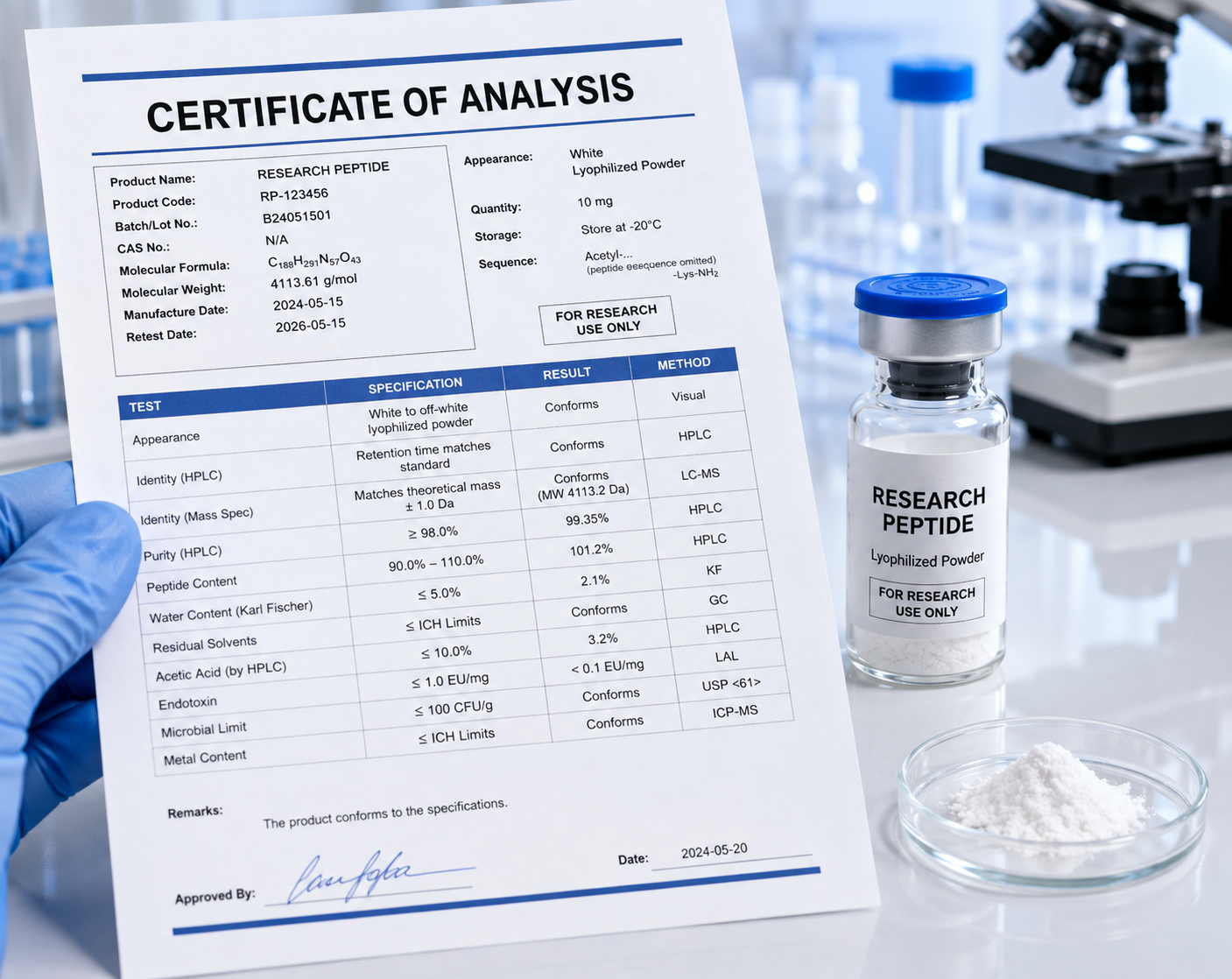
A Certificate of Analysis is essentially a laboratory report describing a particular sample or batch and the results of tests performed on it. Depending on the testing performed, a COA may provide information about identity, purity, peptide content, molecular mass, residual solvents, water content, endotoxins, microbial contamination, or other characteristics.
For researchers, the COA provides evidence that helps answer a fundamental question:
What is actually in this vial?
However, simply seeing “99% purity” on a COA does not tell the entire story. Purity is not necessarily the same thing as quantity, identity, sterility, or potency. Understanding those distinctions can make a COA considerably more useful.
This guide explains the major sections commonly found on peptide Certificates of Analysis and what researchers should look for when evaluating them.
What Exactly Is a Certificate of Analysis?
A Certificate of Analysis is a document reporting analytical testing performed on a material or finished batch.
In pharmaceutical manufacturing, laboratory records and testing are an important component of quality control. FDA regulations for drug manufacturing require appropriate laboratory testing and documentation, including tests used to determine whether components and products conform to established specifications. FDA — Laboratory Controls, 21 CFR §211.160
For research peptides, a COA may originate from the manufacturer, an internal laboratory, or an independent third-party analytical laboratory.
The distinction can matter.
Independent testing provides an additional layer of verification because the organization selling or manufacturing the material is not necessarily the same organization performing the analysis.
Regardless of who performs the testing, the usefulness of a COA depends on what was tested, how it was tested, whether the sample corresponds to the actual batch being evaluated, and whether the laboratory and documentation are credible.
Start With the Batch or Lot Number
One of the first things to examine is surprisingly simple: the batch number or lot number.
Peptides are generally manufactured in batches. Different production batches can potentially have different analytical results.
For example, suppose a supplier has a COA showing excellent results for Batch ABC123. If the vial being evaluated comes from Batch XYZ789, the first COA does not necessarily establish the characteristics of the second batch.
Ideally, the lot or batch number on the COA should correspond to the batch represented by the product.
Researchers should therefore look for information such as:
- Product or peptide name
- Batch or lot number
- Sample identification number
- Manufacturing or production date, when provided
- Testing date
- Report or certificate number
These identifiers help establish traceability.
A generic COA without meaningful batch identification provides considerably less information than a batch-specific report.
Peptide Identity: Is It the Correct Molecule?
Before asking how pure a peptide is, there is an even more fundamental question:
Is it actually the peptide it is supposed to be?
Identity testing attempts to answer this.
One commonly used analytical technique is mass spectrometry, often abbreviated MS. Mass spectrometry measures characteristics related to molecular mass and can provide evidence that the sample corresponds to the expected molecule.
Peptides have predicted molecular masses based upon their amino-acid sequences and chemical structures. Analytical mass data can therefore be compared with the expected value.
Techniques such as liquid chromatography-mass spectrometry, or LC-MS, combine chromatographic separation with mass analysis.
A COA may consequently report something resembling:
Expected molecular mass: 1,234.5 Da
Observed molecular mass: 1,234.6 Da
Close agreement can support the identity of the material.
More sophisticated characterization may use additional analytical methods depending upon the peptide and the purpose of the testing.
Understanding HPLC
Perhaps the most familiar abbreviation on peptide COAs is HPLC.
HPLC stands for High-Performance Liquid Chromatography.
Chromatography separates the components of a sample based upon their interactions with a stationary phase and a moving liquid phase. The resulting chromatogram displays peaks corresponding to substances detected during the analysis.
For peptide testing, HPLC is frequently used to evaluate purity and related impurities.
If one major peak accounts for nearly all of the detected chromatographic signal while several small peaks represent impurities, the laboratory may calculate a high percentage purity.
This is where familiar claims such as:
Purity: 99.2% by HPLC
often originate.
What Does “99% Purity” Actually Mean?
This is one of the most important concepts when reading peptide COAs.
A result of 99% HPLC purity does not necessarily mean that a vial labeled 10 mg contains 9.9 mg of peptide.
HPLC purity generally describes the relative chromatographic purity of the analyzed sample under the conditions of the test.
Imagine a chromatogram containing several detected peptide-related components. If the desired peptide represents approximately 99% of the relevant integrated peak area, the reported chromatographic purity may be approximately 99%.
But that measurement does not automatically determine the total mass of peptide contained in the vial.
Why?
Because the vial may contain other materials that are not represented in the same way by that chromatographic calculation, including water, counterions, salts, residual solvents, or formulation excipients.
Therefore:
Purity and peptide content are different measurements.
This distinction is extremely important when evaluating peptide COAs.
Peptide Content or Assay
A more comprehensive COA may contain an assay or peptide-content measurement in addition to chromatographic purity.
This attempts to determine how much of the specified peptide is actually present relative to the sample or labeled quantity.
A sample could theoretically have very high chromatographic purity but still contain less total peptide than expected.
For example, imagine two hypothetical vials.
Both produce 99% HPLC purity.
But laboratory analysis determines that one contains approximately the expected amount of peptide while the other contains substantially less.
The HPLC purity numbers alone would not necessarily reveal this difference.
This is why researchers should avoid judging an entire peptide product solely from one large “99%+” number.
Reading an HPLC Chromatogram
Some laboratories provide the actual chromatogram in addition to the summary COA.
A chromatogram usually appears as a graph containing peaks.
The horizontal axis generally represents retention time, while the vertical axis represents detector response.
The primary peptide should generally produce a major peak at its characteristic retention time under that analytical method.
Smaller peaks can represent impurities or other components detected by the method.
A chromatogram provides useful supporting information because researchers can see more than simply the final calculated percentage.
However, interpreting chromatography properly requires knowledge of the analytical method. A visually impressive chromatogram is not, by itself, proof that testing was properly conducted.
Mass Spectrometry and HPLC Answer Different Questions
It is helpful to think about these techniques as complementary.
Mass spectrometry primarily helps establish:
“Does the detected material have the expected molecular mass?”
HPLC purity testing primarily helps establish:
“How much of the detected chromatographic material corresponds to the primary component compared with detectable impurities?”
Using both can therefore provide considerably more information than either test alone.
Mass spectrometry helps support identity, while chromatography helps characterize purity.
Water or Moisture Content
Lyophilized peptides are freeze-dried, but that does not necessarily mean absolutely every molecule of water has disappeared.
Residual moisture can remain in a freeze-dried product.
One widely used technique for measuring water is Karl Fischer titration.
Moisture can be important because excessive residual water may affect product stability. Lyophilized formulations are developed to achieve an appropriate residual moisture range rather than simply assuming that the finished material contains zero water.
A comprehensive COA may therefore include:
Water Content / Karl Fischer
along with a specification and measured result.
Residual Solvents
Chemical synthesis and purification can involve various solvents.
Manufacturing processes are designed to remove them, but analytical testing can be performed to determine whether residual solvents remain.
Gas chromatography, commonly abbreviated GC, is one analytical technique that may be used for residual-solvent analysis.
For pharmaceutical products, internationally recognized guidelines establish approaches for controlling residual solvents based upon their potential risk. FDA — Q3C Impurities: Residual Solvents
Residual-solvent testing provides information beyond basic peptide purity and can be another useful element of a comprehensive analytical package.
Endotoxin Testing
Another term sometimes appearing on peptide testing documentation is endotoxin.
Endotoxins are components associated with the outer membrane of certain Gram-negative bacteria. Their presence is a different issue from peptide purity.
A sample could theoretically have excellent HPLC purity while still having an unacceptable endotoxin level.
This illustrates an important principle:
Chemical purity does not establish microbiological quality.
The FDA discusses bacterial endotoxin testing and the importance of controlling pyrogenic contamination in relevant pharmaceutical applications. FDA — Bacterial Endotoxins/Pyrogens
Endotoxin results may be expressed in EU, or Endotoxin Units, relative to a specified quantity or volume.
Sterility Is Not the Same as Purity
This distinction deserves special attention.
An HPLC report showing 99%+ purity does not prove that a product is sterile.
HPLC is an analytical chemistry technique. It does not establish the absence of viable microorganisms.
Sterility requires separate microbiological testing performed according to appropriate procedures.
The United States Pharmacopeia maintains specific standards relating to sterility testing, including USP General Chapter <71>. USP — Sterility Tests
Consequently, researchers should be skeptical of claims suggesting that an HPLC purity result alone establishes sterility or microbiological safety.
What About Heavy Metals?
Some comprehensive testing programs may also evaluate elemental impurities or metals.
Techniques such as ICP-MS, or inductively coupled plasma mass spectrometry, can measure extremely small concentrations of various elements.
For pharmaceutical applications, elemental impurities are addressed separately from ordinary organic purity testing. FDA — Q3D Elemental Impurities
Again, this reinforces the idea that no single test tells you everything about a sample.
Why Third-Party Testing Matters
A supplier may perform testing internally, outsource testing to an independent laboratory, or use some combination of both.
Independent third-party testing can provide additional confidence because the analytical laboratory is separate from the organization selling the material.
But the phrase “third-party tested” should not automatically end the investigation.
Useful questions include:
Who performed the testing?
Can the laboratory be identified?
Is there a report or sample number?
What tests were actually performed?
Does the batch number correspond to the product?
When was the testing performed?
Does the report include actual analytical data?
A recognizable laboratory name on a PDF is useful only if the report itself is legitimate and corresponds to the material being evaluated.
Red Flags When Reading a Peptide COA
Several characteristics should encourage closer scrutiny.
A COA may deserve additional investigation when it has no identifiable batch number, no testing date, no laboratory information, unexplained alterations, inconsistent product information, or analytical results without identifying the method used.
Another potential concern is a supplier using exactly the same COA indefinitely while selling numerous production batches.
Researchers may also want to investigate situations where a purported third-party report cannot reasonably be connected with the laboratory supposedly issuing it.
Professional presentation alone is not proof of authenticity. Modern documents are extremely easy to create or modify.
A Better Way to Evaluate a COA
Instead of looking exclusively for “99% purity,” evaluate the report as a collection of evidence.
A strong peptide analytical package might provide information concerning:
- Identity: Is this the expected peptide?
- Purity: What proportion of the detected peptide-related material corresponds to the desired compound?
- Content: How much peptide is actually present?
- Batch traceability: Does the testing correspond to this production lot?
- Water content: How much residual moisture remains?
- Residual solvents: Are manufacturing solvents within appropriate specifications?
- Endotoxins: Was endotoxin testing performed when relevant?
- Microbial or sterility testing: Was separate microbiological testing performed when applicable?
- Laboratory information: Who performed the testing and when?
Not every research application requires every possible analytical test. However, understanding what each test establishes—and what it does not establish—is critical.
The Bottom Line
A Certificate of Analysis can be one of the most useful tools available when evaluating a research peptide, but only when the information is interpreted correctly.
The biggest mistake is treating one number—usually 99% HPLC purity—as proof of everything.
It isn’t.
Purity does not automatically establish identity. Identity does not establish quantity. Chemical purity does not establish sterility. Sterility does not establish endotoxin levels. And a COA from one batch does not necessarily characterize every future batch.
Instead, think of a good COA as a collection of evidence.
HPLC can provide information about chromatographic purity.
Mass spectrometry can help confirm molecular identity.
Assay or peptide-content testing can help evaluate quantity.
Karl Fischer testing can evaluate moisture.
GC may be used to investigate residual solvents.
Endotoxin, microbial, and sterility testing address entirely different quality characteristics.
When these pieces are combined with clear batch identification and credible laboratory documentation, a Certificate of Analysis becomes much more informative.
For researchers, understanding how to read those results provides something considerably more valuable than simply seeing “99%+ purity” printed on a product page: it provides a better understanding of what was actually tested, what the results mean, and what questions still remain unanswered.
Research-use note: A COA does not by itself establish that a peptide is approved, safe, effective, or suitable for human use. Testing requirements and appropriate specifications depend on the product’s intended application.